Home JavaScript Number Patterns Program 46 JavaScript Concentric Number Square Pattern Definition
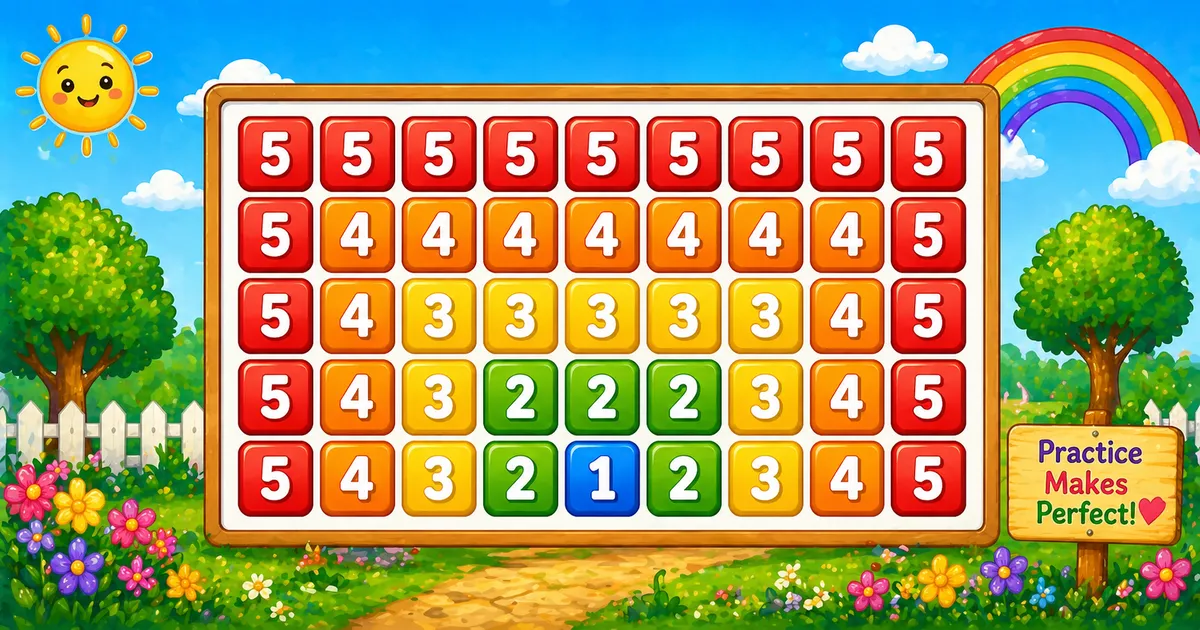
What Is This Pattern? A concentric number square prints layers from k down to 1: outer values stay large, the center is 1, and each row mirrors left-to-right.
Rule: append (j > i ? j : i); left k..1, right 2..k

5 5 5 5 5 5 5 5 5
5 4 4 4 4 4 4 4 5
5 4 3 3 3 3 3 4 5
5 4 3 2 2 2 3 4 5
5 4 3 2 1 2 3 4 5   ← k = 5
Unlike Program 45 (star/zero X), this pattern builds number layers — grid size is k rows by 2k - 1 columns.
Approach
How to Solve It One outer layer loop (i = k..1), then left and right halves with the same cell rule. End each row with console.log.
Method Idea Best for Two-half row Left k..1, right 2..k, value j > i ? j : i Classic concentric demos Compact Same logic with a smaller k (e.g. 3) Quick dry-runs
Pseudocode for i from k down to 1:
line = ""
for j from k down to 1:
append (j if j > i else i) and a space
for j from 2 to k:
append (j if j > i else i) and a space
print line Cheat sheet Goal Pattern Layer loop for (let i = k; i >= 1; i--)Left half for (let j = k; j >= 1; j--)Right half for (let j = 2; j <= k; j++)Cell value line += (j > i ? j : i) + " ";End the row console.log(line);Grid size k rows × 2*k - 1 columns
Printing Numbers vs Starting a New Line API Effect Use for line += …Stays on the same row Each cell value + space console.log(line)Ends the current row After both halves finish
Append without a newline, then end the row once.
Try it
Live Preview Change k and the concentric square updates instantly.
Trace
Worked Walkthrough Trace three rows when k = 3 — watch left half, right half, and the j > i rule.
Row i Left (j=3..1) Right (j=2..3) Printed row 3 3 3 33 33 3 3 3 32 3 2 22 33 2 2 2 31 3 2 12 33 2 1 2 3
Rows = k, columns = 2k - 1. Total cells for k = 5 = 5 × 9 = 45.
Code
JavaScript Programs Three complete programs: fixed k = 5, prompt input, and a compact k = 3 demo. Use View Output for samples, or Try It Yourself to edit and run live.
1. Fixed k 2. User input 3. Compact demo Example 1 — Fixed k = 5 Hard-coded peak — left k..1, right 2..k, value j > i ? j : i.
const k = 5;

for (let i = k; i >= 1; i--) {
  let line = "";
  for (let j = k; j >= 1; j--) {
    line += (j > i ? j : i) + " ";
  }
  for (let j = 2; j <= k; j++) {
    line += (j > i ? j : i) + " ";
  }
  console.log(line);
} 5 5 5 5 5 5 5 5 5
5 4 4 4 4 4 4 4 5
5 4 3 3 3 3 3 4 5
5 4 3 2 2 2 3 4 5
5 4 3 2 1 2 3 4 5 How It Works 1. Walk layers downward. Outer loop i runs from k down to 1 — one row per layer.
2. Build the left half. j runs k..1; append j when j > i, else i.
3. Mirror the right. Second inner loop starts at 2 so the center digit is not printed twice.
Example 2 — User Input k Read the peak with prompt and validate before drawing.
const k = parseInt(prompt("Enter k (peak number):"), 10);

if (!Number.isFinite(k) || k < 1) {
  console.log("Please enter a positive integer.");
} else {
  for (let i = k; i >= 1; i--) {
    let line = "";
    for (let j = k; j >= 1; j--) {
      line += (j > i ? j : i) + " ";
    }
    for (let j = 2; j <= k; j++) {
      line += (j > i ? j : i) + " ";
    }
    console.log(line);
  }
} How It Works 1. Prompt and validate. Use parseInt and require k >= 1.
2. Same square core. Only the source of k changes — both halves match Example 1.
3. Entering 3. Three rows, five columns (2*3 - 1), center is 1.
Example 3 — Compact k = 3 Same two-half logic with a smaller peak for a quick visual check.
const k = 3;

for (let i = k; i >= 1; i--) {
  let line = "";
  for (let j = k; j >= 1; j--) {
    line += (j > i ? j : i) + " ";
  }
  for (let j = 2; j <= k; j++) {
    line += (j > i ? j : i) + " ";
  }
  console.log(line);
} 3 3 3 3 3
3 2 2 2 3
3 2 1 2 3 How It Works 1. Shrink the peak. Only k changes — still left k..1 and right 2..k.
2. Easier to trace. Three rows instead of five — useful while learning j > i.
3. Same center rule. Bottom row still ends with … 1 … in the middle.
Edge Cases & Pitfalls Check these before calling the solution done.
Right start Start the right half at j = 2
Starting at 1 duplicates the center digit and breaks the width formula.
j > i Do not swap the ternary
j > i ? j : i keeps outer rings larger. Reversing it collapses the layers.
k = 1 Single-layer case
Output is just 1 — the right half loop never runs.
Bad input Validate parseInt
Check Number.isFinite(k) and require k >= 1 before the loops.
Analysis
Time and Space Complexity Program Time Extra space Fixed / compact (Examples 1, 3) O(k²)O(k) per row stringUser input (Example 2) O(k²)O(k) per row string
There are k rows and 2k - 1 cells per row, so total work is quadratic in k.
Remember
Key Takeaways Rule: append j > i ? j : i on each half of the row.
Shape: left k..1, right 2..k; width = 2k - 1.
Break the row: call console.log(line) only after both halves finish.
Complexity: O(k²) time — k rows × ~2k cells.
One line: for each layer i, append left then right halves with j > i ? j : i, then log the row.
Frequently Asked Questions What does this pattern print? A concentric number square: the outer layer is k (e.g. 5), values decrease toward the center to 1, then mirror back out on each row.
Why is the output symmetric? Each row appends a left half (j = k..1) and a right half (j = 2..k) with the same j > i rule, mirroring around the center.
What does j > i mean? When column j is still outside the current row layer i, append j. Otherwise append i (the current layer value).
Why two inner loops per row? The first builds the left descending half; the second mirrors columns 2..k on the right without repeating the center digit.
What is the difference between line += and console.log? line += appends on the same row. console.log(line) ends the row after both halves finish.
How is this different from Program 45? Program 45 prints a star-and-zero X on a fixed grid. Program 46 prints decreasing/increasing numbers in a concentric square.
What is the time complexity? O(k²) because each of k rows appends about 2k - 1 cells.
What is the grid width? Each row has 2*k - 1 numbers. For k = 5, width is 9 columns.
🤔
Did you know? Each cell appends j when j > i, else i. Row i runs from k down to 1; grid width = 2k - 1 columns per row.
Next: Full Concentric Number Square Continue with the next pattern in the JavaScript number-pattern series.
Program 47 tutorial → About the author Developer, cloud engineer, and technical writer
I write practical tutorials so students and working developers can learn by doing—from databases and APIs to deployment on AWS.
12 people found this page helpful