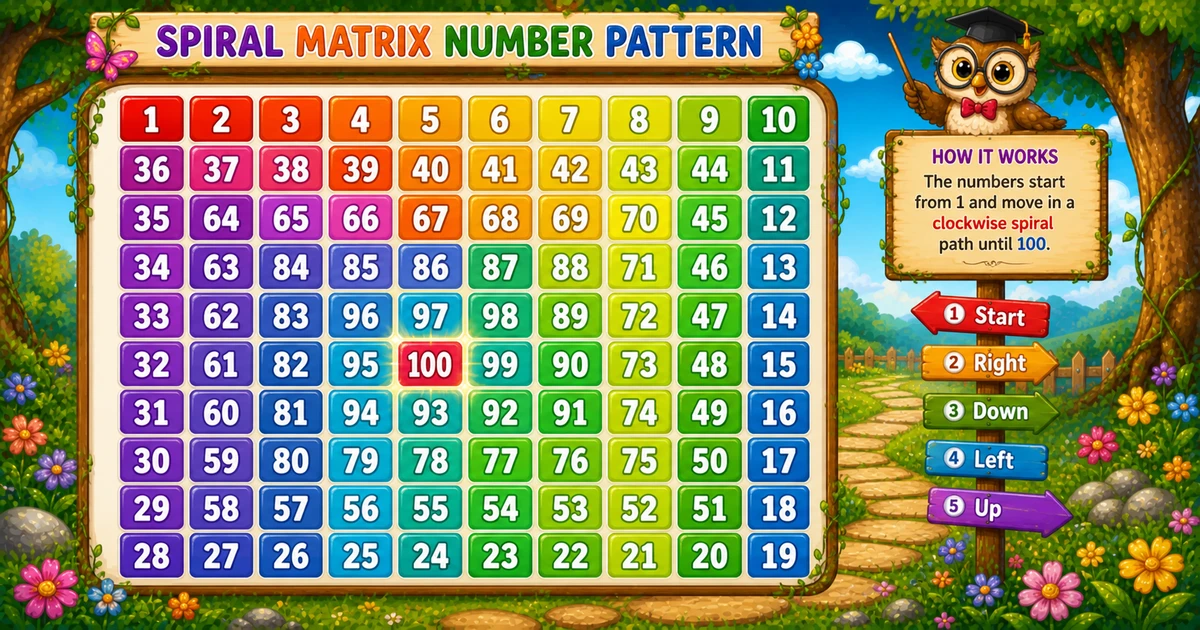
A perfect square spiral fills an n×n grid with 1..n² in clockwise rings — top → right → bottom → left — then shrinks inward until every cell is filled.
Remember
Rule: for each layer (low..high)
        fill top row, right col, bottom row, left col
        then low++, high--

   1   2   3   4   5
  16  17  18  19   6
  15  24  25  20   7
  14  23  22  21   8
  13  12  11  10   9     ← n = 5
Unlike Program 61 (1D digit reverse), here you allocate a 2D array and control four edge loops per ring. This closes the PHP number-pattern series — next, explore star patterns.
Approach
How to Solve It
Allocate an n×n array. For each ring marked by $low/$high, fill four sides in order, then tighten the boundaries. Print with printf("%4d", …) and echo PHP_EOL.
Method
Idea
Best for
Fixed 10×10
Hard-code size; inline four edge loops
Labs and demos
CLI size
Same fill; read $n at runtime
Any square size
Helper functions
fill_spiral + print_matrix
Cleaner structure
Pseudocode
Pseudocode
allocate a[n][n]
low = 0, high = n - 1, val = 1

for layer from 0 to ceil(n/2) - 1:
    for j from low to high:          // top
        a[low][j] = val; val++
    for i from low+1 to high:        // right
        a[i][high] = val; val++
    for j from high-1 down to low:   // bottom
        a[high][j] = val; val++
    for i from high-1 down to low+1: // left
        a[i][low] = val; val++
    low++; high--

print matrix with fixed-width cells
Cheat sheet
Goal
Pattern
Allocate grid
$a = array_fill(0, $n, array_fill(0, $n, 0));
Boundaries
$low = 0; $high = $n - 1;
Layer count
(int)(($n + 1) / 2) rings
Fill order
Top → right → bottom → left
Print cell
printf("%4d", $a[$i][$j]);
End the row
echo PHP_EOL;
Printing Numbers vs Starting a New Line
API
Effect
Use for
printf("%4d", …)
Stays on the same line
Each aligned cell
echo PHP_EOL
Ends the current line
After a full matrix row
Print all cells in a row, then break once.
Try it
Live Preview
Change the matrix size and the spiral updates instantly.
Whole numbers from 3 to 10. Tap a chip or type a value — the preview redraws as you go.
1. Pass by reference.fill_spiral(&$a, $n) writes into the same array the caller allocated.
2. Same edges. Top → right → bottom → left logic is unchanged — only packaged in a function.
3. Separate print.print_matrix keeps formatting out of the fill routine.
Edge Cases & Pitfalls
Check these before calling the solution done.
double corner
Starting every side at the same corner
That overwrites cells. Keep right at $low + 1, bottom to $low, left down to $low + 1.
wrong shrink
Forgetting to update $low / $high
Without $low++ and $high--, the outer ring repeats forever or overlaps.
PHP_EOL inside
echo PHP_EOL inside the cell loop
That prints one number per line. Call it only after each matrix row finishes.
n = 1
Single cell
Output is just 1 — one layer, top loop only.
n ≤ 0
Invalid size
Reject with a clear message before allocating the array.
narrow pad
Using %3d for large n
When n² ≥ 1000, widen the format (e.g. %5d) so columns stay aligned.
Analysis
Time and Space Complexity
Program
Time
Extra space
Fixed / input / helper (Examples 1–3)
O(n²)
O(n²) for the matrix
Every cell is written once and printed once, so both fill and print are O(n²). The grid itself needs O(n²) memory.
Remember
Key Takeaways
Rule: fill top → right → bottom → left, then shrink $low/$high.
Skip corners twice: start right at $low + 1; stop left before $low.
printf vs PHP_EOL: cells stay on the row; echo PHP_EOL advances after each line.
Next series: PHP star patterns — another classic nested-loop workout.
One line: walk four edges per ring, shrink the frame, until the square is full.
Frequently Asked Questions
It fills an n×n (perfect square) grid with numbers 1..n² in a clockwise spiral path, starting at the top-left and moving inward layer by layer.
They mark the current layer's top/bottom row and left/right column. After filling four edges, increment $low and decrement $high to shrink the active rectangle.
The top row already wrote the top-right corner at ($low, $high). Starting at $low + 1 avoids writing that cell twice.
Yes. Allocate an n×n array and run (n + 1) / 2 layers. The same four edge loops work for any positive n — see Example 2.
O(n²) — every cell is assigned exactly once, so work grows with the number of cells.
Yes. Reorder the four edge fills (for example left, bottom, right, top) and adjust loop bounds so corners are not duplicated.
The innermost layer is a single cell. The last loops still work; one iteration may fill only the center (for example n=5 → center is 25).
printf('%4d', ...) stays on the same line for each cell. echo PHP_EOL ends the row after the inner print loop.
Use trim(fgets(STDIN)) and is_numeric($input), then validate (int)$input > 0.
🤔
Did you know?
Fills an n×n matrix in spiral order using $low/$high boundaries — top, right, bottom, left edges per layer. O(n²) time and space.