Home PHP Number Patterns Program 59 PHP Hollow Square Number Pattern (Border) Definition
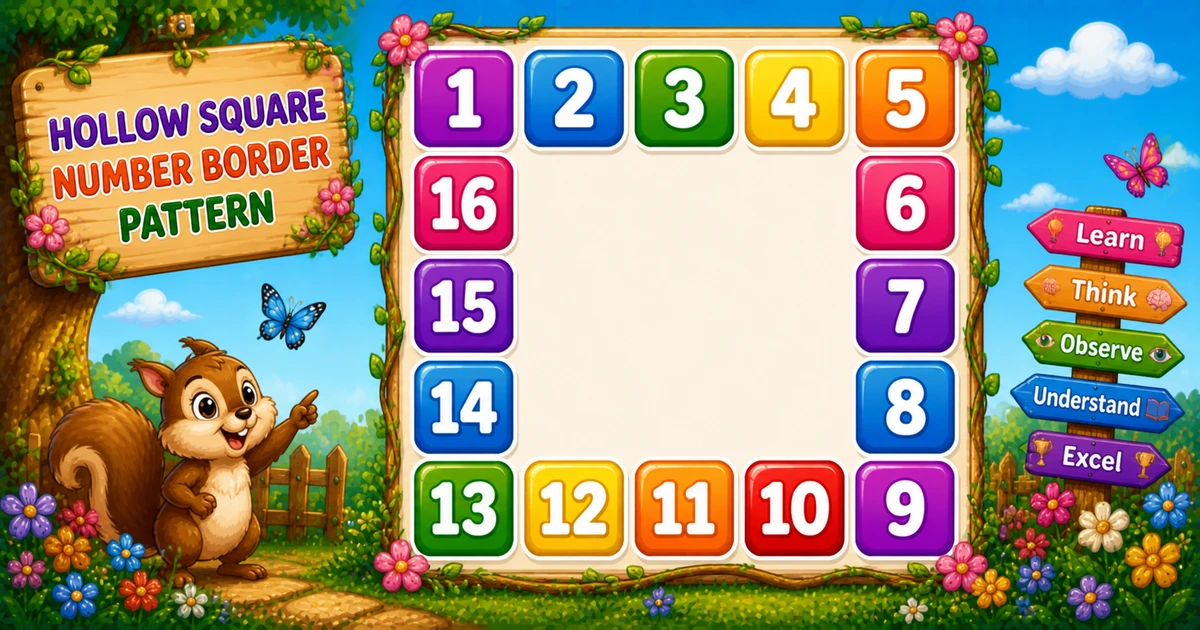
What Is This Pattern? A hollow square border fills only the frame of an n×n grid with consecutive numbers — top left-to-right, right top-to-bottom, bottom right-to-left, left bottom-to-top. Interior cells stay blank.
Rule: for each cell (i, j) in size×size
        if top:    print j
        elif right: print k++
        elif bottom: print l--
        elif left:  print m--
        else:       print spaces

1  2  3  4  5
16          6
15          7
14          8
13 12 11 10 9     ← size = 5
Unlike Program 58 (hollow diamond edges), here you scan a full square and decide border vs interior per cell. Program 60 continues by trimming the last digit each line.
Approach
How to Solve It Nested loops visit every cell. An if/elseif chain picks the correct edge counter. Use printf("%-3d", …) so two-digit values stay aligned. End each row with echo PHP_EOL.
Method Idea Best for Fixed size Hard-code 5×5; counters $k/$l/$m Labs and demos CLI input Same edges; compute counters from $size Any square size Simple border One counter on border cells Easier logic (different sequence)
Pseudocode k = size + 1
l = 3 * size - 2
m = 4 * size - 4
for i from 1 to size:
for j from 1 to size:
if i == 1: print j
else if j == size: print k; k = k + 1
else if i == size: print l; l = l - 1
else if j == 1: print m; m = m - 1
else: print spaces
print newline Cheat sheet Goal Pattern Set size $size = 5;Init counters $k = $size + 1; $l = 3 * $size - 2; $m = 4 * $size - 4;Top edge if ($i == 1) printf("%-3d", $j);Right / bottom / left $k++ / $l-- / $m-- with printfInterior echo " "; (three spaces)End the row echo PHP_EOL;
Printing Numbers vs Starting a New Line API Effect Use for printf("%-3d", …) / echo " "Stays on the same line Each cell (number or spaces) echo PHP_EOLEnds the current line After the inner loop finishes
Build the full row cell by cell, then break once.
Try it
Live Preview Change the square size and the hollow border updates instantly (Examples 1–2 sequence).
Trace
Worked Walkthrough Trace $size = 5 — how each edge gets its numbers (corners belong to the first matching branch).
Edge Condition Values Top $i == 11 2 3 4 5Right $j == 5 (not top)6 7 8 9Bottom $i == 5 (not right)13 12 11 10Left $j == 1 (middle rows)16 15 14
Order of if / elseif matters: the bottom-right corner is taken by the right-edge branch (9), not by $l--.
Code
PHP Programs Three complete programs: fixed 5×5, CLI $size, and a simpler sequential-border variant. Use View Output for sample results.
1. Fixed size 2. User input 3. Simple border Example 1 — Fixed $size = 5 Hard-coded 5×5 — counters $k = 6, $l = 13, $m = 16 with %-3d formatting.
<?php
$k = 6;
$l = 13;
$m = 16;

for ($i = 1; $i <= 5; $i++) {
    for ($j = 1; $j <= 5; $j++) {
        if ($i == 1)
            printf("%-3d", $j);
        elseif ($j == 5)
            printf("%-3d", $k++);
        elseif ($i == 5)
            printf("%-3d", $l--);
        elseif ($j == 1)
            printf("%-3d", $m--);
        else
            echo "   ";
    }
    echo PHP_EOL;
}
?> 1 2 3 4 5
16 6
15 7
14 8
13 12 11 10 9 How It Works 1. Top. When $i == 1, print column index $j — values 1..5.
2. Right, bottom, left. $k++ fills the right edge; $l-- walks the bottom leftward; $m-- walks the left edge upward.
3. Interior. Non-border cells print three spaces so columns stay lined up with %-3d.
Example 2 — User Input Read $size from the CLI and compute $k, $l, $m from formulas.
<?php
echo "Enter size: ";
$input = trim(fgets(STDIN));
if (!is_numeric($input) || (int) $input < 2) {
    echo "Enter a whole number >= 2." . PHP_EOL;
    exit(1);
}
$size = (int) $input;

$k = $size + 1;
$l = 3 * $size - 2;
$m = 4 * $size - 4;

for ($i = 1; $i <= $size; $i++) {
    for ($j = 1; $j <= $size; $j++) {
        if ($i == 1)
            printf("%-3d", $j);
        elseif ($j == $size)
            printf("%-3d", $k++);
        elseif ($i == $size)
            printf("%-3d", $l--);
        elseif ($j == 1)
            printf("%-3d", $m--);
        else
            echo "   ";
    }
    echo PHP_EOL;
}
?> How It Works 1. Validate input. is_numeric rejects letters; require size at least 2.
2. Scale counters. $k = $size + 1, $l = 3*$size - 2, $m = 4*$size - 4 match the clockwise sequence for any $size.
3. Same edges. The if/elseif chain matches Example 1 — only bounds and counters change.
Example 3 — Simple Sequential Border One counter on every border cell — easier code, different (row-major) numbering.
<?php
$size = 5;
$val = 1;

for ($i = 1; $i <= $size; $i++) {
    for ($j = 1; $j <= $size; $j++) {
        $border = ($i == 1 || $i == $size || $j == 1 || $j == $size);
        if ($border)
            printf("%-3d", $val++);
        else
            echo "   ";
    }
    echo PHP_EOL;
}
?> 1 2 3 4 5
6 7
8 9
10 11
12 13 14 15 16 How It Works 1. Border test. A cell is on the frame when row or column is first or last.
2. One counter. $val++ assigns the next number whenever $border is true.
3. Different sequence. Numbers follow scan order, not a continuous clockwise walk like Examples 1–2.
Edge Cases & Pitfalls Check these before calling the solution done.
branch order Testing bottom before right Corners match multiple edges. Keep the order top → right → bottom → left so the bottom-right corner uses $k++.
wrong pad Interior spaces not matching %-3d Use exactly three spaces (" ") or columns drift when numbers hit two digits.
PHP_EOL inside echo PHP_EOL inside the inner loopThat prints one cell per line. Call echo PHP_EOL only after the column loop finishes.
size = 2 Tiny square All four cells are border — no interior spaces. Still a valid hollow frame.
size ≤ 1 Too small Reject or special-case. A 1×1 grid is just 1; size 0 prints nothing.
wrong formulas Hard-coding $k/$l/$m for other sizes Values 6/13/16 are only for size 5. Use the formulas in Example 2 when $size changes.
Analysis
Time and Space Complexity Program Time Extra space Fixed / input (Examples 1–2) O(n²)O(1)Simple border (Example 3) O(n²)O(1)
There are n² cells, and each is visited once, so total work is O(n²). Only a few counters use extra memory.
Remember
Key Takeaways Rule: print numbers on the frame only — top, right, bottom, left — spaces inside.
Branch order: top → right → bottom → left so corners are not double-handled.
printf vs PHP_EOL: each cell stays on the line; echo PHP_EOL advances after the row.
Next step: Program 60 prints a number, then drops its last digit on each following line.
One line: walk the square border with edge counters; leave the interior blank.
Frequently Asked Questions What does this pattern print? Numbers only on the border of a square grid — interior cells are spaces creating a hollow frame.
Why use counters k, l, and m? Each edge continues the sequence differently: $k increments on the right, $l and $m decrement on bottom and left edges.
Why use printf('%-3d', value)? Fixed-width formatting keeps columns aligned when numbers reach two digits.
Can I change the 5×5 size? Yes. Generalize with $k=$size+1, $l=3*$size-2, $m=4*$size-4 — see Example 2.
How is Example 3 different? Example 3 uses a simple border check and one counter — easier but a different number sequence (row-major).
Why are there gaps inside the square? Non-border cells print three spaces — that creates the hollow interior.
What is the difference between echo and PHP_EOL? printf/echo stay on the same line for each cell. echo PHP_EOL ends the row after the inner loop.
What is the time complexity? O(n²) for an n×n grid because every cell is visited once.
How should I read size safely? Use trim(fgets(STDIN)) and is_numeric($input) before casting to int.
🤔
Did you know? Numbers print only on the border of a 5×5 grid: top row 1..5, right column 6..9, bottom row 13..9, left column 16..14 — interior cells are spaces.
Next: Remove Last Digit Each Line Continue with a pattern that shortens the number on every row.
Program 60 tutorial → About the author Developer, cloud engineer, and technical writer
I write practical tutorials so students and working developers can learn by doing—from databases and APIs to deployment on AWS.
12 people found this page helpful