Home PHP Number Patterns Program 25 PHP Number Triangle Pattern (Bidirectional) Definition
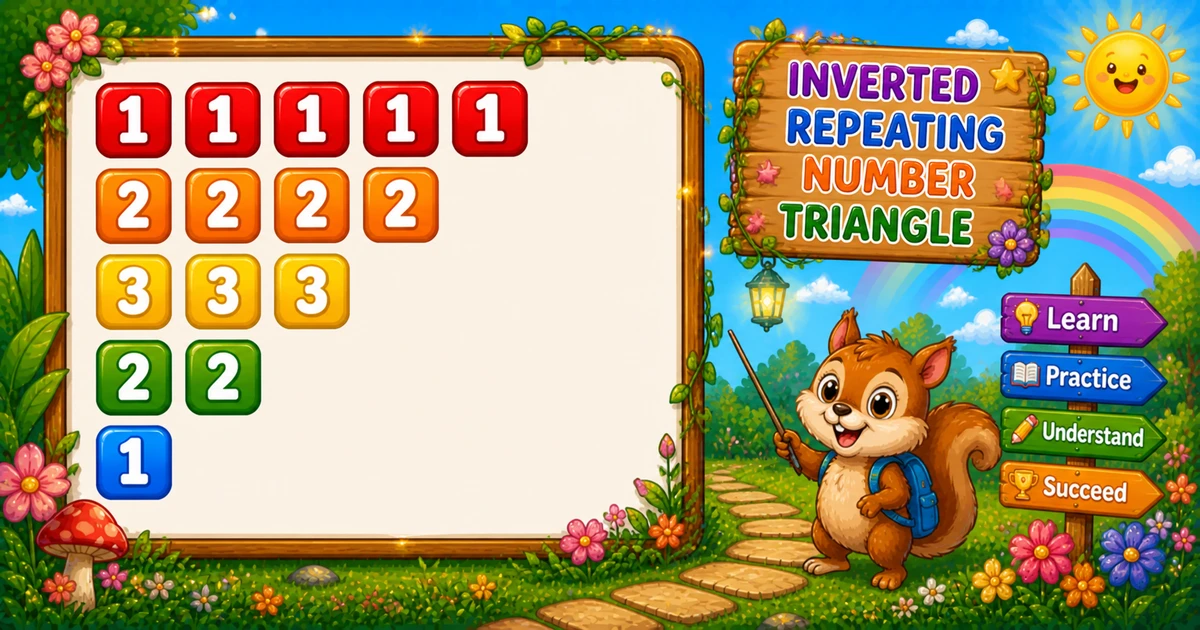
What Is This Pattern? A bidirectional number triangle prints a shrinking row of the same digit each time — digits rise on early rows (1, 2, 3), then mirror down (2, 1).
Rule: for i = 1..rows
      val = i if i < rows-1, else rows+1-i
      print val repeated (rows - i + 1) times

11111
2222
333
22
1           ← rows = 5
After Program 24 ’s centered continuous pyramid, this pattern focuses on a shrinking inner bound plus a simple digit map.
Approach
How to Solve It Walk $i from 1 to $rows; pick the row digit, then repeat it from $j = $i to $rows.
Method Idea Best for Map + shrink Digit from if/else or ternary; inner $j = $i..$rows Learning, interviews CLI input Same loops; read $rows with fgets(STDIN) Interactive practice Spaced digits Same bounds; echo $val . " " Readable console output
Pseudocode for i from 1 to rows:
if i < rows - 1:
val = i
else:
val = rows + 1 - i
for j from i to rows:
print val (no newline)
print newline Cheat sheet Goal Pattern Set rows $rows = 5;Outer loop for ($i = 1; $i <= $rows; $i++)Digit map $val = ($i < $rows - 1) ? $i : ($rows + 1 - $i);Inner loop for ($j = $i; $j <= $rows; $j++)Print digit echo $val;End row echo PHP_EOL;Chars per row $rows - $i + 1
Printing Numbers vs Starting a New Line API Effect Use for echo $valStays on the same line Each digit echo PHP_EOLEnds the current line After the inner loop
Print all digits without a newline, then end the row once with echo PHP_EOL. Putting PHP_EOL inside the inner loop prints one digit per line.
Try it
Live Preview Change the row count and the bidirectional triangle updates instantly.
Trace
Worked Walkthrough — $rows = 5 Trace each outer $i, the mapped digit, how many times it repeats, and the printed row.
$i$valRepeats Printed row 115 11111224 2222333 33342 (6 - 4)2 2251 (6 - 5)1 1
When $i < 4, use $i; otherwise use 6 - $i. Total digits = 15 = 5×6/2.
Code
PHP Programs Three complete programs: fixed $rows = 5, CLI input, and spaced digits. Use View Output for sample results.
1. Fixed rows = 5 2. CLI input 3. Spaced digits Example 1 — Fixed $rows = 5 Hard-coded height — if/else digit map and a shrinking inner loop.
<?php
for ($i = 1; $i <= 5; $i++) {
    for ($j = $i; $j <= 5; $j++) {
        if ($i < 4) {
            echo $i;
        } else {
            echo 6 - $i;
        }
    }
    echo PHP_EOL;
}
?> How It Works 1. Outer loop. $i runs from 1 to 5 — one shrinking row each time.
2. Digit map. If $i < 4, print $i; else print 6 - $i (so rows 4 and 5 become 22 and 1).
3. Inner loop. $j runs from $i to 5, then echo PHP_EOL ends the row.
Example 2 — CLI Input Read $rows from STDIN and use a ternary that works for any height.
<?php
echo "Enter rows: ";
$rows = (int) trim(fgets(STDIN));

for ($i = 1; $i <= $rows; $i++) {
    $val = ($i < $rows - 1) ? $i : ($rows + 1 - $i);

    for ($j = $i; $j <= $rows; $j++) {
        echo $val;
    }

    echo PHP_EOL;
}
?> How It Works 1. Read rows. Ask for a count, then trim(fgets(STDIN)) and cast to int.
2. General map. ($i < $rows - 1) ? $i : ($rows + 1 - $i) replaces the hard-coded 4 and 6.
3. Safer input tip. Bare (int) casts turn letters into 0. Prefer:
echo "Enter rows: ";
$input = trim(fgets(STDIN));
if (!is_numeric($input) || (int) $input < 1) {
    echo "Enter a positive whole number." . PHP_EOL;
    exit(1);
}
$rows = (int) $input;
Example 3 — Spaced Digits Same loops; append a space after each digit for easier reading.
<?php
$rows = 5;

for ($i = 1; $i <= $rows; $i++) {
    $val = ($i < $rows - 1) ? $i : ($rows + 1 - $i);

    for ($j = $i; $j <= $rows; $j++) {
        echo $val . " ";
    }

    echo PHP_EOL;
}
?> 1 1 1 1 1
2 2 2 2
3 3 3
2 2
1 How It Works 1. Same structure. Outer loop, digit map, and inner bounds match Example 2.
2. Only the print changes. echo $val . " " adds a trailing space after each digit.
3. Shape unchanged. Still rises then mirrors down while shrinking each row.
Edge Cases & Pitfalls Check these before calling the solution done.
hard-coded 4 / 6 Breaks for other heights $i < 4 and 6 - $i only work for $rows = 5. Use the ternary with $rows for any size.
fixed inner Full rectangle If the inner loop always runs 1..$rows, every row has the same length. Start at $j = $i.
PHP_EOL inside Vertical digits If echo PHP_EOL is inside the inner loop, each digit lands on its own line.
map inside Repeated if Set $val once before the inner loop, then just echo $val — do not recompute the map on every $j.
rows = 1 Single digit Output is just 1 — a good sanity check.
fgets Check is_numeric Bare (int) casts turn non-numeric strings into 0 — prefer is_numeric before casting.
Analysis
Time and Space Complexity Program Time Extra space Examples 1–3 O(n²)O(1)
Digits per pattern = n + (n-1) + … + 1 = n(n+1)/2 → O(n²).
Remember
Key Takeaways Rule: shrink with $j = $i..$rows; map the digit with rise-then-fall.
General map: ($i < $rows - 1) ? $i : ($rows + 1 - $i).
echo vs PHP_EOL: digits stay on the line; echo PHP_EOL advances after each row.
Complexity: total digits = n(n+1)/2 → O(n²).
One line: shrink each row while the digit rises then mirrors back down.
Frequently Asked Questions Why does the last row print 1 and not 5? For $i = 5 and $rows = 5, the mapping uses $rows + 1 - $i = 6 - 5 = 1, so the last row prints a single 1.
Why does the row length shrink? Because the inner loop runs from $j = $i to $rows. As $i increases, the inner loop executes fewer times.
What does bidirectional mean here? Digits rise (1, 2, 3) on early rows then mirror down (2, 1) on the last rows via the $rows + 1 - $i mapping.
What is the difference between echo and PHP_EOL? echo $val repeats the digit on the same line. echo PHP_EOL ends the row after the inner loop finishes.
Why use if/else instead of two separate loops? A single inner loop with a digit mapping keeps the shrinking row logic in one place.
How do I generalize for any row count? Use $val = ($i < $rows - 1) ? $i : ($rows + 1 - $i) — see Example 2.
What is the time complexity? O(n²) for n rows because total prints are triangular (n + (n-1) + … + 1).
How should I read rows safely? Use trim(fgets(STDIN)) and check is_numeric($input) before casting to int.
What happens if rows is 1? Only one row prints — a single 1.
🤔
Did you know? This pattern prints repeated digits per row. The inner loop runs from $j = $i to $rows, shrinking each row. The row digit is $i for the first half, then switches to $rows + 1 - $i to produce 22 and 1.
Next: Diagonal Asterisk Pattern Continue with the next pattern in the PHP number-pattern series.
Program 26 tutorial → About the author Developer, cloud engineer, and technical writer
I write practical tutorials so students and working developers can learn by doing—from databases and APIs to deployment on AWS.
12 people found this page helpful