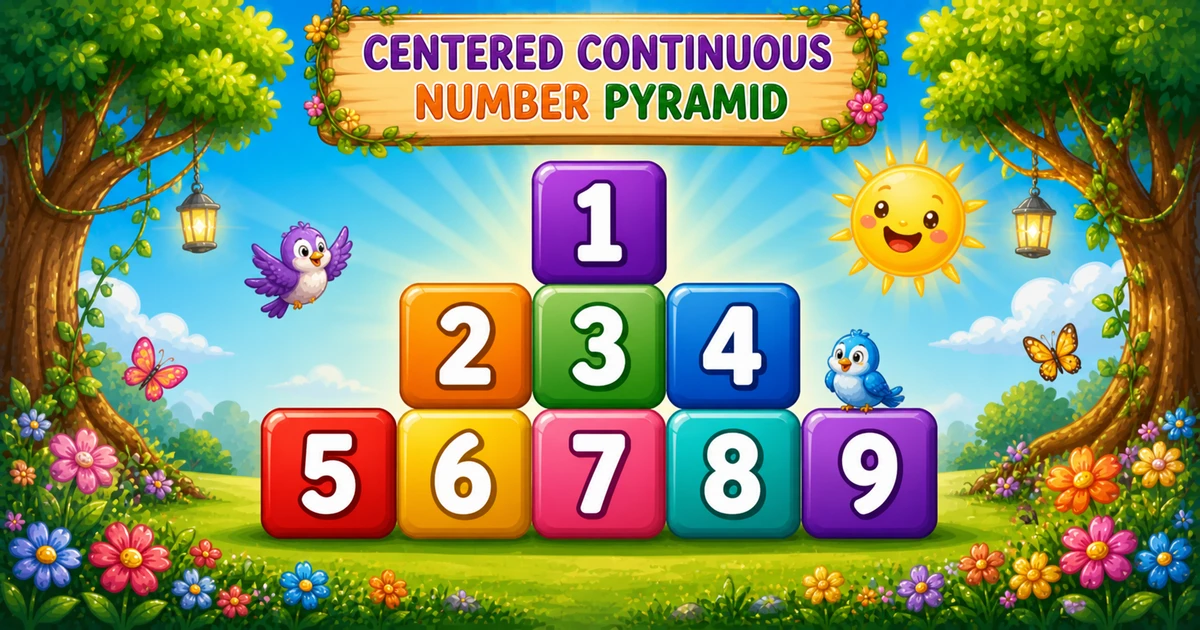
A centered continuous number pyramid prints odd-width rows with leading spaces, while a single counter $k keeps rising across every row.
Remember
Rule: for odd i up to max,
      reverse-scan columns — space when j > i, else print k++

    1
  2 3 4
5 6 7 8 9     ← max = 5
Unlike Program 20 (left-aligned continuous triangle), this version centers each row with a reverse inner loop and an if ($j > $i) space check. Program 25 continues with a bidirectional number triangle.
Approach
How to Solve It
Odd outer widths, reverse inner scan, shared counter $k. End each row with echo PHP_EOL.
Method
Idea
Best for
Reverse + if
Scan $j from $max down; space when $j > $i, else $k++
Learning, interviews, exams
Safe input
Same loops; re-prompt until is_numeric succeeds
Console apps that must reject bad input
Pseudocode
Pseudocode
k = 1
for i from 1 to max step 2:
    for j from max down to 1:
        if j > i:
            print space
        else:
            print k and a space
            k = k + 1
    print newline
Cheat sheet
Goal
Pattern
Odd row widths
for ($i = 1; $i <= $max; $i += 2)
Start counter once
$k = 1; before the outer loop
Reverse columns
for ($j = $max; $j >= 1; $j--)
Space vs number
if ($j > $i) echo " "; else echo $k++ . " ";
End the row
echo PHP_EOL;
Even max fix
if ($max % 2 == 0) $max -= 1;
Printing Numbers vs Starting a New Line
API
Effect
Use for
echo " " / echo $k++ . " "
Stays on the same line
Leading spaces and each number
echo PHP_EOL
Ends the current line
After the inner loop
Print spaces and numbers without a newline, then end the row once.
Try it
Live Preview
Change the max odd width and the centered pyramid updates instantly. Even values are adjusted down by 1.
Odd whole numbers from 1 to 9 (single digits). Even values are adjusted down by 1.
Live resultmax = 5 · 3 rows · 9 numbers
    1
  2 3 4
5 6 7 8 9
Trace
Worked Walkthrough
Trace $max = 5 — leading spaces, printed numbers, and $k after each row.
$i
Leading spaces
Numbers
$k after
Printed row
1
4 ($j = 5..2)
1
2
1
3
2 ($j = 5..4)
2 3 4
5
2 3 4
5
0
5 6 7 8 9
10
5 6 7 8 9
Each row scans all $max columns — total work is O(n²) for width n.
Code
PHP Programs
Three complete programs: fixed max, CLI input with even-width fix, and a safe re-prompt loop. Use View Output for sample results.
Example 1 — Fixed $max = 5
Hard-coded width — reverse inner loop centers each row; $k never resets.
1. Read max. Ask for a max width, then trim(fgets(STDIN)) and cast to int.
2. Keep it odd. If the user types 6, subtract 1 so the last row width is still 5.
3. Same pyramid core. After the fix, the reverse-loop + $k++ logic matches Example 1.
Example 3 — Safe Input Loop
Re-prompt until a positive whole number arrives, then draw the pyramid.
PHP
<?php
$max = 0;

echo "Enter the maximum odd width: ";
while ($max < 1) {
    $input = trim(fgets(STDIN));
    if (is_numeric($input) && (int) $input >= 1) {
        $max = (int) $input;
    } else {
        echo "Please enter a positive whole number: ";
    }
}

if ($max % 2 == 0) {
    $max -= 1;
}

$k = 1;
for ($i = 1; $i <= $max; $i += 2) {
    for ($j = $max; $j >= 1; $j--) {
        if ($j > $i) {
            echo " ";
        } else {
            echo $k++ . " ";
        }
    }
    echo PHP_EOL;
}
?>
Output (when user enters 3)
Enter the maximum odd width: 3
  1
2 3 4
How It Works
1. Validate in a loop. Stay in while ($max < 1) until a positive int arrives.
2. Reject bad tokens. Non-numeric input re-prompts instead of casting to 0 silently.
3. Then draw. After validation (and the even-width fix), the same reverse-loop pyramid runs.
Edge Cases & Pitfalls
Check these before calling the solution done.
k inside
Resetting $k each row
Declaring $k inside the outer loop restarts at 1 every row. Keep $k before the loops.
i++
Using $i++ instead of $i += 2
That prints every length. Use $i += 2 for the odd pyramid shape.
forward j
Scanning $j upward
That puts spaces after numbers. The reverse scan ($j from $max down) puts spaces on the left.
PHP_EOL inside
echo PHP_EOL inside the inner loop
That breaks the row. Call echo PHP_EOL only after the column scan finishes.
max = 1
Single number
Output is 1 — a good sanity check.
even max
Even width without a fix
Subtract 1 (or prompt again) so the last row still has an odd width.
Analysis
Time and Space Complexity
Program
Time
Extra space
Fixed / input / safe (Examples 1–3)
O(n²)
O(1)
There are about n/2 rows, and each row scans all n columns, so total work is O(n²).
Remember
Key Takeaways
Rule: for each odd $i, reverse-scan columns — space when $j > $i, else print $k++.
Scope: keep $k outside the outer loop so the sequence never restarts.
echo vs PHP_EOL: spaces and numbers stay on the line; echo PHP_EOL advances after each row.
Next step: Program 25 prints a bidirectional number triangle.
One line: for odd $i, reverse-scan — space when $j > $i, else echo $k++ . " ", then echo PHP_EOL.
Frequently Asked Questions
The program prints leading spaces when $j > $i, which shifts the numbers to the right and centers the pyramid.
Because the counter $k is not reset inside the outer loop. It increments with $k++ each time a number is printed.
Row widths are odd (1, 3, 5, …) so each row adds two more numbers than the previous row.
echo " " stays on the same line for spaces and numbers. echo PHP_EOL ends the current row after the inner loop finishes.
The reverse inner loop lets you print leading spaces first (when $j > $i) and numbers afterward — a common centering trick.
Subtract 1 to force an odd width, or validate and prompt again. This version assumes odd row sizes.
O(n²) for max width n because each row iterates across n columns.
Use trim(fgets(STDIN)) and check is_numeric($input) before casting to int — see Example 3 for a re-prompt loop.
Only one row prints — a single centered 1 (no leading spaces when max is 1).
🤔
Did you know?
This centered pyramid prints numbers continuously using a counter $k. An if inside a reverse loop prints leading spaces when $j > $i, then prints $k++ once the column reaches the row boundary.