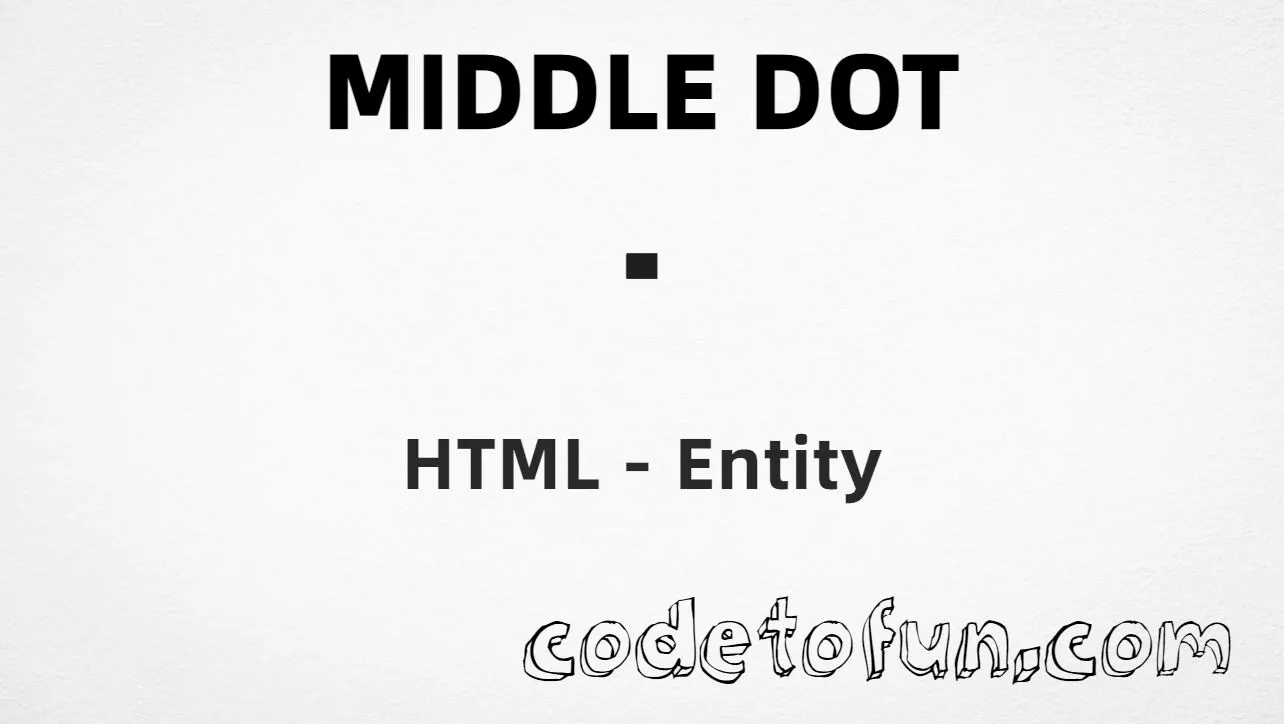
Middle dot (·) is Unicode U+00B7 — also called an interpunct. HTML5 provides ·. Use it as a lightweight separator, not as a sentence-ending period.
Remember
Character     ·
Unicode       U+00B7
Named entity  ·
Hex entity    ·
Decimal       ·
CSS escape    \00B7
Named, hex, decimal, CSS, and a typed character all produce the same glyph: ·.
Reference
Quick Reference
One table for every form you will actually use.
Form
Code
Where it goes
Named entity
·
HTML markup (preferred)
Direct character
·
UTF-8 HTML text
Hex entity
·
HTML markup
Decimal entity
·
HTML markup
CSS escape
\00B7
Stylesheet content
When to Use Which
Situation
Use
Inline separators and labels
· (clearest HTML form)
Need an entity in HTML source
·, ·, or ·
Generated text via ::before / ::after
content: "\00B7"
List bullets
Prefer • (•) or CSS list-style
Sentence punctuation
Use period . — not middle dot
See it
Live Preview
Middle dot as a separator and typography mark.
SeparatorRed · Green · Blue
Large glyph·
Named entity· → ·
vs . and •· | . | •
With entitiesNamed: · | Hex: · | Decimal: ·
Code
Complete HTML Example
One page that shows the middle dot with named, hex, decimal, and CSS forms. Use View Output or open the live editor.
Use · (named), · (hex), · (decimal), or the CSS escape \00B7 in the content property. All render ·. Prefer · in HTML source.
U+00B7 (MIDDLE DOT). Hex 00B7, decimal 183. It belongs to the Latin-1 Supplement block and is also called an interpunct.
Yes. · is the common HTML5 named entity for ·. HTML5 also defines · and · for the same character.
Use it for inline separators (Red · Green · Blue), math multiplication dots, Catalan geminated L (l·l), and typography accents.
HTML entities (·, ·, or ·) go in markup. The CSS escape \00B7 is used in stylesheets (usually in the content property of ::before/::after). Both render ·.
No. Period is . (U+002E). Bullet is • (•, U+2022). Middle dot is · (·, U+00B7).
🤔
Did you know?
Middle dot is Unicode U+00B7 (decimal 183) — MIDDLE DOT (interpunct) in Latin-1 Supplement. HTML5 provides · (also ·). Handy for separators and Catalan l·l. Not a period (.) and not a bullet (•).