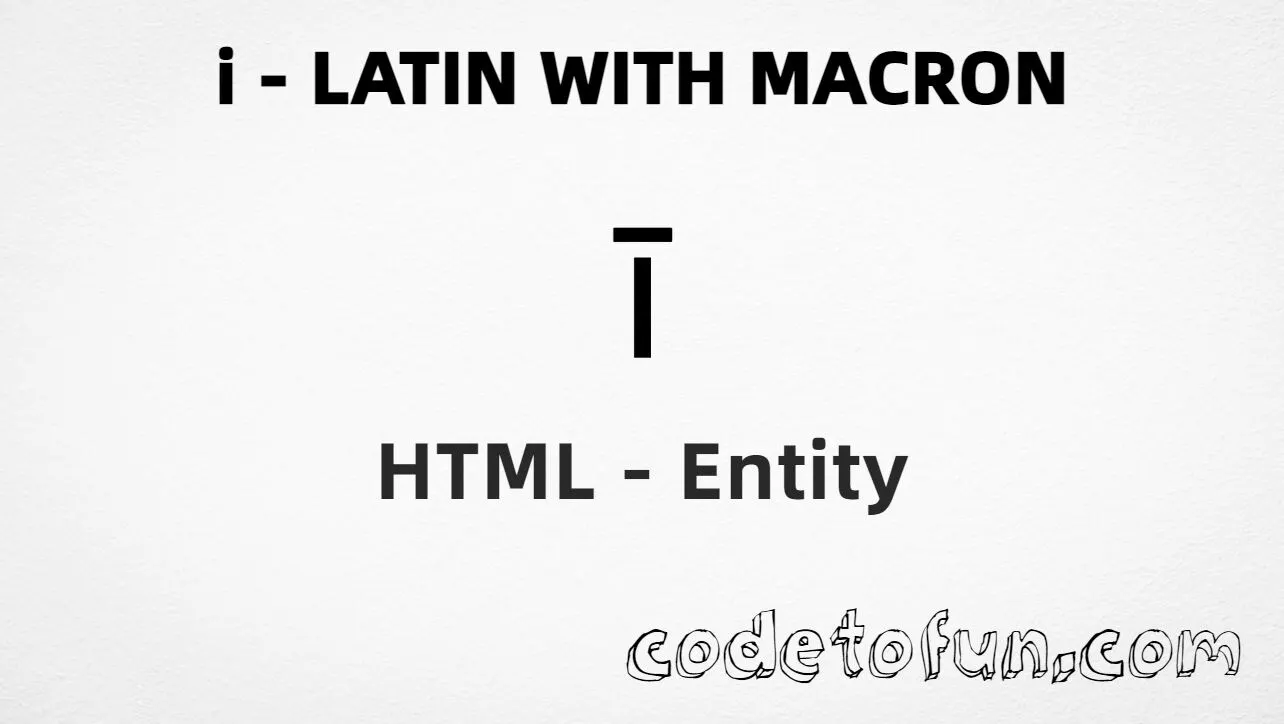
Lowercase i with macron (ī) is the Unicode character at U+012B in Latin Extended-A. Official name: LATIN SMALL LETTER I WITH MACRON — the letter i with a macron (¯). It marks a long i in Latin and appears in Latvian.
Remember
Character     ī
Unicode       U+012B
Named entity  ī
Hex entity    ī
Decimal       ī
CSS escape    \012B
Capital       Ī (Ī)
Not the same  i (U+0069) · combining i (U+0365)
Prefer ī in HTML. Alternatives: ī, ī, or type ī in a UTF-8 document.
Built with Named: ī
Built with Hex: ī
Built with Decimal: ī
Built with CSS: ī
Typed: ī
Latin: vīta, fīlius
How It Works
1. Named:ī is the HTML5 name for U+012B → ī. Prefer this in markup.
2. Hex:ī inserts the same code point. Same visual as named.
3. Decimal: same code point as 299 → ī.
4. CSS: use \012B in content (not an HTML entity). #point::after appends ī.
5. Typed + sample: paste ī in UTF-8, or use ī in Latin words like vīta.
Pitfalls & Tips
Common mistakes when working with lowercase i with macron.
Name
Prefer ī
The named entity is clearer than inventing names — use ī for U+012B in HTML.
Case
ī ≠ Ī
Named entities are case-sensitive. Lowercase is ī; uppercase is Ī.
i
Not plain i
Plain i is U+0069. In Latin, ī marks length — do not replace it with short i.
Look-alikes
Not combining i or acute
Combining Latin small letter i is U+0365. Acute í (í) is a different accent — not a macron.
CSS
Pad the CSS escape
Prefer \012B (four hex digits). A short \12B can swallow the next hex digit if one follows immediately.
CSS vs HTML
Do not mix escapes
\012B belongs in CSS strings. ī / ī / ī belong in HTML.
Semicolon
End references
Always finish entities with ; — write ī, not &imacr.
Compatibility
Browser Support
Lowercase i with macron (U+012B) and its entity forms (ī, ī, ī, CSS \\012B) are supported in all mainstream browsers. Visible glyphs depend on Latin Extended-A font coverage.
✓ Universal support
Lowercase I Latin Macron (ī)
Encode with named, hex, decimal, CSS escape, or type the character — same code point everywhere encoding is supported.
100%Browser coverage
Google ChromeSupported
Yes
Microsoft EdgeSupported
Yes
Mozilla FirefoxSupported
Yes
Apple SafariSupported
Yes
OperaSupported
Yes
Internet ExplorerAll versions
Yes
U+012BFull support
Bottom line: Prefer ī in HTML. Use ī / ī when numeric form is required, and \\012B only inside CSS content.
Remember
Key Takeaways
Unicode: lowercase i with macron is U+012B (decimal 299) — glyph ī.
HTML: prefer ī — also ī / ī / type ī.
Prefer ī (named). You can also use ī (hex), ī (decimal), type ī in UTF-8, or the CSS escape \012B in content.
U+012B (LATIN SMALL LETTER I WITH MACRON). Hex 12B, decimal 299. It belongs to Latin Extended-A (U+0100–U+017F).
Yes. HTML5 defines ī for ī. The capital form is Ī (Ī, U+012A) — names are case-sensitive.
Use it for Latin long i (e.g. vīta), Latvian text, Hawaiian, and other languages that need ī. Prefer plain i for ordinary English words.
HTML entities (ī, ī, or ī) go in markup. The CSS escape \012B goes in stylesheet strings (usually content on ::before/::after).
No. U+012B is a precomposed letter. Combining Latin small letter i is U+0365. Combining macron is U+0304 after a base. Prefer ī when the precomposed form exists.
🤔
Did you know?
Lowercase i with macron is Unicode U+012B (decimal 299) — LATIN SMALL LETTER I WITH MACRON in Latin Extended-A. HTML5 provides ī — the most readable form. Capital is Ī (Ī, U+012A). Marks a long i in Latin and appears in Latvian orthography.