HTML Entity for Lowercase D Stroke (đ)

Beginner
5 min read
Updated: Sep 2026
1 example
Unicode U+0111

What Is the Lowercase D Stroke Entity?

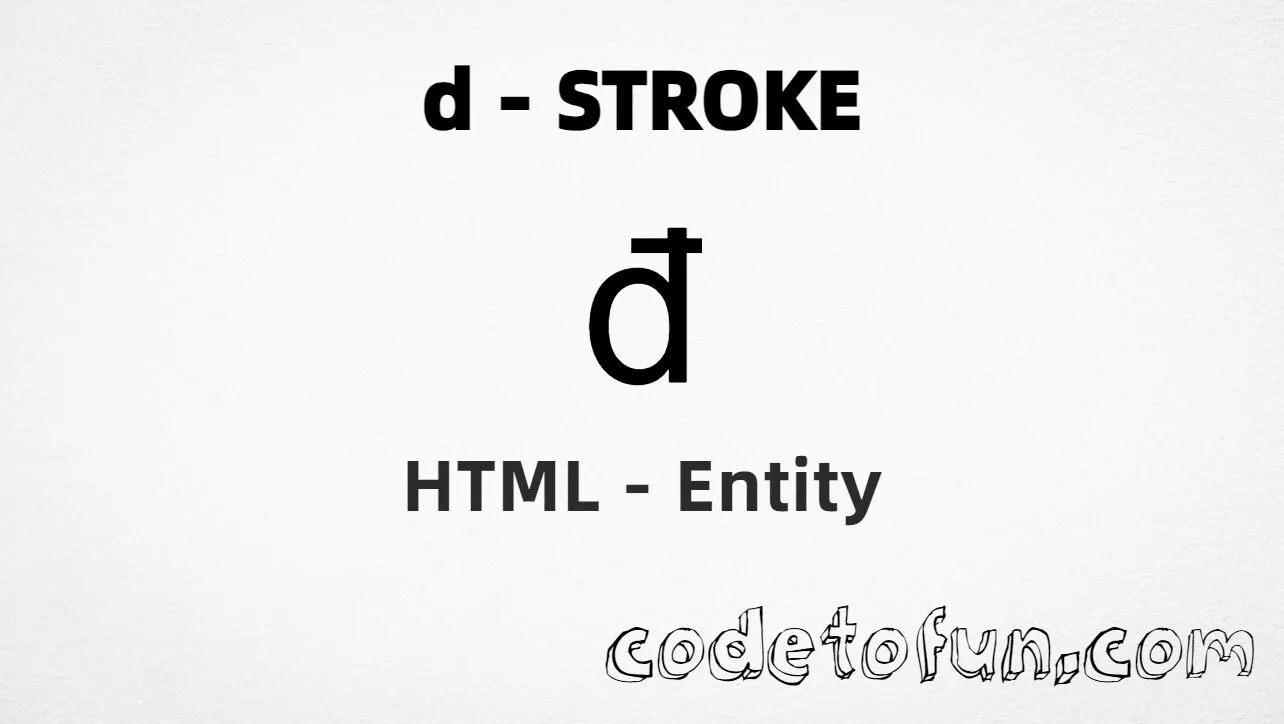
Lowercase d stroke (đ) is the Latin Extended-A character at Unicode U+0111 (LATIN SMALL LETTER D WITH STROKE). It is the letter d with a horizontal stroke — a distinct letter in Vietnamese and several other Latin orthographies.

Remember
Character     đ
Unicode       U+0111
Named entity  đ
Hex entity    đ
Decimal       đ
CSS escape    \0111
Capital       Đ (Đ)

Named, hex, decimal, CSS, and a typed character all produce the same glyph: đ. Prefer đ in HTML source for clarity.

Quick Reference

One table for every form you will actually use.

FormCodeWhere it goes
Named entityđHTML markup (best default)
Hex entityđHTML markup
Decimal entityđHTML markup
CSS escape\0111Stylesheet content
Direct characterđUTF-8 HTML text

When to Use Which

SituationUse
Readable HTML sourceđ
Numeric entity requiredđ or đ
Generated text via ::before / ::aftercontent: "\0111"
Capital ĐĐ — see Uppercase D Stroke
Plain d / eth / d carond · ð · ď (U+010F)

Live Preview

Lowercase d stroke in language and comparison contexts.

Large glyph đ
Vietnamese sample đi, đẹp, đường
Named entity đ → đ
vs d / Đ / ð / ď đ  |  d  |  Đ  |  ð  |  ď
With entities Named: đ | Hex: đ | Decimal: đ

Complete HTML Example

One page that shows this character with named, hex, decimal, and CSS forms. Use View Output or open the live editor.

Named + Hex + Decimal + CSS

Four ways to produce đ in a single document.

html
<!DOCTYPE html>
<html lang="en">
<head>
  <meta charset="UTF-8">
  <title>Lowercase D Stroke (&dstrok;)</title>
  <style>
    #point::after {
      content: "\0111";
    }
  </style>
</head>
<body>
  <p>Using Named Entity: &dstrok;</p>
  <p>Using Hex Code: &#x111;</p>
  <p>Using HTML Code: &#273;</p>
  <p id="point">Using CSS Entity: </p>
  <p lang="vi">Tiếng Việt: &dstrok;i</p>
</body>
</html>
Try It Yourself

How It Works

1. Named: &dstrok; is the clearest HTML form and renders đ.

2. Hex: U+0111 → &#x111; in HTML. Same result as the named entity.

3. Decimal: same code point as 273 → &#273;. Same result as hex.

4. CSS: use \0111 in content (not an HTML entity). #point::after appends that đ after the paragraph text.

Pitfalls & Tips

Common mistakes when working with lowercase d stroke.

Case

&dstrok; ≠ &Dstrok;

Named entities are case-sensitive. Lowercase is đ; uppercase is Đ.

Look-alikes

Not d, ð, or ď

Do not confuse &dstrok; with plain d, &eth; (ð), or d caron ď (U+010F).

Compose

Prefer precomposed

Use &dstrok; instead of inventing a stroked d with overlays. The precomposed form is standard.

CSS vs HTML

Do not mix escapes

\0111 belongs in CSS. &dstrok; / &#x111; / &#273; belong in HTML.

Encoding

Declare UTF-8

If you type đ directly, keep <meta charset="UTF-8"> so the file is not misread.

Semicolon

End references

Always finish with ; — write &dstrok;, not &dstrok.

Browser Support

Lowercase d stroke (U+0111) and its entity forms (&dstrok;, &#x111;, &#273;, CSS \\0111) are supported in all modern browsers.

✓ Universal encoding

Lowercase D Stroke (đ)

Encode with named, hex, decimal, or CSS escape — or type đ directly in UTF-8 HTML.

100% Browser coverage
Google Chrome Supported
Yes
Microsoft Edge Supported
Yes
Mozilla Firefox Supported
Yes
Apple Safari Supported
Yes
Opera Supported
Yes
Internet Explorer IE 9+
Yes*
U+0111 Full support

Bottom line: Prefer &dstrok; for readable HTML. Use \\0111 only inside CSS content.

Key Takeaways

  • Unicode: this character is U+0111 (decimal 273).
  • HTML: prefer &dstrok; — or use &#x111; / &#273;.
  • CSS: use \0111 inside content for generated text.
  • Watch out: &dstrok; ≠ &Dstrok; ≠ &eth; ≠ plain d.

One line: U+0111 → &dstrok; / &#x111; / &#273; / CSS \0111.

Frequently Asked Questions

Use &dstrok; (named), &#x111; (hex), &#273; (decimal), or the CSS escape \0111 in the content property. All render đ. Prefer &dstrok; in HTML source.
U+0111 (LATIN SMALL LETTER D WITH STROKE). Hex 111, decimal 273. It belongs to Latin Extended-A (U+0100–U+017F).
Yes. &dstrok; is the HTML5 named entity for đ. The capital form is &Dstrok; (Đ, U+0110) — names are case-sensitive.
Use it for Vietnamese (đi, đẹp), Croatian/Serbian Latin text, Sámi content, and other pages that need the letter đ.
HTML entities (&dstrok;, &#273;, or &#x111;) go in markup. The CSS escape \0111 is used in stylesheets (usually in the content property of ::before/::after). Both render đ.
Plain d is U+0064. Eth ð is U+00F0 (&eth;). D caron ď is U+010F. D stroke đ is U+0111 — a distinct letter with a horizontal stroke through the ascender.

Did you know?

Lowercase d stroke is Unicode U+0111 (decimal 273) — LATIN SMALL LETTER D WITH STROKE in Latin Extended-A. HTML5 provides &dstrok; — the most readable form. Capital is &Dstrok; (Đ, U+0110). Used in Vietnamese, Croatian, Serbian Latin, and Sámi orthographies.
Next: Lowercase D Tail

Learn the HTML entity for lowercase d with tail (ɖ).

Continue tutorial →

About the author

Mari Selvan M P
Mari Selvan M P 🔗

Developer, cloud engineer, and technical writer

  • Experience 12 years building web and cloud systems
  • Focus Full Stack Development, AWS, and Developer Education

I write practical tutorials so students and working developers can learn by doing—from databases and APIs to deployment on AWS.

8 people found this page helpful

