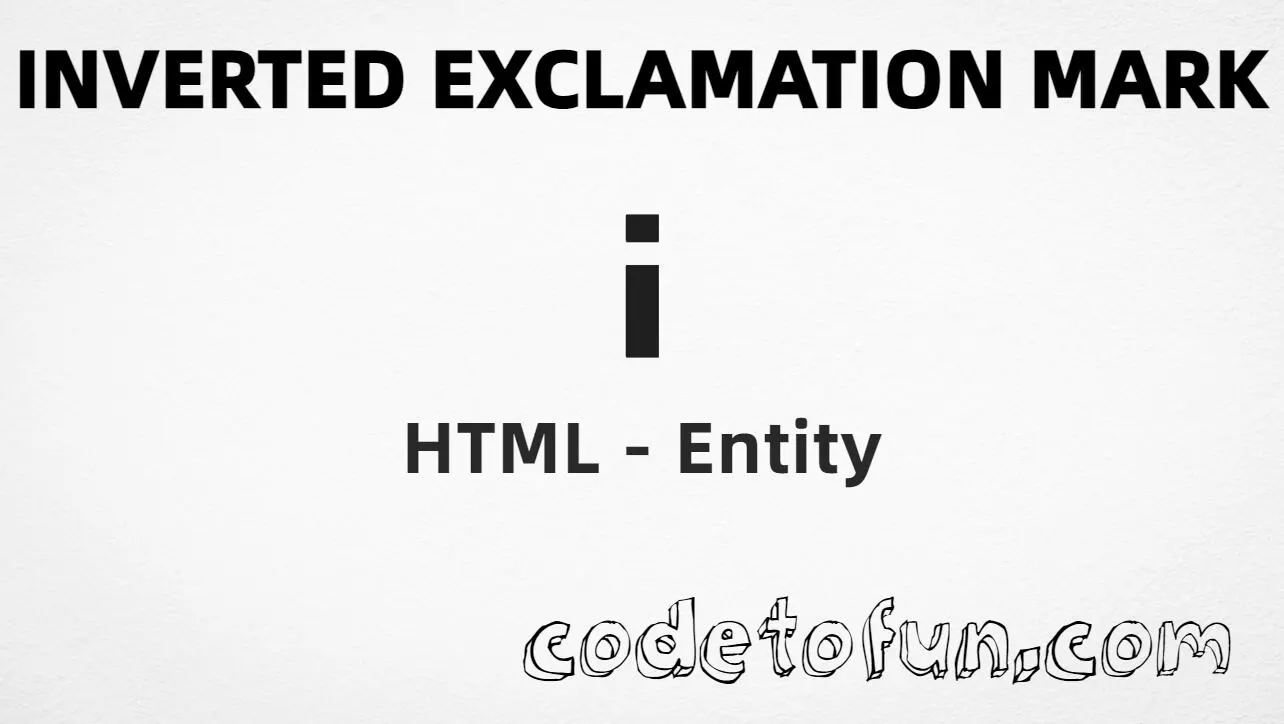
HTML Entity for Inverted Exclamation Mark (¡)

What You'll Learn
How to display the Inverted Exclamation Mark (¡) in HTML using hexadecimal, decimal, named entity, and CSS escape methods. Spanish punctuation requires ¡ at the start and ! at the end of exclamatory phrases (e.g. ¡Hola! ¿Qué tal?).
This character is U+00A1 (INVERTED EXCLAMATION MARK) in the Latin-1 Supplement block (U+0080–U+00FF). Render it with ¡, ¡, ¡, or CSS \00A1.
⚡ Quick Reference — Inverted Exclamation Mark
U+00A1Latin-1 Supplement
¡Hexadecimal reference
¡Decimal reference
¡Most readable option
Name Value
──────────── ──────────
Unicode U+00A1
Hex code ¡
HTML code ¡
Named entity ¡
CSS code \00A1
Meaning Opening exclamation (Spanish ¡)
Example ¡Hola!Complete HTML Example
This example demonstrates the Inverted Exclamation Mark symbol (¡) using hexadecimal code, decimal HTML code, the named entity, and a CSS content escape:
<!DOCTYPE html>
<html>
<head>
<style>
#point:after{
content: "\00A1";
}
</style>
</head>
<body>
<p>Inverted Exclamation Mark using Hexadecimal: ¡</p>
<p>Inverted Exclamation Mark using Decimal: ¡</p>
<p>Inverted Exclamation Mark using Named Entity: ¡</p>
<p id="point">Inverted Exclamation Mark using CSS Entity: </p>
</body>
</html>🌐 Browser Support
The Inverted Exclamation Mark symbol (¡) is universally supported in all modern browsers:
👀 Live Preview
See the Inverted Exclamation Mark (¡) in Spanish punctuation contexts:
🧠 How It Works
Hexadecimal Code
¡ uses the Unicode hexadecimal value 00A1 to display the Inverted Exclamation Mark. The x prefix indicates hexadecimal format.
Decimal HTML Code
¡ uses the decimal Unicode value 161 to display the same character.
CSS Entity
\00A1 is used in CSS stylesheets, particularly in the content property of pseudo-elements like ::before and ::after.
Named Entity
¡ is the standard named HTML entity for the inverted exclamation mark—easy to read and remember in source markup.
Same visual result
All four methods produce ¡. Unicode U+00A1 is in Latin-1 Supplement. Next: Inverted Glottal Stop (U+01BE).
Use Cases
The Inverted Exclamation Mark symbol (¡) is commonly used in:
Open exclamations with ¡ and close with ! (e.g. ¡Hola!).
Localized sites and apps with correct Spanish punctuation.
Language courses, textbooks, and learning materials.
Articles, blogs, and publications in Spanish.
UI strings, notifications, and messages with exclamatory tone.
Proper punctuation helps screen readers interpret Spanish exclamations.
💡 Best Practices
Do
- Prefer
¡for readable source markup - Pair ¡ with closing ! in Spanish (e.g.
¡Hola!) - Set
<meta charset="utf-8"> - Use one entity style (named, hex, or decimal) per project
- Include ¡ in Spanish locale strings for i18n/l10n
Don’t
- Use only ! at the start in Spanish (omit the opening ¡)
- Confuse ¡ (U+00A1) with regular ! (U+0021)
- Use CSS
\00A1inside HTML text nodes - Mix entity styles randomly in one file
- Assume all fonts lack Latin-1 (U+00A1 is widely supported)
Key Takeaways
Three HTML references all render ¡
¡ ¡ ¡For CSS stylesheets, use \00A1 in the content property
Unicode U+00A1 — INVERTED EXCLAMATION MARK
Prefer ¡ for readability in HTML source
Previous: Inverted Double Arch Below Next: Inverted Glottal Stop
❓ Frequently Asked Questions
¡ (hex), ¡ (decimal), ¡ (named), or \00A1 in CSS content. All produce ¡.U+00A1 (INVERTED EXCLAMATION MARK). Latin-1 Supplement block (U+0080–U+00FF). Hex 00A1, decimal 161. Opens exclamations in Spanish (e.g. ¡Hola!).¡, ¡, or ¡) go in markup. The CSS escape \00A1 is used in stylesheets, typically on ::before or ::after. Both render ¡.¡ is the named HTML entity for ¡ (inverted exclamation). It is part of the HTML/Latin-1 entity set and is well supported in modern browsers.Explore More HTML Entities!
Discover 1500+ HTML character references — punctuation, symbols, and more.
8 people found this page helpful