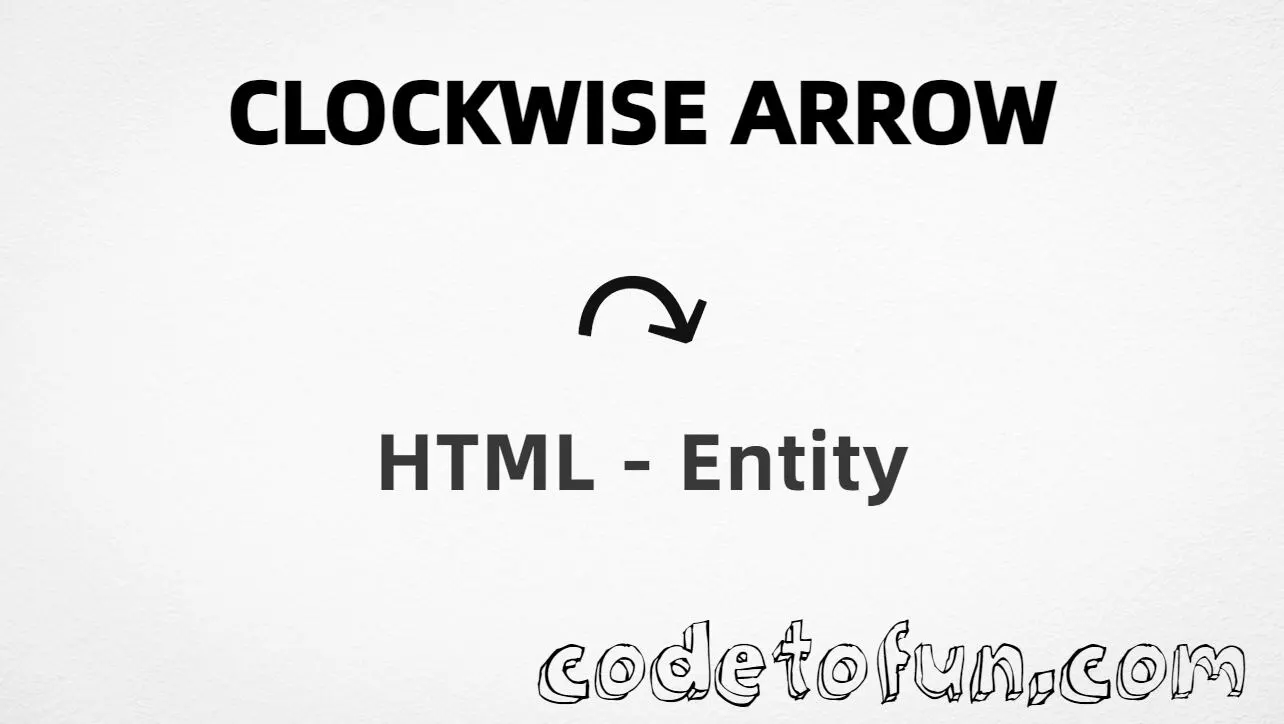
Clockwise Arrow (↷) is the Unicode character at U+21B7 in the Arrows block (official name: CLOCKWISE TOP SEMICIRCLE ARROW). It is a curved arrow used for rotate, redo, refresh, and “continue” cues in text and simple UI labels.
Remember
Character     ↷
Unicode       U+21B7
Hex entity    ↷
Decimal       ↷
Named entity  ↷
CSS escape    \21B7
All of these produce the same glyph: ↷. Prefer ↷ or a typed ↷ in hand-written HTML; use numeric forms when generating markup.
Clockwise arrow rendered in common writing contexts.
Inline text↷ Rotate image
Large glyph↷
Compared↷ ↻ ↺
Monospaceaction: ↷ redo
With entitiesNamed: ↷ | Hex: ↷ | Decimal: ↷
Code
Complete HTML Example
One page that shows Clockwise Arrow with the named entity, hex entity, decimal entity, CSS escape, and a typed character. Use View Output or open the live editor.
Named + Hex + Decimal + CSS + Typed
Five ways to produce ↷ in a single document.
html
<!DOCTYPE html>
<html lang="en">
<head>
<meta charset="UTF-8">
<title>Clockwise Arrow (↷) in HTML</title>
<style>
#point::after {
content: "\21B7";
}
</style>
</head>
<body>
<p>Clockwise Arrow using Named Entity: ↷</p>
<p>Clockwise Arrow using Hex Code: ↷</p>
<p>Clockwise Arrow using HTML Code: ↷</p>
<p id="point">Clockwise Arrow using CSS Entity: </p>
<p>Typed directly: ↷</p>
</body>
</html>
Clockwise Arrow using Named Entity: ↷
Clockwise Arrow using Hex Code: ↷
Clockwise Arrow using HTML Code: ↷
Clockwise Arrow using CSS Entity: ↷
Typed directly: ↷
How It Works
1. Named:↷ is the HTML5 named reference for U+21B7 → ↷.
2. Hex:U+21B7 → ↷ in HTML. Same glyph as the named form.
3. Decimal: same code point as 8631 → ↷. Same result as hex.
4. CSS: use \21B7 in content (not an HTML entity). #point::after appends that ↷ after the paragraph text.
5. Typed ↷: fine in UTF-8 pages. All five lines show the same glyph.
Pitfalls & Tips
Common mistakes when working with Clockwise Arrow entities.
Named
Use ↷
That is the named form for ↷. Always end with ;.
CSS vs HTML
Do not mix escapes
\21B7 belongs in CSS. ↷ / ↷ / ↷ belong in HTML.
↷ vs ↻
Different characters
↷ is U+21B7. Full open-circle ↻ is U+21BB (↻).
A11y
Do not rely on the glyph alone
Pair ↷ with text (or an accessible name) so screen-reader users get the same meaning — e.g. “Rotate”.
Semicolon
End references
Always finish with ; — write ↷ and ↷, not bare forms.
Icons
Glyph vs SVG
For polished buttons and animation, an SVG icon is often clearer than a Unicode arrow alone.
Compatibility
Browser Support
Clockwise Arrow (U+21B7) and its entity forms (↷, ↷, ↷, CSS \\21B7) are supported in all mainstream browsers.
✓ Universal support
Clockwise Arrow (↷)
Type ↷, or encode with named, hex, decimal, or CSS escape — same glyph everywhere encoding is supported.
100%Browser coverage
Google ChromeSupported
Yes
Microsoft EdgeSupported
Yes
Mozilla FirefoxSupported
Yes
Apple SafariSupported
Yes
OperaSupported
Yes
Internet ExplorerAll versions
Yes
U+21B7 / entitiesFull support
Bottom line: Prefer ↷ or a typed ↷ for rotate/redo cues. Use decimal when generating markup, and \\21B7 only inside CSS content.
Remember
Key Takeaways
Unicode: clockwise arrow is U+21B7 (decimal 8631).
HTML: prefer ↷ (also ↷, ↷).
CSS: use \21B7 inside content for generated text.
Watch out: ↷ ≠ ↻ (top semicircle ≠ open circle arrow).
Use ↷ (hex), ↷ (decimal), ↷ (named), or the CSS escape \21B7 in the content property. All render ↷. You can also paste ↷ directly when your file is UTF-8.
U+21B7 (hex 21B7, decimal 8631). Unicode names it CLOCKWISE TOP SEMICIRCLE ARROW. It belongs to the Arrows block.
Yes. ↷ is the HTML5 named reference for ↷. Numeric forms ↷ and ↷ also work.
Use it for rotate, redo, refresh, or “continue forward” cues in UI copy and diagrams. Prefer SVG icons when you need precise control over size, color, and animation.
HTML entities (↷, ↷, or ↷) go in markup. The CSS escape \21B7 goes in stylesheet strings (usually content on ::before/::after).
↷ (U+21B7 / ↷) is a top-semicircle clockwise arrow. ↻ (U+21BB / ↻) is a full open-circle clockwise arrow. They look related but are different characters.
🤔
Did you know?
Clockwise arrow is Unicode U+21B7 (decimal 8631) — official name CLOCKWISE TOP SEMICIRCLE ARROW in the Arrows block. HTML named reference is ↷. It is not the full circle arrow ↻ (U+21BB / ↻).