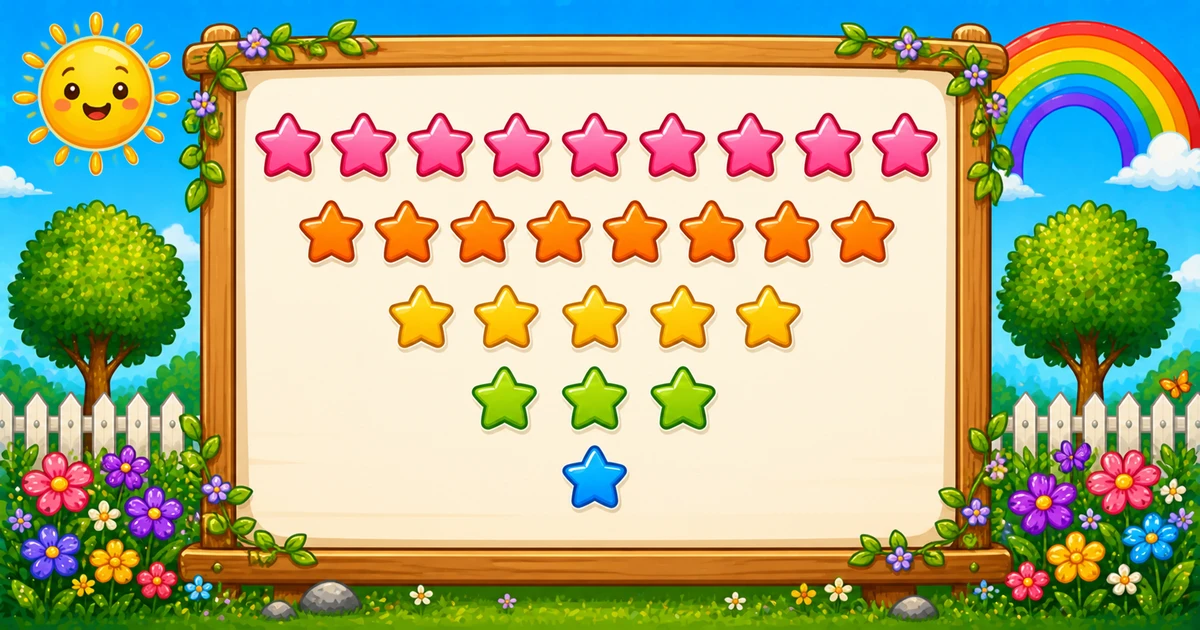
An inverted center-aligned pyramid prints the widest odd-width star row first, then narrows to a single tip star — with leading spaces so each shorter row stays centered.
Remember
Rule: for i from rows down to 1,
      print (rows - i) spaces, then (2 * i - 1) stars

*********
 *******
  *****
   ***
    *     ← 5 rows (base on top)
It is the flip of Program 5: keep the same space and star formulas, reverse only the outer loop. That mirrors how Program 2 inverts Program 1, but with odd-width centering.
Approach
How to Solve It
Two ways to emit the same shape — start with nested loops, then optionally shorten with String.repeat.
Method
Idea
Best for
Nested loops
Countdown i; spaces then odd stars via line +=
Learning, interviews, exams
String.repeat
Build margin and star run in one expression
Shorter demos once formulas click
Pseudocode
Pseudocode
for i from rows down to 1:
    line = ""
    for j from 1 to (rows - i):
        line += " "
    for k from 1 to (2 * i - 1):
        line += "*"
    print line
Cheat sheet
Goal
Pattern
Countdown rows
for (let i = rows; i >= 1; i--)
Leading spaces
for (let j = 1; j <= rows - i; j++) line += " ";
Odd star run
for (let k = 1; k <= 2 * i - 1; k++) line += "*";
End the row
console.log(line);
First printed row
0 spaces + 2 * rows - 1 stars
One-line shortcut
console.log(" ".repeat(rows - i) + "*".repeat(2 * i - 1));
Change the height and the inverted pyramid updates instantly — including the star total (n²).
Whole numbers from 1 to 14. Tap a chip or type a value — the preview redraws as you go.
Live result5 rows · 25 stars
*********
 *******
  *****
   ***
    *
Trace
Worked Walkthrough — rows = 4
Trace spaces, stars, and the printed line as i counts down from 4 to 1.
i
Spaces rows - i
Stars 2*i - 1
Printed row
4
0
7
*******
3
1
5
*****
2
2
3
***
1
3
1
*
Star total: 7 + 5 + 3 + 1 = 16 = 4² — same as Program 5, only the print order differs. That square sum is why time is O(n²).
Code
JavaScript Programs
Three complete programs: fixed rows, prompt input, and a String.repeat shortcut. Use View Output for sample results, or Try It Yourself to edit and run in the playground.
Example 1 — Fixed rows = 5
Hard-coded height — countdown outer loop with space and star inner loops.
JavaScript
let rows = 5;

for (let i = rows; i >= 1; i--) {
  let line = "";
  for (let j = 1; j <= rows - i; j++) {
    line += " ";
  }
  for (let k = 1; k <= 2 * i - 1; k++) {
    line += "*";
  }
  console.log(line);
}
1. Set height.rows = 5 means five lines from base to tip.
2. Outer loop counts down.i runs from rows down to 1 — widest row first. Start a fresh line = "" each time.
3. Spaces, then stars. Append rows - i spaces, then 2 * i - 1 stars with line +=.
4. Print the row.console.log(line) after both inner loops starts the next row.
When i = 5 you get 0 spaces and 9 stars; when i = 1 you get 4 spaces and 1 star.
Example 2 — User Input Version
Read the height at runtime with prompt. Prefer validating with Number.isFinite (shown in the tip below).
JavaScript
let rows = parseInt(prompt("Enter the number of rows:"), 10);

for (let i = rows; i >= 1; i--) {
  let line = "";
  for (let j = 1; j <= rows - i; j++) {
    line += " ";
  }
  for (let k = 1; k <= 2 * i - 1; k++) {
    line += "*";
  }
  console.log(line);
}
1. Prompt and parse. Ask for a row count, then convert with parseInt(..., 10).
2. Same countdown core. Only the source of rows changes — the space and star logic matches Example 1.
3. Safer input tip. Bare parseInt yields NaN on letters or Cancel. Prefer:
Safer input
let rows = parseInt(prompt("Enter the number of rows:"), 10);
if (!Number.isFinite(rows) || rows < 1) {
  console.log("Enter a positive whole number.");
} else {
  // run the pattern loops here
}
Example 3 — String.repeat for Spaces and Stars
Build each margin and odd star run in one expression — same shape, no explicit character loops.
JavaScript
let rows = 5;

for (let i = rows; i >= 1; i--) {
  console.log(" ".repeat(rows - i) + "*".repeat(2 * i - 1));
}
1. Same countdown. Still walk i from rows down to 1.
2. Build each segment." ".repeat(rows - i) is the margin; "*".repeat(2 * i - 1) is the star run.
3. Learn loops first. Use Examples 1–2 when you need to show nested bounds; treat this as a polish shortcut afterward.
Edge Cases & Pitfalls
Check these before calling the solution done.
i++
Upright pyramid by mistake
If you increment i from 1 to rows, you reprint Program 5. Use i-- from rows down to 1.
Tabs
Broken centering
Always append the space character " ", not tabs — tab width varies and skews the tip.
console.log inside
Column of stars
If console.log is inside either inner loop, each character lands on its own line. Use line += for spaces and stars; log only after both loops.
rows = 1
Single tip star
Output is just * — base and tip coincide. A good sanity check.
rows ≤ 0
Empty output
Outer loop never runs. Validate before looping for interactive programs.
Bad prompt
Guard against NaN
Cancel or letters yield NaN — check Number.isFinite(rows) before looping.
Analysis
Time and Space Complexity
Program
Time
Extra space
Nested loops (Examples 1–2)
O(rows²)
O(rows) for the line string
String.repeat (Example 3)
O(rows²)
O(rows) per temporary row string
Total stars = 1 + 3 + … + (2n - 1) = n², plus up to Θ(n) spaces per row — still quadratic in n. Same totals as Program 5.
Remember
Key Takeaways
Rule: countdown i; append rows - i spaces then 2 * i - 1 stars.
Flip of Program 5: same formulas — only reverse the outer loop.
Break the row: call console.log only after both space and star loops.
Complexity:O(n²) time from n² stars; O(n) for the row string.
One line: for i from rows down to 1, append rows - i spaces and 2 * i - 1 stars, then console.log(line).
Frequently Asked Questions
The outer loop runs i from rows down to 1. Stars still use 2*i-1, so large i prints many stars first. As i shrinks, stars become 9,7,5,… and spaces (rows-i) grow from 0 upward. Same formulas as Program 5 — only the order of i changes.
Spaces use (rows-i). When i is rows, the margin is 0; when i is 1, the margin is rows-1. As i steps down, the margin grows while 2*i-1 shrinks, which keeps shorter rows centered under the wide top.
Program 5 uses for (let i = 1; i <= rows; i++) so stars grow. Program 6 uses for (let i = rows; i >= 1; i--) with the same inner loops, so the base prints first and the tip last.
Program 2 is an inverted left-aligned triangle (i stars, no centering). Program 6 keeps (rows-i) spaces and odd star runs so the tip stays centered.
line += stays on the same row with no newline between characters. console.log(line) ends the row after both inner loops finish.
O(n²) for n rows. Same totals as Program 5; only iteration order differs. Total stars equal n².
Yes. With the countdown outer loop: console.log(' '.repeat(rows - i) + '*'.repeat(2 * i - 1)).
Use parseInt(prompt(...), 10) and check Number.isFinite(rows) && rows >= 1 so bad input does not produce NaN rows.
🤔
Did you know?
This inverted pyramid is exactly Program 5 with the outer loop reversed — same formulas, different print order. Total stars still equal n².