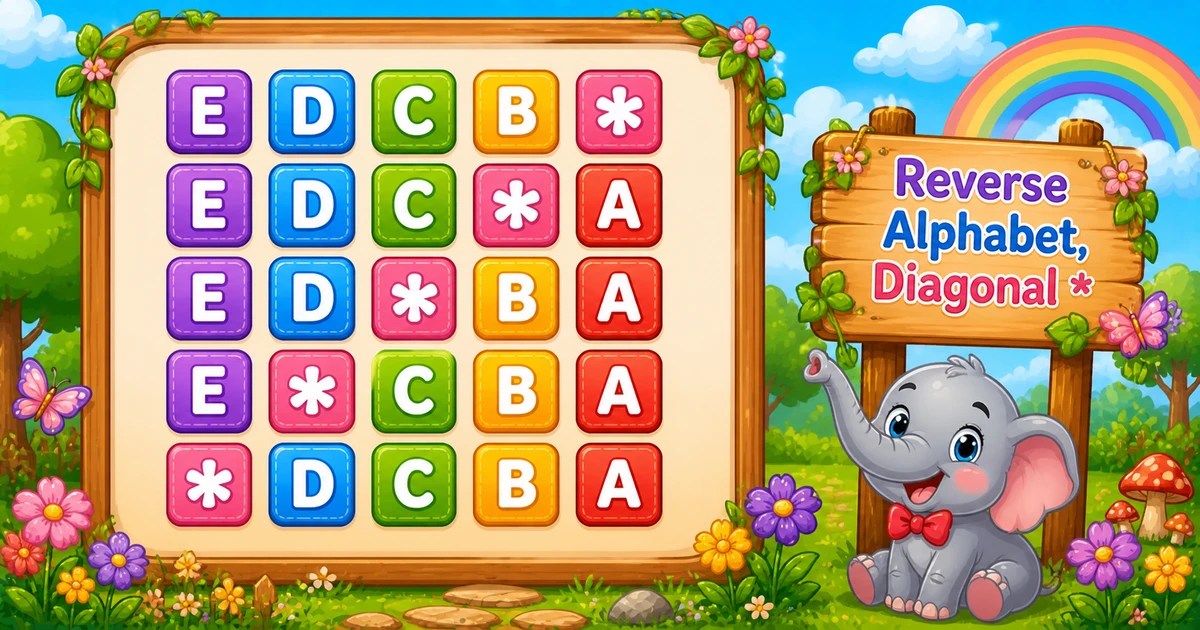
A reverse alphabet diagonal-star pattern prints the reverse run top…A on every row, but replaces exactly one character with * where i === j. The star slides right → left.
Remember
Rule: each row is top…A; print * when i === j

EDCB*
EDC*A
ED*BA
E*CBA
*DCBA     ← top = E
Outer loop walks row keys A…top; inner loop walks columns top…A. One tiny condition turns a flat reverse grid into a moving diagonal.
Approach
How to Solve It
Build an n×n character grid. For each cell, print * or the column letter based on i === j.
Method
Idea
Best for
Reverse + diagonal
Inner j from top…A; star when i === j
This pattern (star slides right → left)
Forward + diagonal
Inner j from A…top; same i === j test
Star slides left → right
Pseudocode
Pseudocode
base = code of 'A'
top  = code of peak letter
for i from base to top:
    line = ""
    for j from top down to base:
        if i == j:
            append '*'
        else:
            append fromCharCode(j)
    print line
Cheat sheet
Goal
Pattern
Row key
for (let i = base; i <= top; i++)
Reverse columns
for (let j = top; j >= base; j--)
Diagonal star
line += (i === j) ? "*" : String.fromCharCode(j);
End the row
console.log(line);
Top from rows
const top = "A".charCodeAt(0) + rows - 1;
Forward twin
Inner loop A…top → star slides left to right
Printing Letters vs Starting a New Line
API
Effect
Use for
line += ch
Stays on the same row
Each letter or *
console.log(line)
Ends the current row
After the inner loop
Append without a newline, then end the row once.
Try it
Live Preview
Change the size (top letter) and the diagonal-star grid updates instantly.
Whole numbers from 1 to 10. Size n means top letter = A + n - 1. Tap a chip or type a value — the preview redraws as you go.
Live result5×5 · top E
EDCB*
EDC*A
ED*BA
E*CBA
*DCBA
Trace
Worked Walkthrough — top = D (4×4)
Trace each row key i and where i === j places the star.
i
Star at column
Printed row
A
rightmost (j = A)
DCB*
B
one left
DC*A
C
one more left
D*BA
D
leftmost (j = D)
*CBA
Each of n rows prints n characters → n² total work, so time is O(n²).
Code
JavaScript Programs
Three complete programs: fixed top E, prompt for top letter, and a forward diagonal variant. Use View Output for sample results, or Try It Yourself to edit and run in the playground.
Example 1 — Fixed Top E
Outer i runs A..E. Inner j runs E..A. When i === j, append *; otherwise append the column letter.
JavaScript
const base = "A".charCodeAt(0);
const top = "E".charCodeAt(0);

for (let i = base; i <= top; i++) {
  let line = "";
  for (let j = top; j >= base; j--) {
    if (i === j) {
      line += "*";
    } else {
      line += String.fromCharCode(j);
    }
  }
  console.log(line);
}
2. Outer loop picks the row key.i walks A..E — the letter that will become * on that row.
3. Inner loop prints reverse columns.j walks E..A. When i === j, append *; else append fromCharCode(j).
4. Break the line.console.log(line) after the inner loop finishes.
Row i = A matches the rightmost column → EDCB*. By i = E, the star is leftmost → *DCBA.
Example 2 — Top Letter Input
Read the top letter at runtime. Validate a single A–Z character from prompt().trim().toUpperCase().
JavaScript
const raw = (prompt("Enter the top letter (like E):") || "").trim().toUpperCase();
const base = "A".charCodeAt(0);

if (!/^[A-Z]$/.test(raw)) {
  console.log("Please enter a single letter A-Z.");
} else {
  const top = raw.charCodeAt(0);

  for (let i = base; i <= top; i++) {
    let line = "";
    for (let j = top; j >= base; j--) {
      line += (i === j) ? "*" : String.fromCharCode(j);
    }
    console.log(line);
  }
}
1. Prompt and validate. Trim, uppercase, and require a single A–Z letter.
2. Same diagonal core. Only the bound top changes — with D you get a 4×4 grid and the star still slides right → left.
Example 3 — Forward A..E with Diagonal *
Flip the inner loop to A..E. The star now slides left → right on the main diagonal.
JavaScript
const base = "A".charCodeAt(0);
const top = "E".charCodeAt(0);

for (let i = base; i <= top; i++) {
  let line = "";
  for (let j = base; j <= top; j++) {
    line += (i === j) ? "*" : String.fromCharCode(j);
  }
  console.log(line);
}
1. Same diagonal rule. Still print * when i === j.
2. Flip column order. Inner loop walks A..E instead of E..A — letters go forward and the star travels left → right.
Comparing Examples 1 and 3 shows how inner-loop direction controls both letter order and which way the star moves.
Edge Cases & Pitfalls
Check these before calling the solution done.
wrong compare
No star / wrong diagonal
Use letter codes for both i and j. Comparing a row index (1..n) to a char code never matches cleanly.
log inside
Column of characters
Call console.log only after the inner loop. Logging inside splits one row across many lines.
Reuse line
Growing leftovers
Reset line = "" at the start of each outer iteration, or previous characters stick around.
top < A
Empty grid
If top < base, the outer loop never runs. Require a letter from A–Z.
top = A
Single *
Output is just * on one line — a good sanity check (1×1 grid).
Bad prompt
Validate one letter
Reject empty strings and multi-character input before using charCodeAt(0).
Analysis
Time and Space Complexity
Program
Time
Extra space
Reverse diagonal (Examples 1–2)
O(n²)
O(n) for the current line string
Forward diagonal (Example 3)
O(n²)
O(n) for the current line string
An n×n grid prints n characters per row across n rows — still quadratic in n.
Remember
Key Takeaways
Rule: each row is top…A; print * when i === j.
Diagonal: one star per row; reverse columns make it slide right → left.
Break the row: call console.log(line) only after the inner loop.
Complexity:O(n²) time for an n×n character grid.
One line: for each row key i, scan columns top…A and print * when i === j.
Frequently Asked Questions
i walks A…E down the rows while j scans E…A across columns (as letter codes). The condition i === j marks one diagonal position per row, which gets replaced by '*'.
Because i increases each row, but the printed letters go from E down to A across the row. The match i === j occurs at a different column each time, sliding the star left.
The star prints when i === j, so each row replaces exactly one character at the matching column.
Yes. Replace '*' with any symbol (like '#' or '@') in the conditional branch.
line += '*' or line += String.fromCharCode(j) stays on the same row. console.log(line) ends the row after the inner loop finishes.
You print forward letters instead of E…A, and the star slides the other way (left to right on the main diagonal).
O(n²) for an n×n letter grid because every row prints n characters.
Use prompt().trim().toUpperCase(), require a single A–Z character, and reject empty input. Cap at Z if you only want alphabetic ranges.
🤔
Did you know?
The diagonal is defined by i === j while the row prints letters from E down to A. Since i increases A..E each row, the star moves one position left each line: EDCB*, EDC*A, ED*BA, E*CBA, *DCBA.