Sequential Alphabet Triangle in JavaScript

Beginner
⏱️ 8 min read
📚 Updated: Aug 2026
🎯 3 Code Examples
🚀 Live Preview
Nested Loops

What You’ll Learn

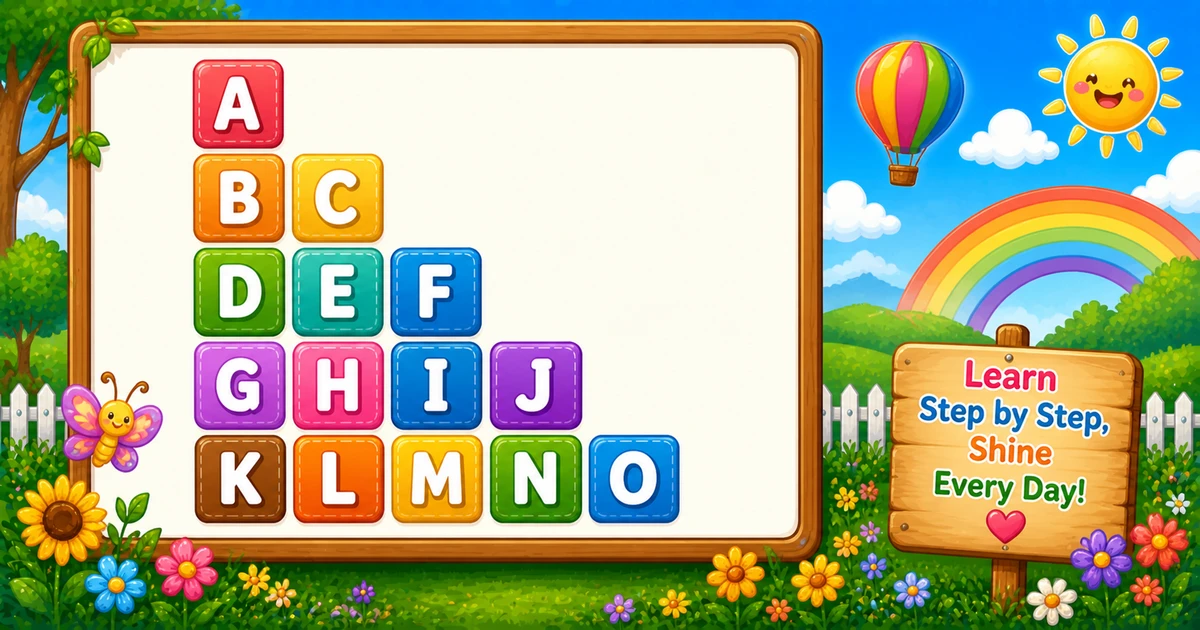
Each row is wider than the last, but letters stay in order across the whole shape: A, then B C, then D E F, up to K L M N O for five rows. This differs from Program 1 (letters reset per row); here one counter walks the alphabet continuously. Includes a live preview, worked JavaScript examples, edge cases, and complexity.

Shape Rule

Grow width, keep sequence

Row i prints i consecutive letters from a running counter.

Running Char

Never reset

code = "A".charCodeAt(0) lives outside the outer loop and advances across rows.

Inner Loop

Print then code++

Each cell prints String.fromCharCode(code), optionally a space, then code++.

line vs console.log

Same line / next line

Letters use line += ch; end each row with console.log(line).

Live Preview

1–7 rows

Pick a row count and draw the sequential triangle in the browser.

O(n²)

Complexity

Total letters = n(n+1)/2; extra memory stays O(1).

Introduction

A sequential alphabet triangle grows by one letter on each new line, but the alphabet does not restart. Letters flow continuously: the last letter on one row is followed by the next letter on the next row.

In JavaScript you usually solve it with nested for loops plus a third variable code that increments after every print. Optional spaces between letters make the output easier to read.

Why it matters?

It is the classic “running counter” pattern. Once you can keep state across rows, many continuous fill patterns (letters, digits, or custom sequences) become straightforward.

Key Highlights

Continuous Letters

One code walks A, B, C… across the whole triangle.

Width Still Grows

Outer loop still prints 1, 2, 3, … letters per row.

Increment Per Cell

code++ belongs inside the inner loop, not after the row.

Not Program 1

Program 1 resets to A each row; this one never resets.

In short: start code = "A".charCodeAt(0), for each row print i letters with line += String.fromCharCode(code) then code++, and call console.log(line) after the row.

📝 Problem & Approach

Given a positive integer rows, print a left-aligned triangle of consecutive alphabet letters where row i has i letters and the sequence never resets.

JavaScript
// First 5 rows (with spaces)
// A
// B C
// D E F
// G H I J
// K L M N O

Inputs & Outputs

ItemTypeDescription
rowsintNumber of triangle lines. For A–Z only, keep rows(rows+1)/2 ≤ 26 (max 6 full rows, or 7 with overflow past Z).
Printed outputtextLeft-aligned consecutive letters; optional spaces between letters on a row.

Minimal workflow

Pseudocode
code = "A".charCodeAt(0)
for i from 1 to rows:
    for j from 1 to i:
        print String.fromCharCode(code) (no newline)
        if j < i: append space
        code++
    console.log the row

Approach comparison

ApproachIdeaBest for
Running codeOuter width + inner print/code++Learning and interviews
Integer indexch = String.fromCharCode("A".charCodeAt(0) + count); count++Same idea with an int counter

⚡ Quick Reference

GoalPattern
Start the sequencecode = "A".charCodeAt(0) (outside outer loop)
Grow row widthfor (let i = 1; i <= rows; i++)
Print next letterline += String.fromCharCode(code); code++
Space between lettersif (j < i) line += " "
End the rowconsole.log(line)
Reset-per-row styleSee Program 1 (A, AB, ABC, …)

📋 line vs console.log vs code++

Same triangle - different roles for each tool.

line += ch
same line

Prints a letter or space without moving to the next line

console.log(line)
new line

Ends the current row after all letters are printed

code++
next letter

Advances the running character after each cell

Learning tip
no reset

Do not set code = "A".charCodeAt(0) inside the outer loop

Context

When This Pattern Shows Up

Reach for a running counter when values must continue across rows.

  1. After Program 1

    Contrast reset-per-row letters with a continuous sequence.

  2. State across loops

    Practice keeping mutable state outside the outer loop.

  3. Digit / token fills

    Same idea works with numbers or any ordered token stream.

  4. Gateway to Program 14

    Next: odd-length rows that still start from A each time.

  5. Not a UI layout tool

    This is a console teaching pattern - not how you build modern app screens.

Key benefit: one small program that locks in continuous state across nested loops - a skill used far beyond alphabet demos.

🔮 Live Preview

Choose a row count between 1 and 7 and draw the sequential alphabet triangle in the browser (spaces between letters).

Try 5 (through O) or 4 (through J). Six rows stay in A–Z; seven needs 28 letters (past Z).

Live result
Press "Draw pattern".

Examples Gallery

Three complete JavaScript programs - fixed rows with spaces, prompt input, and a compact no-space variant. Click View Output to reveal sample console results, or Try it Yourself to run in the browser editor.

📚 Getting Started

Print five sequential rows with a running character and spaces.

Example 1 — Fixed rows = 5

Hard-coded height - ideal for first demos and screenshots.

JavaScript
let code = "A".charCodeAt(0);

for (let i = 1; i <= 5; i++) {
  let line = "";
  for (let j = 1; j <= i; j++) {
    line += String.fromCharCode(code);
    if (j < i) {
      line += " ";
    }
    code++;
  }
  console.log(line);
}
Try it Yourself

How It Works

code starts at "A".charCodeAt(0) and never resets. Row 1 builds A, row 2 builds B C, and so on. code++ after each letter keeps the sequence continuous.

📈 Practical Variant

Let the user choose the height at runtime.

Example 2 — User Input Version

Read rows and keep appending. Validate parseInt(prompt()) with Number.isFinite in real apps; cap rows for A-Z if needed.

JavaScript
const rowsInput = prompt("Enter the number of rows:");
let rows = parseInt(rowsInput, 10);
rows = Math.max(1, Math.min(rows, 7));
let code = "A".charCodeAt(0);

for (let i = 1; i <= rows; i++) {
  let line = "";
  for (let j = 1; j <= i; j++) {
    line += String.fromCharCode(code);
    if (j < i) {
      line += " ";
    }
    code++;
  }
  console.log(line);
}
Try it Yourself

How It Works

Same running-code core as Example 1; only the outer bound changes. For A-Z-only demos, stop when code > "Z".charCodeAt(0) or clamp so rows(rows+1)/2 ≤ 26.

⚡ Compact Style

Same sequence without spaces between letters.

Example 3 — No Spaces

Drop the space append for a denser triangle.

JavaScript
let code = "A".charCodeAt(0);

for (let i = 1; i <= 5; i++) {
  let line = "";
  for (let j = 1; j <= i; j++) {
    line += String.fromCharCode(code);
    code++;
  }
  console.log(line);
}
Try it Yourself

How It Works

Same continuous code++ logic as Example 1, without spaces between letters on a row. Great for denser console output; keep the spaced version when readability matters.

🧠 How the Algorithm Prints Rows

1

Set up

Use prompt() when reading input. Start code = "A".charCodeAt(0) before the outer loop.

Setup
2

Outer loop (width)

for (let i = 1; i <= rows; i++) decides how many letters this row prints.

1..n
3

Inner loop (cells)

Print String.fromCharCode(code), optional space, then code++ so the next cell gets the next letter.

code++
4

New line

console.log(line) ends the row; code keeps its value for the next row.

Break
=

Triangle complete

Total letters: 1+2+…+n = n(n+1)/2O(n²) time, O(1) extra memory.

🔎 Worked Walkthrough — rows = 5

Trace each outer-loop value of i and watch how code advances across the whole triangle.

icode before rowPrinted rowcode after row
1'A'A'B'
2'B'B C'D'
3'D'D E F'G'
4'G'G H I J'K'
5'K'K L M N O'P'

Total letter prints: 1 + 2 + 3 + 4 + 5 = 15 = 5×6/2 (A through O).

Use Cases

Where this tiny pattern (and its running counter) shows up beyond the homework prompt.

1. Continuous State Drill

Clearest demo that loop counters and printed values can be different variables.

Example: move code++ outside the inner loop and watch letters repeat.

2. Contrast with Program 1

Teach reset-per-row vs continuous-fill as a one-idea change.

Example: side-by-side A/AB/ABC vs A/BC/DEF.

3. Number Triangles

Swap code for an integer counter to print 1, 2 3, 4 5 6, …

Example: start n = 1 and print/increment the same way.

4. Formatting Variants

Add/remove spaces, or print commas, without changing the sequence logic.

Example: Example 3 drops spaces for a compact fill.

5. Complexity Intuition

Triangular totals make O(n²) concrete for beginners.

Example: 5 rows → 15 letters (A–O).

6. Alphabet Bounds Labs

Pair the pattern with a “stop at Z” or wrap policy.

Example: break when code > "Z".charCodeAt(0).

Pro Tip: say “one counter walks the alphabet; the outer loop only chooses how many to print” before coding - that story prevents resetting code each row.

Advantages

Why this pattern earns a spot after the repeating-letter triangles.

  1. 1. Instant Visual Feedback

    Wrong increment placement shows up immediately as repeated letters.

  2. 2. Minimal Concepts

    Only loops, one extra char, and console output.

  3. 3. Easy to Adapt

    Swap letters for digits or remove spaces with tiny edits.

  4. 4. O(1) Extra Memory

    Streaming output needs no storage beyond loop counters and code.

Pro Tip: keep code outside the outer loop; resetting it each row accidentally recreates Program 1’s shape with a different letter rule.

Usage Tips

Small habits that keep sequential-pattern code clean.

  1. 1. Name the Runner

    Use code or nextLetter for the sequence - keep i/j for row/column.

  2. 2. Validate prompt() input

    Avoid crashes when the user types letters instead of a number.

  3. 3. Increment Per Cell

    Put code++ inside the inner loop, after printing.

  4. 4. Watch the Alphabet Cap

    Six rows use 21 letters; seven need 28 - past Z unless you wrap/stop.

  5. 5. Dry-Run One Small n

    Trace rows = 3 (A / B C / D E F) on paper before coding larger demos.

Pro Tip: if every row starts with A, you almost certainly reset code inside the outer loop.

Common Pitfalls

Mistakes that commonly break sequential alphabet patterns.

  1. 1. Resetting code Each Row

    Setting code = "A".charCodeAt(0) inside the outer loop recreates a reset-style triangle.

    → Declare and initialize code once, before the outer loop.

  2. 2. Incrementing Only Once Per Row

    Moving code++ after the inner loop repeats the same letter across the row.

    → Increment inside the inner loop after each print.

  3. 3. console.log(line) Inside the Inner Loop

    Each letter lands on its own line - you get a column, not a triangle.

    → Use line += ch for letters; console.log(line) only after the inner loop.

  4. 4. Blind parseInt(prompt())

    Non-numeric input yields NaN with bare parseInt(prompt()).

    → Validate parseInt(prompt()) with Number.isFinite and validate range.

  5. 5. Ignoring the Z Boundary

    Large rows walk past 'Z' into non-letter characters.

    → Cap rows or stop when code > "Z".charCodeAt(0) for A–Z demos.

Edge Cases

Check these inputs before calling the solution done.

rows = 1

Single letter

Output is just A on one line.

rows = 0

Empty pattern

Treat as invalid; re-prompt instead of silent empty output.

rows = 6

Last full A–Z fit

21 letters (A–U). Still inside A–Z.

rows = 7

Past Z

28 letters needed - define wrap/stop policy.

Bad input

Non-numeric input

Non-numeric input becomes 0 - check Number.isFinite first.

Case

Lowercase variant

Same loops work with code = "a".charCodeAt(0).

🎯 Practice Problems

Try these variations to lock in the pattern.

1. Compare with Program 1

  • Reset to A each row vs continuous code
  • See Program 1

2. Number version

  • Print 1 / 2 3 / 4 5 6 / …
  • Same loops, int counter

3. Stop at Z

  • Break when code > "Z".charCodeAt(0)
  • Partial last row is OK

4. Odd-length next

  • Continue to Program 14
  • Rows of length 1, 3, 5, …

Notes

  • Triangular count. Total letters for n rows is n(n+1)/2 - hence O(n²) time.
  • Keep code outside the outer loop; increment it inside the inner loop.
  • Spaces are optional formatting - they do not change the letter sequence.
  • Decide what happens past Z before accepting large row counts.

Quick Takeaway: outer loop picks the width, running code supplies consecutive letters, then break the line - that is the whole pattern.

⏱️ Time and Space Complexity

ProgramTimeExtra space
Nested loops (Examples 1-3)O(rows²)O(1)
Wrap Up

🎉 Conclusion

The sequential alphabet triangle is a small nested-loop exercise with lasting payoff: continuous state across rows, line += ch vs console.log(line), and O(n²) intuition. Master the running-code version, then optionally drop spaces for a compact fill.

Practice the three examples above, then continue to Program 14’s odd-length alphabet rows.

Keep code outside the outer loop, increment it per cell, and decide what happens after Z before accepting large row counts.

💡 Best Practices

✅ Do

  • Initialize code once before the outer loop
  • Increment code inside the inner loop after each print
  • Use line += String.fromCharCode(code) for letters and console.log(line) after each row
  • Check Number.isFinite after prompt()
  • State O(n²) time and the triangular letter count when asked

❌ Don’t

  • Reset code = "A".charCodeAt(0) on every outer iteration
  • Increment only once per row if you want per-cell sequences
  • Call console.log(line) inside the inner letter loop
  • Ignore the Z boundary for large row counts
  • Confuse this with Program 1’s reset-per-row rule

Key Takeaways

Knowledge Unlocked

Five things to remember about this alphabet pattern

Print the sequential triangle the beginner-friendly way.

5
Core concepts
A+ 02

Running char

Never reset between rows

Code
++ 03

Inner loop

Print then code++

Code
04

console.log(line)

Ends each row

I/O
O 05

Complexity

O(n²) time

Analysis

❓ Frequently Asked Questions

Because the letter code is updated after every appended character and is not reset inside the outer loop. That is what makes the sequence continuous across the triangle.
A single running character starts at A and increments after every append. Row 1 logs 1 character, row 2 logs 2, row 3 logs 3, so you see consecutive letters across the whole triangle.
Because each cell must use a new next letter. If you incremented only once per row, the wider rows would repeat the same letter.
line += String.fromCharCode(code) (and optional spaces) builds the full row string. console.log() inside the inner loop would log one letter per line. Log once after the inner loop finishes.
1+2+...+n = n(n+1)/2. For 5 rows that is 15 letters (A through O).
O(n^2) where n is the number of rows. Total logged letters equal n(n+1)/2.
Plain code++ continues past Z into later Unicode code points. Cap rows so n(n+1)/2 <= 26, or stop when code > "Z".charCodeAt(0), if you want A-Z only.
Use parseInt with Number.isFinite after prompt(), then clamp rows so the triangular letter count stays in range for your alphabet policy.

Did you Know? 🔊

Unlike Program 1 (letters reset to A each row), this pattern uses one running character that increments after every append. Letters stay consecutive across the whole triangle: A, then B C, then D E F, and so on.

Continue to Alphabet Pattern 14

Next up: odd-length rows (A, ABC, ABCDE, …) stepping the end letter by two.

Program 14 tutorial →

About the author

Mari Selvan M P
Mari Selvan M P 🔗

Developer, cloud engineer, and technical writer

  • Experience 12 years building web and cloud systems
  • Focus Full Stack Development, AWS, and Developer Education

I write practical tutorials so students and working developers can learn by doing—from databases and APIs to deployment on AWS.

12 people found this page helpful
