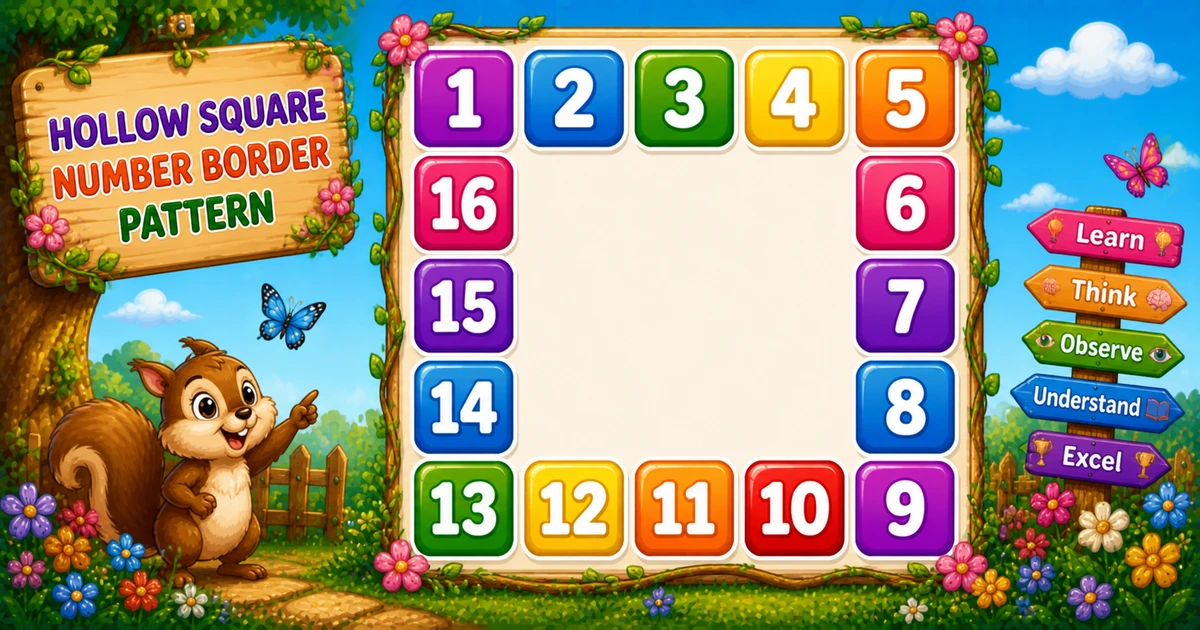
A hollow square border prints numbers only on the edges of an n × n grid. Interior cells are spaces — a hollow number frame.
Remember
Rule: print on border only
  top:    1 .. n
  right:  k++   (starts at n+1)
  bottom: l--   (starts at 3n−2)
  left:   m--   (starts at 4n−4)

1  2  3  4  5
16          6
15          7
14          8
13 12 11 10 9     ← n = 5
Order of checks matters: top → right → bottom → left. Corners belong to the first matching edge (top-left/top-right on the top row; bottom-right on the right column).
Approach
How to Solve It
Scan every cell; if it is on the border, print the next edge number — otherwise print spaces.
Method
Idea
Best for
Fixed n
Hard-coded counters for 5×5
Labs and demos
Scanner input
Compute k, l, m from n
Interactive practice
Sequential counter
One val++ on any border cell
Simpler logic (different order)
Pseudocode
Pseudocode
k = n + 1
l = 3*n - 2
m = 4*n - 4

for i from 1 to n:
    for j from 1 to n:
        if i == 1:      print j          // top
        else if j == n: print k; k++     // right
        else if i == n: print l; l--     // bottom
        else if j == 1: print m; m--     // left
        else:           print spaces     // interior
    new line
Cheat sheet
Goal
Pattern
Set size
int n = 5;
Start counters
k = n+1; l = 3*n-2; m = 4*n-4;
Top / right
i == 1 → j; j == n → k++
Bottom / left
i == n → l--; j == 1 → m--
Align columns
System.out.format("%-3d", value)
Interior
System.out.print(" ") (three spaces)
Printing Numbers vs Starting a New Line
API
Effect
Use for
System.out.print / format
Stays on the same line
Each cell (number or spaces)
System.out.println
Ends the line
After the inner j loop finishes
Build each row with print/format, then break once.
Try it
Live Preview
Change n and the hollow square border updates instantly (classic k/l/m sequence).
Whole numbers from 3 to 8. Tap a chip or type a value — the preview redraws as you go.
Live resultn = 5 · cells = 25
1  2  3  4  5
16          6
15          7
14          8
13 12 11 10 9
Trace
Worked Walkthrough — n = 3
Counters: k = 4, l = 7, m = 8. Trace each row left to right.
Row i
What prints
Printed row
1
Top: 1 2 3
1 2 3
2
Left m--=8, space, right k++=4
8 4
3
Bottom: 7 6 5 (right corner via k)
7 6 5
On the last row, the rightmost cell matches j == n first, so it uses k (here 5), then the remaining bottom cells use l--.
Code
Java Programs
Three complete programs: fixed 5×5, Scanner input, and a sequential border counter. Use View Output to reveal sample results.
Example 1 — Fixed n = 5
Hard-coded 5×5 — counters k=6, l=13, m=16 with a border if-else chain and %-3d.
Java
public class HollowSquareBorder {
    public static void main(String[] args) {
        int k = 6, l = 13, m = 16;

        for (int i = 1; i <= 5; i++) {
            for (int j = 1; j <= 5; j++) {
                if (i == 1)
                    System.out.format("%-3d", j);
                else if (j == 5)
                    System.out.format("%-3d", k++);
                else if (i == 5)
                    System.out.format("%-3d", l--);
                else if (j == 1)
                    System.out.format("%-3d", m--);
                else
                    System.out.print("   ");
            }
            System.out.println();
        }
    }
}
Output
1  2  3  4  5
16          6
15          7
14          8
13 12 11 10 9
How It Works
1. Top row. When i == 1, print j → 1 2 3 4 5.
2. Right, bottom, left.k++ down the right edge, l-- across the bottom, m-- up the left.
3. Interior. Everything else prints three spaces so columns stay aligned with %-3d.
Example 2 — Scanner Input
Same border logic; compute counters from n at runtime.
Java
import java.util.Scanner;

public class HollowSquareBorderInput {
    public static void main(String[] args) {
        Scanner sc = new Scanner(System.in);
        System.out.print("Enter size: ");
        int n = sc.nextInt();
        if (n < 1) return;

        int k = n + 1, l = 3 * n - 2, m = 4 * n - 4;

        for (int i = 1; i <= n; i++) {
            for (int j = 1; j <= n; j++) {
                if (i == 1) System.out.format("%-3d", j);
                else if (j == n) System.out.format("%-3d", k++);
                else if (i == n) System.out.format("%-3d", l--);
                else if (j == 1) System.out.format("%-3d", m--);
                else System.out.print("   ");
            }
            System.out.println();
        }
        sc.close();
    }
}
1. Formulas.k = n+1, l = 3n−2, m = 4n−4 scale the counters for any size.
2. Same edges. Only the source of n changes — the if-else chain matches Example 1.
3. Safer input tip. Prefer:
Safer input
if (!sc.hasNextInt()) {
    System.out.println("Enter a positive integer.");
    return;
}
int n = sc.nextInt();
if (n < 1) {
    System.out.println("Enter a positive integer.");
    return;
}
Example 3 — Sequential Border Counter
One val++ on any border cell — simpler code, different number order.
Java
public class HollowSquareBorderSimple {
    public static void main(String[] args) {
        int n = 5;
        int val = 1;

        for (int i = 1; i <= n; i++) {
            for (int j = 1; j <= n; j++) {
                boolean border = (i == 1 || i == n || j == 1 || j == n);
                if (border) System.out.format("%-3d", val++);
                else System.out.print("   ");
            }
            System.out.println();
        }
    }
}
Output
1  2  3  4  5
6           7
8           9
10         11
12 13 14 15 16
How It Works
1. Border test.i==1 || i==n || j==1 || j==n marks every edge cell.
2. Row-major count. Numbers increase left-to-right, top-to-bottom — not clockwise like Examples 1–2.
3. Same hollow shape. Interior still prints three spaces; only the sequence differs.
Edge Cases & Pitfalls
Check these before calling the solution done.
Wrong order
Corner ownership
Check top → right → bottom → left. Reordering assigns corners to the wrong counter.
Bad counters
Off-by-one edges
Use k=n+1, l=3n−2, m=4n−4. Wrong starts break the continuous sequence.
print vs format
Misaligned columns
Two-digit numbers need %-3d (or matching spaces). Plain print skews the frame.
n = 1
Single cell
Output is just 1 — all four edges collapse onto one cell.
n = 2
No interior
Every cell is on the border — the frame is solid with no hollow middle.
Bad input
Use hasNextInt
nextInt() throws on letters — prefer hasNextInt() and require a positive integer.
Analysis
Time and Space Complexity
Program
Time
Extra space
Examples 1–3
O(n²)
O(1)
You visit every cell of an n × n grid once → O(n²) time and constant extra memory.
Remember
Key Takeaways
Rule: print numbers on the border only; interior gets spaces.
Counters:k=n+1, l=3n−2, m=4n−4 for the classic clockwise sequence.
Align: use %-3d (or three spaces) so two-digit numbers stay in columns.
Complexity:O(n²) for size n.
One line: walk the square edge by edge with dedicated counters; leave the middle blank.
Frequently Asked Questions
Numbers only on the border of a square grid — interior cells are spaces, creating a hollow frame.
Each edge continues the sequence differently: k increments on the right, l and m decrement on the bottom and left.
Fixed-width formatting keeps columns aligned when numbers reach two digits.
Yes. Use k = n+1, l = 3n−2, m = 4n−4 — see Example 2.
Example 3 uses a simple border check and one counter — easier logic, but a different number order.
Non-border cells print three spaces — that creates the hollow interior.
O(n²) for an n×n grid because every cell is visited once.
Use sc.hasNextInt() before sc.nextInt() so bad input does not throw InputMismatchException.
🤔
Did you know?
Numbers print only on the border of an n×n grid. For n=5: top 1..5, right 6..9, bottom 13..9, left 16..14 — interior cells are spaces.