Python Star Cross Pattern (Over Zeros)
Definition
What Is This Pattern?
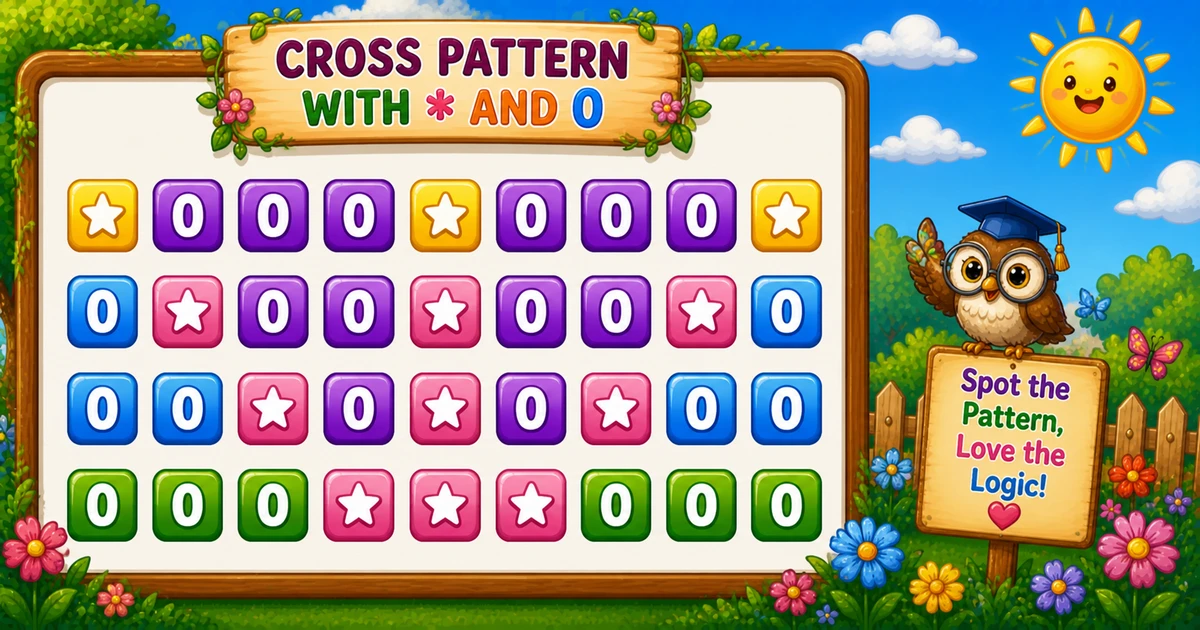
An X pattern of stars and zeros fills a rectangular grid: print * on both diagonals and the center column; print 0 everywhere else.
Rule: * if i==j or j==mid or i==cols+1-j; else 0

*000*000*
0*00*00*0
00*0*0*00
000***000   ← rows = 4, cols = 9
Follows the number diamond in Program 44; next is the concentric number square in Program 46.
Approach
How to Solve It
One nested loop over the grid, plus a three-way star condition.
| Method | Idea | Best for |
|---|
| Diagonals + mid | i==j / j==mid / anti-diagonal | Learning, interviews, exams |
| Sized grid | Same logic with rows, cols, mid | Practice / demos |
Pseudocode
mid = (cols + 1) / 2
for i from 1 to rows:
    for j from 1 to cols:
        if i == j or j == mid or i == cols + 1 - j:
            print "*"
        else:
            print "0"
    print newline
Cheat sheet
| Goal | Pattern |
|---|
| Walk rows / cols | for i in range(1, rows + 1): / for j in range(1, cols + 1): |
| Center column | mid = (cols + 1) // 2 |
| Star test | if i == j or j == mid or i == cols + 1 - j: |
| Print star / fill | print("*", end="") / print("0", end="") |
| End the row | print() |
Printing Numbers vs Starting a New Line
| API | Effect | Use for |
|---|
print("*", end="") / print("0", end="") | Stays on the same line | Each cell |
print() | Ends the current line | After the column loop finishes a row |
Print each cell without a newline, then end the row once.
Try it
Live Preview
Change the row count (width becomes 2 × rows + 1) and the X updates instantly.
Trace
Worked Walkthrough — rows = 4, cols = 9
mid = 5. Trace why key cells print *.
| Cell | Why *? | Row so far |
|---|
(1,1) | i == j (main diagonal) | * |
(1,5) | j == mid | *000* |
(1,9) | i == 10 - j | *000*000* |
(4,4)..(4,6) | diagonal + mid meet | 000***000 |
Every cell is decided once — total prints = rows × cols.
Code
Python Programs
Three complete programs: fixed 4×9, input() size, and diagonals-only contrast. Use View Output for sample results.
Example 1 — Fixed rows = 4, cols = 9
Hard-coded bounds with literals 5 and 10 - j.
for i in range(1, 5):
for j in range(1, 10):
if i == j or j == 5 or i == 10 - j:
print("*", end="")
else:
print("0", end="")
print()
*000*000*
0*00*00*0
00*0*0*00
000***000
How It Works
1. Grid walk. Outer i picks the row; inner j picks the column.
2. Star test. i == j (main), j == 5 (center), or i == 10 - j (anti-diagonal).
3. Fill. Everything else prints 0; bare print() ends each row.
Example 2 — User Input (rows & cols)
Read size, compute mid, and use cols + 1 - j for the anti-diagonal.
try:
    rows = int(input("Enter rows: "))
    cols = int(input("Enter cols (odd): "))
except ValueError:
    print("Please enter whole numbers.")
    raise SystemExit(1)

if rows < 1:
    print("Please enter a positive row count.")
    raise SystemExit(1)

if cols < 1 or cols % 2 == 0:
    print("Please enter a positive odd column count.")
    raise SystemExit(1)

mid = (cols + 1) // 2

for i in range(1, rows + 1):
    for j in range(1, cols + 1):
        if i == j or j == mid or i == cols + 1 - j:
            print("*", end="")
        else:
            print("0", end="")
    print()
How It Works
1. Validate size. Require positive rows and an odd cols so a true center column exists.
2. Same star rule. mid and cols + 1 - j replace the hard-coded 5 and 10 - j.
3. Safer input tip. Cap demos for a readable X:
if rows < 1 or rows > 6 or cols % 2 == 0 or cols < rows:
    print("Use rows 1–6 and odd cols >= rows.")
    raise SystemExit(1)
Example 3 — Diagonals Only
Drop the center-column check — a pure X without the vertical line.
for i in range(1, 5):
    for j in range(1, 10):
        if i == j or i == 10 - j:
            print("*", end="")
        else:
            print("0", end="")
    print()
*0000000*
0*00000*0
00*000*00
000*0*000
How It Works
1. Two tests only. Main diagonal i == j and anti-diagonal i == 10 - j.
2. Compare. The middle column of zeros shows what j == mid added in Example 1.
Edge Cases & Pitfalls
Check these before calling the solution done.
even colsEven column count
There is no single center column. Prefer odd cols so mid is exact.
0-basedLoops from 0 with 1-based formulas
If indices are 0-based, adjust to i == j, j == mid, and i + j == cols - 1.
andUse and instead of or
Almost no cells match all three tests at once. Border stars need or.
print() insideprint() inside the column loop
That puts every cell on its own line. Call bare print() only after the inner loop.
rows > colsMore rows than columns
The main diagonal exits the grid early. Keep rows <= cols for a clear X.
input()Catch ValueError
Bare int(input()) crashes on non-numeric text — wrap it in try/except ValueError.
Analysis
Time and Space Complexity
| Program | Time | Extra space |
|---|
| Fixed / diagonals (Examples 1, 3) | O(rows × cols) | O(1) |
| User input (Example 2) | O(rows × cols) | O(1) |
Every cell of the grid is visited once, so work is proportional to the product of rows and columns.
Remember
Key Takeaways
Rule: * on main diagonal, anti-diagonal, and center column; 0 elsewhere.
Size: prefer odd cols; mid = (cols + 1) // 2; anti-diagonal uses cols + 1 - j.
end="" vs print(): each cell stays on the line; bare print() advances after each row.
Complexity: O(rows × cols) time; O(1) extra space.
One line: visit every cell; print * on the X and center, 0 everywhere else.
Frequently Asked Questions
An X-style grid: * on both diagonals and the center column, with 0 filling the remaining cells (classic demo: 4×9).
With cols = 9, mid = (cols + 1) // 2 = 5. Checking j == mid draws the vertical center line.
Main diagonal: i == j. Anti-diagonal: i == cols + 1 - j (for cols = 9 that is i == 10 - j).
Program 44 prints a centered number diamond. Program 45 prints a rectangular * / 0 grid using diagonal and center conditions.
Use rows and cols variables, compute mid = (cols + 1) // 2, and use cols + 1 - j for the anti-diagonal — see Example 2.
O(rows × cols) because each cell is visited once.
Yes — drop the j == mid check for a pure X of diagonals only — see Example 3.
For 1-based indexing, row i meets column j on the anti-diagonal when i + j equals cols + 1.
Use try/except ValueError around int(input()) and require positive rows plus an odd cols — see Example 2.
🤔
Did you know?
Print * when i == j, j == mid, or i == cols + 1 - j; otherwise print 0. A rows × cols grid visits every cell once.
Next: Concentric Number Square
Print values that decrease toward the center and mirror back out (5..1..5).
About the author
Developer, cloud engineer, and technical writer
I write practical tutorials so students and working developers can learn by doing—from databases and APIs to deployment on AWS.
12 people found this page helpful

