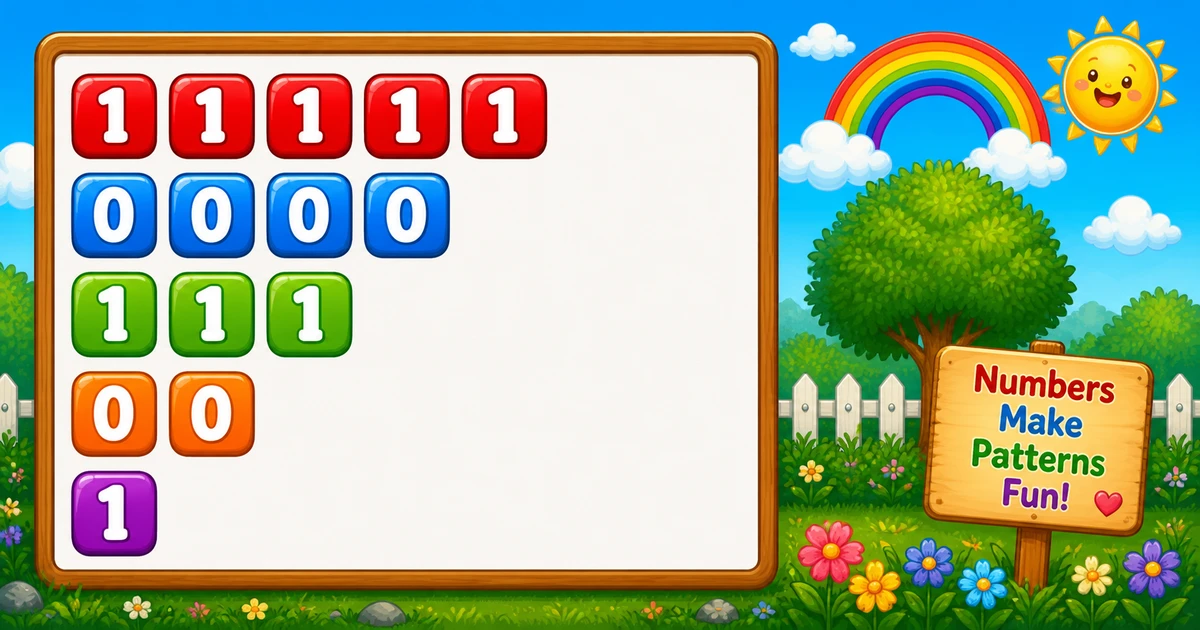
An alternating 1 and 0 pattern prints a shrinking triangle where odd rows are all 1s and even rows are all 0s, chosen with i % 2.
Remember
Rule: odd i → 1, even i → 0; length = rows - i + 1

11111
0000
111
00
1   ← 5 rows
Follows the rotating number pattern in Program 39; next is the square numbers pyramid in Program 41.
Approach
How to Solve It
One nested-loop idea driven by row parity — pick the digit once per row, then repeat it while the length shrinks.
Method
Idea
Best for
If/else + modulo
Even i → 0; odd i → 1
Learning, interviews, exams
print(i % 2)
Same parity check in one expression
Shorter demos
Pseudocode
Pseudocode
for i from 1 to rows:
    for j from i to rows:
        if i is even: print 0 else print 1
    print newline
Cheat sheet
Goal
Pattern
Walk each row
for i in range(1, rows + 1):
Shrink the row
for j in range(i, rows + 1):
Pick 1 or 0
print("0" if i % 2 == 0 else "1", end="")
Short form
print(i % 2, end="")
End the row
print()
Printing Numbers vs Starting a New Line
API
Effect
Use for
print(..., end="")
Stays on the same line
Each 1 or 0
print()
Ends the current line
After the inner loop
Print characters without a newline, then end the row once.
Try it
Live Preview
Change the row count and the alternating binary triangle updates instantly.
Whole numbers from 1 to 9. Tap a chip or type a value — the preview redraws as you go.
Live result5 rows · 15 chars
11111
0000
111
00
1
Trace
Worked Walkthrough — rows = 4
Trace parity and length. Odd rows use 1; even rows use 0.
i
Parity / count
Printed row
1
odd → 1 × 4
1111
2
even → 0 × 3
000
3
odd → 1 × 2
11
4
even → 0 × 1
0
Row length is rows - i + 1. The character depends only on i, not on j.
Code
Python Programs
Three complete programs: fixed height with if/else, input() with i % 2, and a compact rows = 3 demo. Use View Output to reveal sample results.
Example 1 — Fixed rows = 5
If/else on i % 2; each row repeats one digit while the length shrinks.
Python
rows = 5

for i in range(1, rows + 1):
    for j in range(i, rows + 1):
        if i % 2 == 0:
            print("0", end="")
        else:
            print("1", end="")
    print()
Output
11111
0000
111
00
1
How It Works
1. Outer loop.i grows from 1 to 5 — odd rows start with 1, even rows with 0.
2. Parity check.i % 2 == 0 means even → print 0; otherwise print 1.
3. Shrink. Inner range(i, rows + 1) prints rows - i + 1 characters, then bare print().
Example 2 — User Input Rows
Read rows with input(), validate, then use the short i % 2 form.
Python
try:
    rows = int(input("Enter rows: "))
except ValueError:
    print("Please enter a positive whole number.")
    raise SystemExit(1)

if rows < 1:
    print("Please enter a positive whole number.")
    raise SystemExit(1)

for i in range(1, rows + 1):
    for j in range(i, rows + 1):
        print(i % 2, end="")
    print()
Output (when user enters 3)
Enter rows: 3
111
00
1
How It Works
1. Prompt and validate. Catch ValueError; require rows >= 1 before printing.
2. Same core.print(i % 2, end="") matches Example 1 — odd prints 1, even prints 0.
3. Safer input tip. Cap demos for readable output:
Safer input tip
if rows < 1 or rows > 9:
    print("Enter a whole number from 1 to 9.")
    raise SystemExit(1)
Example 3 — Compact rows = 3
Same structure with only three rows — easy to confirm parity and shrinking length.
Python
rows = 3

for i in range(1, rows + 1):
    for j in range(i, rows + 1):
        if i % 2 == 0:
            print("0", end="")
        else:
            print("1", end="")
    print()
Output
111
00
1
How It Works
1. Same rules. Odd i → 1; even i → 0; length = rows - i + 1.
2. Quick check. The last row is a single 1.
3. Scale up next. Once the small demo is clear, use Examples 1–2 for five rows or user input.
Edge Cases & Pitfalls
Check these before calling the solution done.
grow instead
Loop j from 1 to i
That grows rows instead of shrinking them. Keep for j in range(i, rows + 1).
j % 2
Test j % 2 instead of i % 2
That flips inside a row (10101). The digit must depend on the row index i only.
print() inside
Broken rows
If bare print() sits inside the inner loop, you get one character per line. Call it only after the loop.
extra spaces
Accidental spacing
Default print(i % 2) adds a newline. Use end="" for tight digits.
rows = 1
Single digit
Output is just 1. A good sanity check for input validation.
input()
Catch ValueError
Bare int(input()) crashes on non-numeric text — wrap it in try/except ValueError.
Analysis
Time and Space Complexity
Program
Time
Extra space
Fixed / input (Examples 1–2)
O(n²)
O(1)
Compact rows = 3 (Example 3)
O(n²)
O(1)
Row lengths are n + (n−1) + … + 1 = n(n+1)/2 → O(n²) time. Only a few loop variables are needed.
Remember
Key Takeaways
Rule: odd i prints 1; even i prints 0.
Shrink: inner range(i, rows + 1) makes length rows - i + 1.
end="" vs print(): digits stay on the line; bare print() advances after each row.
Complexity:O(n²) time; O(1) extra space.
One line: for each row, pick 1 or 0 from i % 2 and repeat it while the row length shrinks.
Frequently Asked Questions
An alternating 1/0 triangle: for rows=5 you get 11111 / 0000 / 111 / 00 / 1 — odd rows are 1s, even rows are 0s, and each row shrinks by one.
It checks i % 2. When i is even, the row prints 0; when i is odd, the row prints 1.
The inner loop runs from j = i to rows, printing rows - i + 1 characters per row — decreasing from rows down to 1.
Print 1 - (i % 2) instead of i % 2, or swap the if/else outputs.
Program 39 rotates digits 1..rows per row. Program 40 prints only 1 or 0 per row based on parity, with shrinking row length.
Use print(i % 2, end=" ") instead of print(i % 2, end="").
Use try/except ValueError around int(input()) and require rows >= 1 — see Example 2.
O(n²) for n rows because total prints are 1 + 2 + … + n = n(n+1)/2.
🤔
Did you know?
Odd rows print 1, even rows print 0 — chosen with i % 2. Row i prints rows - i + 1 characters; total prints = n(n+1)/2.