Palindromic Number Pyramid in Python
What You’ll Learn
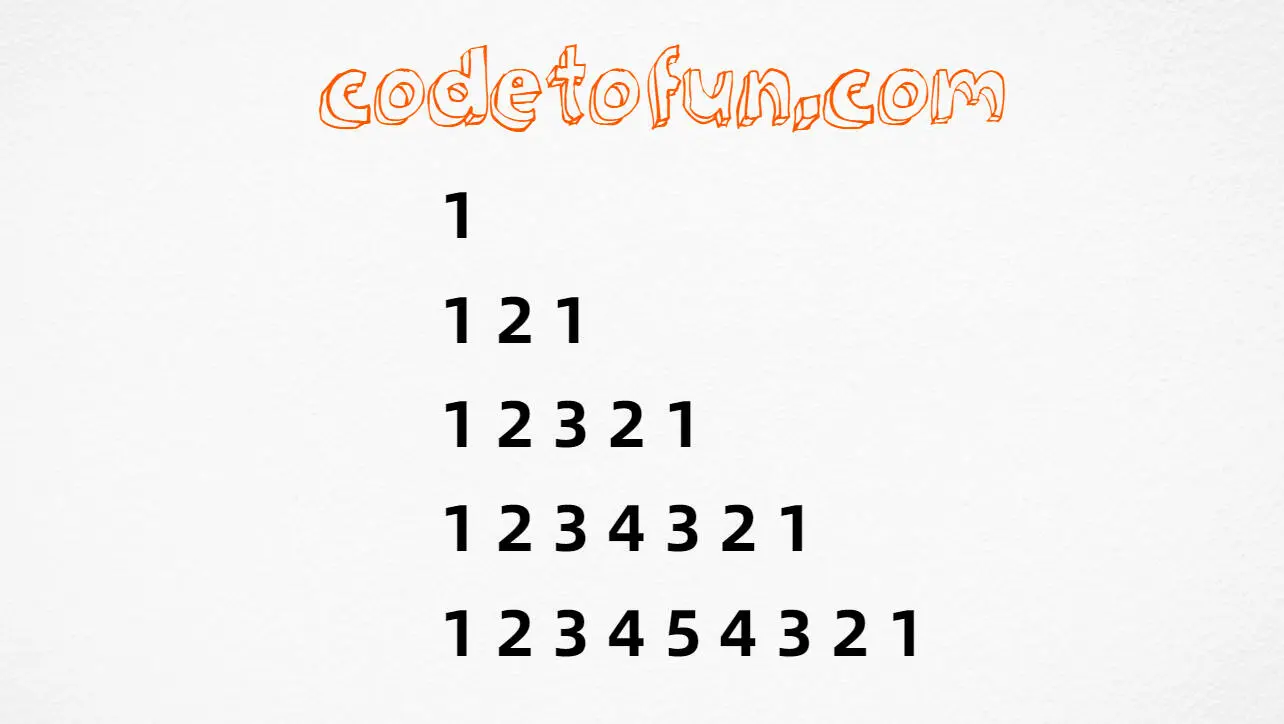
How to print a palindromic number pyramid in Python, where each row reads the same forward and backward:
1121123211234321123454321
The core idea is to print an increasing sequence, then print the decreasing sequence without repeating the peak.
⭐ Pattern Output
For 5 rows, the pattern looks like this:
1
121
12321
1234321
123454321Complete Python Program
The first inner loop prints ascending numbers, and the second prints descending numbers to form the palindrome.
for i in range(2, 7):
    for j in range(1, i):
        print(j, end="")
    for k in range(i - 2, 0, -1):
        print(k, end="")
print()🧠 How It Works
Outer loop controls the height
for i in range(2, 7) generates 5 rows (i = 2..6). Each row prints up to i - 1.
Print ascending part
for j in range(1, i) prints 1 through i - 1.
Print descending part
for k in range(i - 2, 0, -1) prints i - 2 down to 1, completing the palindrome without repeating the peak digit.
New line after each row
print() moves to the next row.
Palindromic rows
Each row has length \(2r-1\). Total digits printed across \(n\) rows is \(1+3+5+\dots+(2n-1)=n^2\), so overall time is O(n²).
Variation — User Input Version
Choose the number of rows at runtime. This keeps the same palindrome idea for any size.
rows = int(input("Enter the number of rows: "))

for i in range(2, rows + 2):
    for j in range(1, i):
        print(j, end="")
    for k in range(i - 2, 0, -1):
        print(k, end="")
print()💡 Tips for Enhancement
Try These
- Validate input (reject
rows < 1) before printing - Right-align or center the pyramid using leading spaces
- Add spaces between digits for readability (then update output)
- Replace numbers with letters to create alphabet palindromes
- Build the row as a string for faster printing in large patterns
Avoid
- Repeating the peak digit in the second loop (it breaks the palindrome)
- Forgetting
print()after each row - Mixing default print behavior with
end=""in the same row - Assuming user input is always valid (wrap
int()conversion if needed)
Key Takeaways
Print ascending digits first, then descending digits to form each palindrome row.
Start the descending loop at i - 2 to avoid repeating the peak digit.
Row lengths are odd: 1, 3, 5, ... up to \(2n-1\).
Total digits printed across \(n\) rows is \(n^2\), so runtime is O(n²).
❓ Frequently Asked Questions
i = 2 makes the first row print only 1 (since the ascending loop prints 1..i-1). That cleanly matches the pattern output.rows - r spaces first, then print the palindrome digits.chr(ord('A') + x) or similar. The ascending/descending structure remains the same.Explore More Python Number Patterns!
Keep practicing symmetry and nested loops with more number pattern programs.
Palindromic patterns are a great way to practice thinking in terms of “build left half, then mirror it”—the same idea used in many string and array problems.
About the author


12 people found this page helpful