Python Descending Number Triangle Pattern (Odd Length)
Beginner
5 min read
Updated: Sep 2026
3 programs
Live preview
Definition
What Is This Pattern?
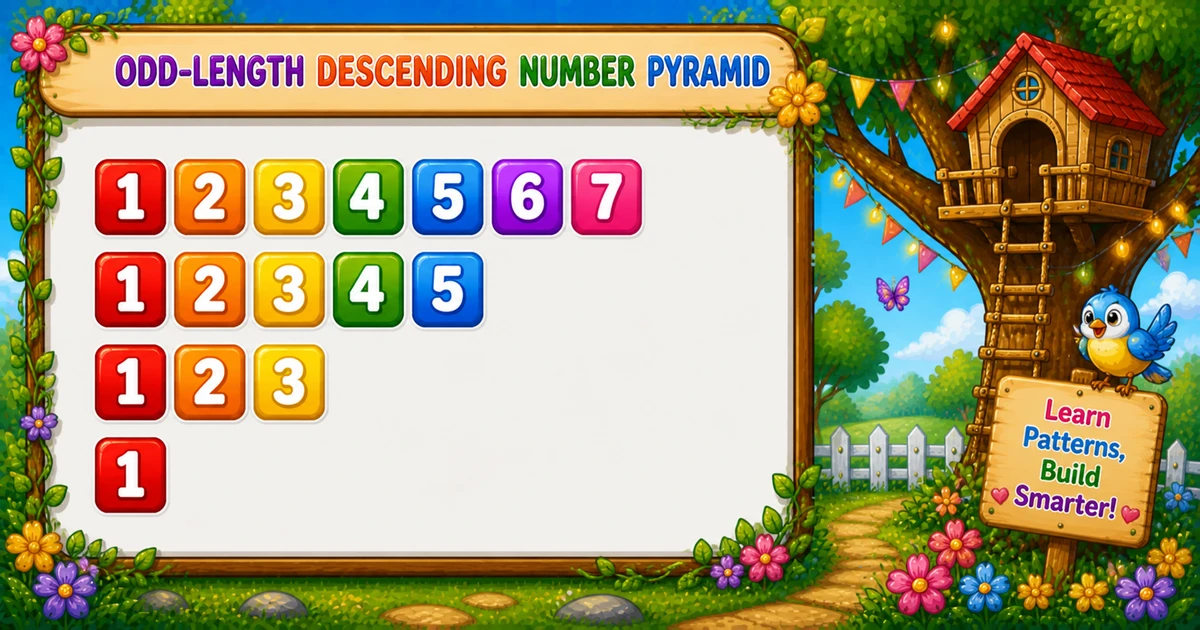
An odd-length descending number triangle prints ascending digits 1..i, but only for odd row widths — so you see 1234567, 12345, 123, 1.
Remember
Rule: for i = max..1 step -2, print 1..i

1234567
12345
123
1   ← max = 7
In Python you solve it with an outer loop that steps by 2: for i in range(max_n, 0, -2), an inner loop that prints each digit with print(j, end=""), then bare print() ends the row. Program 13 flips direction with i % 2; this pattern always ascends but skips even widths.
Approach
How to Solve It
Outer loop counts down from an odd max_n with step 2. Inner loop prints 1..i. End each row with print().
Method
Idea
Best for
Step by 2
Outer range(..., -2) visits only odd widths
Learning, interviews, exams
Every width
Same inner loop with range(..., -1) for comparison
Seeing what the custom step skips
Pseudocode
Pseudocode
for i from max down to 1 step 2:
    for j from 1 to i:
        print j (no newline)
    print newline
Cheat sheet
Goal
Pattern
Walk odd widths
for i in range(max_n, 0, -2):
Print 1..i
for j in range(1, i + 1): print(j, end="")
End the row
print()
Force odd max
if max_n % 2 == 0: max_n -= 1
Every width (compare)
for i in range(max_n, 0, -1):
Printing Numbers vs Starting a New Line
API
Effect
Use for
print(j, end="")
Stays on the same line
Each digit in 1..i
print()
Ends the current line
After the inner loop
Print all digits without a newline, then end the row once.
Try it
Live Preview
Change the maximum width and the odd-length triangle updates instantly — prefer odd values so the top row matches the classic demo.
Whole numbers from 1 to 9 (single digits). Odd values keep the classic odd-only shape.
Live resultmax = 7 · 16 digits
1234567
12345
123
1
Trace
Worked Walkthrough
Trace max_n = 7 — each outer-loop value of i, the inner range, and the printed row.
i
Inner j
Length
Printed row
7
1..7
7
1234567
5
1..5
5
12345
3
1..3
3
123
1
1..1
1
1
Total digits are 7+5+3+1 = 16 — for odd max n, that equals ((n+1)/2)².
Code
Python Programs
Three complete programs: fixed odd max, input(), and an every-width comparison. Use View Output for sample results.
Example 1 — Fixed max_n = 7
Hard-coded odd maximum — outer steps by 2, inner prints 1..i.
Python
max_n = 7

for i in range(max_n, 0, -2):
    for j in range(1, i + 1):
        print(j, end="")
    print()
2. Inner prints ascending digits.j runs from 1 to i with print(j, end="").
3. End the row. Call bare print() only after the inner loop finishes.
Example 2 — User Input
Read the maximum width from the keyboard. Prefer an odd value so the top row matches the classic demo.
Python
max_n = int(input("Enter an odd maximum (e.g. 9): "))

for i in range(max_n, 0, -2):
    for j in range(1, i + 1):
        print(j, end="")
    print()
Output (when user enters 5)
Enter an odd maximum (e.g. 9): 5
12345
123
1
How It Works
1. Same loop core. Only the source of max_n changes from a literal to keyboard input.
2. Entering 5 stops early. You get three odd-length rows ending at 1.
3. Safer input tip. Validate and force an odd top width:
Safer input
raw = input("Enter an odd maximum (e.g. 9): ").strip()
try:
    max_n = int(raw)
except ValueError:
    print("Enter a positive whole number.")
    raise SystemExit(1)
if max_n < 1:
    print("Enter a positive whole number.")
    raise SystemExit(1)
if max_n % 2 == 0:
    max_n -= 1
Example 3 — Every Width (range(..., -1))
Same inner loop with a normal step — includes even lengths for comparison.
Python
max_n = 7

for i in range(max_n, 0, -1):
    for j in range(1, i + 1):
        print(j, end="")
    print()
Output
1234567
123456
12345
1234
123
12
1
How It Works
1. Only the step changed.range(..., -1) visits every width; range(..., -2) in Example 1 skips the even ones.
2. Same inner rule. Digits still print 1..i with print(j, end="").
3. Compare side by side. Seeing both outputs makes the custom step easy to remember.
Edge Cases & Pitfalls
Check these before calling the solution done.
even max
Start with an odd maximum
An even start prints even lengths (6, 4, 2). Force odd with if max_n % 2 == 0: max_n -= 1.
wrong step
Use range(..., -2), not -1
range(..., -1) reprints the every-width triangle (see Example 3).
print(i)
print(i, end="") instead of print(j, end="")
That repeats the row length. This pattern prints the sequence value of j.
print() inside
Bare print(j) inside the inner loop
That puts each digit on its own line. Use print(j, end="") for digits; call bare print() only after the row finishes.
max = 1
Single digit
Output is just 1 — a good sanity check.
max ≤ 0
Empty output
The outer loop never runs. Validate and prompt again for clearer UX.
Analysis
Time and Space Complexity
Program
Time
Extra space
Odd widths (Examples 1–2)
O(n²)
O(1)
Every width (Example 3)
O(n²)
O(1)
For odd max n you print 1+3+…+n digits — about half of the full triangle, but still O(n²).
Remember
Key Takeaways
Rule: for odd i from max_n down by 2, print digits 1..i.
Custom step:range(..., -2) is what skips even row lengths.
end= vs print(): digits stay on the line; bare print() advances after each row.
Next step: Program 15 builds an alternating binary triangle with 0 and 1.
One line: step i down by 2 from an odd max, print 1..i with end="", then call print().
Frequently Asked Questions
The outer loop uses range(max_n, 0, -2), so it visits only odd widths: 7, 5, 3, 1. Even lengths like 6, 4, 2 are skipped.
Because the step of -2 skips even row lengths. After 1234567 (7 digits), the next row is 5 digits (12345), not 6.
print(j, end="") stays on the same line. print() ends the current line. Digits use end=""; the row break uses print() after the inner loop.
Program 13 alternates ascending/descending direction with i % 2 (12345, 4321, 123, 21, 1). Program 14 always prints 1..i but only for odd row lengths using a step of -2.
O(n²) where n is the maximum row width. You print about 1+3+5+…+n odd-width digits, which is still O(n²).
Subtract 1 to make it odd (e.g. if max_n % 2 == 0: max_n -= 1) so the first row stays odd-length, or document that even input shifts the pattern.
Wrap int(input()) in try/except ValueError, or check that the raw string is digits, and require max_n >= 1.
The outer loop never runs, so nothing is printed. Validate and prompt again if you want a clear user message.
🤔
Did you know?
Only odd-length rows print. The outer loop uses range(..., -2) (7, 5, 3, 1) and the inner loop prints 1..i — still O(n²) total digit prints for maximum width n.