Shape Rule
Palindrome row
Row $i prints $i down to 2, then 1 up to $i — a symmetric sequence.

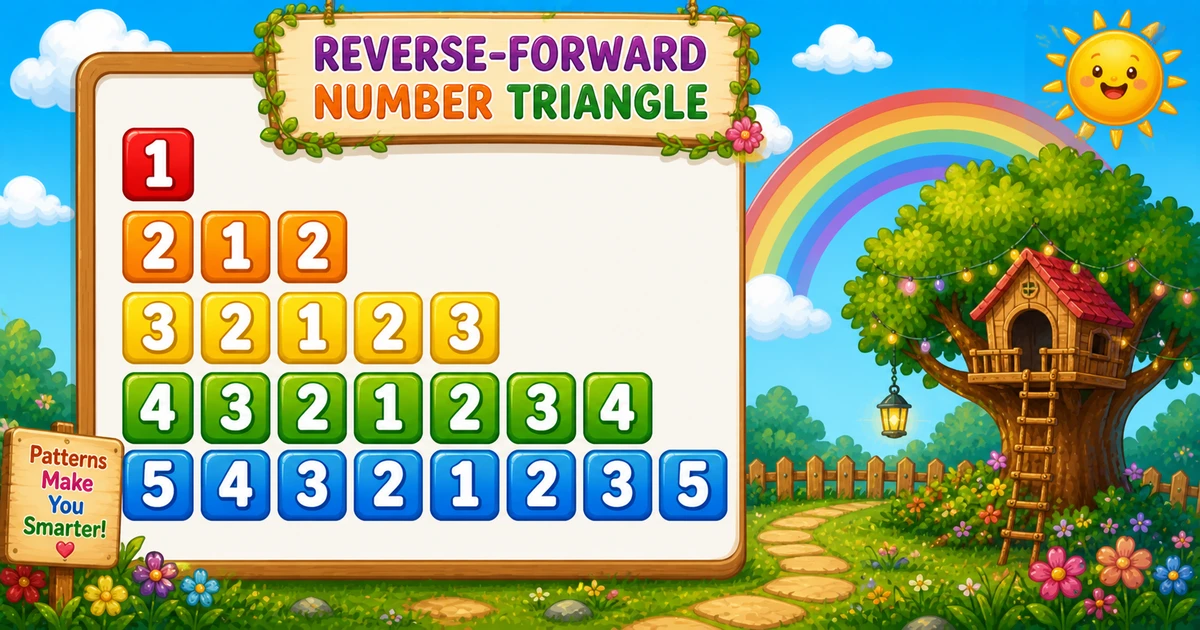
The palindrome number triangle prints 1, then 212, then 32123, … — a natural follow-up after Program 36’s right-aligned decreasing triangle. This tutorial covers descending and ascending inner loops, row symmetry, nested loops, a live preview, worked PHP examples, edge cases, and complexity.
Palindrome row
Row $i prints $i down to 2, then 1 up to $i — a symmetric sequence.
$i = 1..$rows
for ($i = 1; $i <= $rows; $i++) — one palindrome row per iteration.
$i..2
for ($j = $i; $j > 1; $j--) — prints the descending left side of the palindrome.
1..$i
for ($j = 1; $j <= $i; $j++) — completes the palindrome with ascending digits.
3–7 rows
Pick a row count and draw the palindrome number triangle in the browser.
Complexity
Digits per row = 2 * $i - 1 — total digits = n².
A palindrome number triangle prints a symmetric sequence on each row: 1, then 212, then 32123, and so on. With $rows = 5, each row reads the same forward and backward.
In PHP you use two inner loops per row: print $j from $i down to 2, then from 1 up to $i, then echo PHP_EOL.
It combines descending and ascending inner loops to build symmetry — a step after Program 36’s right-aligned decreasing pattern.
Left half.
Right half.
Digits per row.
Follow Program 36; continue to Program 38 next.
In short: outer $i = 1..$rows, desc $j = $i..2, asc $j = 1..$i, then echo PHP_EOL.
Given $rows = 5, print a palindrome number triangle: for each row $i, print descending $i..2 then ascending 1..$i.
// $rows = 5
//1
//212
//32123
//4321234
//543212345 | Item | Type | Description |
|---|---|---|
$rows | int | Triangle height — number of palindrome lines to print. |
$i | int | Outer loop — current row (1 to rows). |
$j | int | Inner loop — descending ($i..2) or ascending (1..$i). |
for i from 1 to rows:
for j from i down to 2: print j
for j from 1 to i: print j
print newline | Approach | Idea | Best for |
|---|---|---|
| Fixed rows | 1, 212, … | Learning and interviews |
| User-input rows | (int) trim(fgets(STDIN)); | Configurable triangle size |
| Compact trace | $rows = 3 on paper first | Debugging loop bounds |
| Goal | Pattern |
|---|---|
| Outer loop | for ($i = 1; $i <= $rows; $i++) |
| Left half (desc) | for ($j = $i; $j > 1; $j--) echo $j; |
| Right half (asc) | for ($j = 1; $j <= $i; $j++) echo $j; |
| End the row | echo PHP_EOL; |
| User input | (int) trim(fgets(STDIN)) |
Same palindrome triangle — different ways to control the row count.
$i = 1..$rowsOne palindrome row per iteration
$j = $i..2Descending digits
$j = 1..$iAscending digits
2 * $i - 1Digits per row
Reach for this pattern when teaching symmetry, dual inner loops, and palindrome construction in nested loops.
Natural follow-up — replaces right alignment with symmetric palindrome rows built from two inner loops.
Practice descending then ascending loops to build mirrored sequences on each row.
Combine loops with fgets(STDIN) and is_numeric() checks for flexible row counts.
Compare Program 36 (decreasing) and Program 38 (next in series) next.
This is a console teaching pattern — not how you build modern app screens.
Key benefit: one small program that locks in dual inner loops, formatted output, and O(n²) thinking.
Choose a row count between 3 and 7 and draw the palindrome number triangle in the browser.
Three complete PHP programs — fixed rows, user input, and a smaller trace demo. Click View Output to reveal sample console results.
Print five rows of the palindrome number triangle with descending and ascending inner loops.
$rows = 5Hard-coded row count — ideal for first demos and screenshots.
<?php
$rows = 5;
for ($i = 1; $i <= $rows; $i++) {
for ($j = $i; $j > 1; $j--) {
echo $j;
}
for ($j = 1; $j <= $i; $j++) {
echo $j;
}
echo PHP_EOL;
} When $i = 3, the first loop prints 3 2, the second prints 1 2 3 — output 32123. When $i = 1, only the ascending loop runs — output 1.
Read the row count with fgets(STDIN) instead of hard-coding 5.
Read $rows with (int) trim(fgets(STDIN)) after checking is_numeric().
<?php
echo "Enter rows: ";
$input = trim(fgets(STDIN));
if (!is_numeric($input)) return;
$rows = (int) $input;
if ($rows < 1) return;
for ($i = 1; $i <= $rows; $i++) {
for ($j = $i; $j > 1; $j--) {
echo $j;
}
for ($j = 1; $j <= $i; $j++) {
echo $j;
}
echo PHP_EOL;
} Same palindrome core as Example 1; only $rows comes from user input instead of being hard-coded as 5. Non-numeric input leaves $rows unset if you skip is_numeric() checks — always check it in safer labs.
Run with $rows = 3 to trace every row on paper before scaling up.
$rows = 3Same descending and ascending loops with a smaller row count for quick tracing.
<?php
$rows = 3;
for ($i = 1; $i <= $rows; $i++) {
for ($j = $i; $j > 1; $j--) {
echo $j;
}
for ($j = 1; $j <= $i; $j++) {
echo $j;
}
echo PHP_EOL;
} Only $rows changes from 5 to 3 — the two inner loops stay identical. Trace $i = 1, 2, 3 on paper to see how each row grows symmetrically.
Set $rows = 5; and use fgets(STDIN) when reading input. Set loop variables $i, $j.
for ($i = 1; $i <= $rows; $i++) — ascending outer loop; one palindrome row per iteration.
for ($j = $i; $j > 1; $j--) — prints $i, $i-1, ..., 2.
for ($j = 1; $j <= $i; $j++) — completes the palindrome: 1, 2, ..., $i.
echo PHP_EOL ends the row after both inner loops finish.
Digits per row = 2 * $i - 1 — total digits = n²; O(n²) time.
$rows = 5Trace each outer-loop value of $i, left and right halves, and full row output.
$i | Left half ($i..2) | Right half (1..$i) | Row output |
|---|---|---|---|
1 | — | 1 | 1 |
2 | 2 | 1, 2 | 212 |
3 | 3, 2 | 1, 2, 3 | 32123 |
4 | 4, 3, 2 | 1, 2, 3, 4 | 4321234 |
5 | 5, 4, 3, 2 | 1, 2, 3, 4, 5 | 543212345 |
Digits per row = 2 * $i - 1 — total digits = 1 + 3 + 5 + ... + (2n-1) = n².
Where this tiny pattern (and its loop structure) shows up beyond the homework prompt.
Clearest visual proof that outer and inner bounds interact.
Example: swap the ascending and descending loops and watch the palindrome break.
Foundation for symmetry-based patterns and mirrored sequences.
Example: compare with Program 36 (decreasing) and Program 38 next.
Practice concatenated digit output without spaces between numbers.
Example: add j + " " between digits for a spaced palindrome variant.
Add leading spaces for center alignment once the two-loop structure works.
Example: print rows - i spaces before the descending loop.
Triangular totals make O(n²) concrete for beginners.
Example: count digits for $rows = 5 — total is 1+3+5+7+9 = 25 = 5².
Pair the pattern with is_numeric($input) checks and positive-row validation.
Example: reject $rows <= 0 and re-prompt.
Pro Tip: when an interviewer asks for patterns, explain the outer/inner roles first — then write the loops. The story matters as much as the code.
Why this pattern earns a permanent spot in beginner PHP courses.
Wrong bounds show up immediately as a broken staircase.
Only loops and console output — no arrays or math libraries.
Invert, center, hollow, or change the fill character with small edits.
Streaming output needs no storage beyond loop counters.
Pro Tip: trace $i and both inner loops on paper for $rows = 3 before coding — watch how each row grows symmetrically.
Small habits that keep number-pattern code clean.
Descending loop ($j > 1) must run before ascending loop ($j <= $i).
is_numeric($input)Avoid undefined behavior when the user types letters instead of a number.
Only call echo PHP_EOL after both inner loops finish the row.
Write left half ($i..2) and right half (1..$i) for each row before coding.
Trace $i = 1..3 on paper before coding the full $rows = 5 demo.
Pro Tip: if the output is a vertical list of single digits per line, you almost certainly put echo PHP_EOL inside an inner loop.
Mistakes that commonly break palindrome number triangles.
Each digit lands on its own line — you get a column, not a triangle.
→ Use echo $j; echo PHP_EOL only after both inner loops.
Running ascending before descending breaks the palindrome symmetry.
→ Always print descending $j = $i..2 first, then ascending $j = 1..$i.
Using j >= 1 in the first loop duplicates the center digit.
→ Keep for ($j = $i; $j > 1; $j--) — stop at 2, let the ascending loop print 1.
Starting the descending loop at j >= 1 prints 1 twice in the middle.
→ Descending stops at $j > 1; ascending starts at $j = 1.
Letters or empty input leave $rows uninitialized or unchanged.
→ Call is_numeric($input) and re-prompt on failure.
Check these inputs before calling the solution done.
Output is just 1 — only the ascending loop runs.
Outer loop never runs when $rows < 1 — print nothing or show a message.
$rows < 1Treat as invalid; re-prompt instead of silent empty output.
Two rows: 1 and 212.
Unchecked CLI input leaves $rows unset — call is_numeric($input) first.
Total digits = rows² — grows quadratically with rows.
Try these variations to lock in the pattern.
$i has 2 * $i - 1 digits$i..2, right half = 1..$iis_numeric($input) until $rows >= 1$i = 1..$rows. Descending $j = $i..2, then ascending $j = 1..$i — row $i prints 2 * $i - 1 digits.echo $j stays on the line; echo PHP_EOL advances — mix them carefully.$rows >= 1 for interactive programs; $rows = 1 prints a single 1.1 — compare with Program 36 where each row restarts from $rows.Quick Takeaway: outer $i = 1..$rows, desc $j = $i..2, asc $j = 1..$i, then echo PHP_EOL.
| Program | Time | Extra space |
|---|---|---|
| Nested loops (Examples 1–3) | O(n²) | O(1) |
| Smaller demo (Example 3) | O(n²) | O(1) |
The palindrome number triangle is a compact lesson in symmetry: print descending $i..2, then ascending 1..$i, and end each row with echo PHP_EOL. Master the fixed-$rows version, then try user input and a smaller trace demo.
Practice the three examples above, then continue to Program 38 for the next pattern in the series.
Descending loop must stop at $j > 1 — validate $rows when reading from the console.
for ($i = 1; $i <= $rows; $i++) in the outer loopfor ($j = $i; $j > 1; $j--) echo $j;for ($j = 1; $j <= $i; $j++) echo $j;is_numeric($input) instead of ignoring bad inputecho PHP_EOL inside an inner loopj >= 1 in the descending loop (duplicates 1)$rows = 1 edge casePrint the pattern the beginner-friendly way.
Left half
DefinitionRight half
CodeDigits/row
Codeecho PHP_EOL after both inner loops
ShapeO(n²) time
AnalysisEach row is a palindrome: print $i down to 2, then 1 up to $i. Row $i prints 2 * $i - 1 digits — total digits across all rows = n².
Move on to the sequential number triangle with decreasing width in the PHP number-pattern series.
12 people found this page helpful