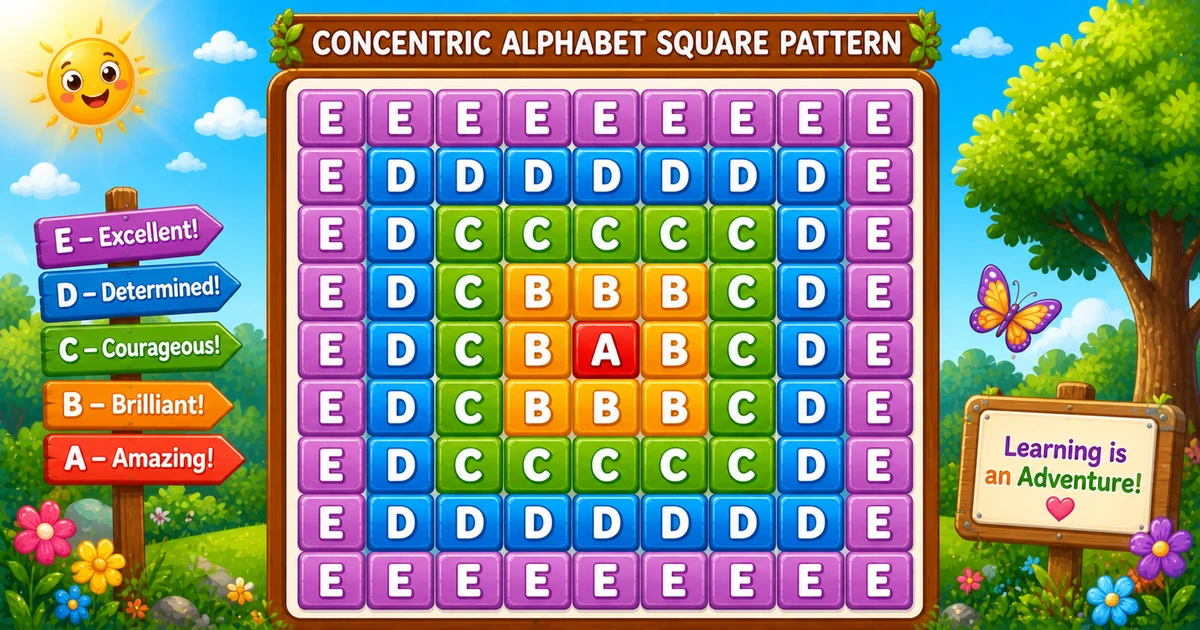
A reverse centered alphabet pyramid prints Program 28’s layered rows down to the A-center line, then mirrors them back up to the top letter — without printing the center twice.
Remember
Rule: PrintRow(i) = left k..0 + right 1..k with (j > i ? j : i)
      Phase 1: i = k..0   Phase 2: i = 1..k

E E E E E E E E E
E D D D D D D D E
E D C C C C C D E
E D C B B B C D E
E D C B A B C D E   ← center once
E D C B B B C D E
E D C C C C C D E
E D D D D D D D E
E E E E E E E E E     ← top = 'E' (9×9)
Program 28 is exactly the upper half. The lower phase starts at $i = 1 (B) so the A-center row is not duplicated.
Approach
How to Solve It
Two ways to emit the same diamond — duplicate the row body in both phases, or factor helpers.
Method
Idea
Best for
Two phases inline
Upper $k..0, lower 1..$k, same row body
Learning, interviews, exams
print_cell + print_row
One place owns the floor rule and both halves
Cleaner demos once the rule clicks
Pseudocode
Pseudocode
$k = ord($top) - ord('A')
define PrintRow($i):
    for $j from $k down to 0: echo ($j > $i ? $alpha[$j] : $alpha[$i])
    for $j from 1 to $k:      echo ($j > $i ? $alpha[$j] : $alpha[$i])
    echo PHP_EOL

for $i from $k down to 0: PrintRow($i)   // upper
for $i from 1 to $k:      PrintRow($i)   // lower
Print cells without a newline, then end the row once.
Try it
Live Preview
Change the top letter and the reverse-centered diamond updates instantly — rows = width = 2k + 1.
One letter from A to F. Tap a chip or type a letter — the preview redraws as you go.
Live resultTop E · 9 rows · width 9
E E E E E E E E E
E D D D D D D D E
E D C C C C C D E
E D C B B B C D E
E D C B A B C D E
E D C B B B C D E
E D C C C C C D E
E D D D D D D D E
E E E E E E E E E
Trace
Worked Walkthrough — Top = E ($k = 4)
Trace each floor and the resulting 9-letter line across both phases.
Phase
$i
Floor
Printed row
Upper
4
E
E E E E E E E E E
Upper
3
D
E D D D D D D D E
Upper
2
C
E D C C C C C D E
Upper
1
B
E D C B B B C D E
Upper
0
A
E D C B A B C D E
Lower
1
B
E D C B B B C D E
Lower
2
C
E D C C C C C D E
Lower
3
D
E D D D D D D D E
Lower
4
E
E E E E E E E E E
Width is always 2×4 + 1 = 9. Total rows are 2×5 − 1 = 9. The A-center row appears only once (upper phase).
Code
PHP Programs
Three complete programs: fixed A–E, top-letter input, and a helper-function rewrite. Use View Output to reveal sample results.
Example 1 — Fixed A–E
Same row logic as Program 28, printed in two phases to complete the reverse centered pyramid.
PHP
<?php
$k = 4; // index for 'E'
$alpha = str_split("ABCDEFGHIJKLMNOPQRSTUVWXYZ");

// Upper half (E down to A)
for ($i = $k; $i >= 0; $i--) {
    for ($j = $k; $j >= 0; $j--)
        echo ($j > $i ? $alpha[$j] : $alpha[$i]) . " ";
    for ($j = 1; $j <= $k; $j++)
        echo ($j > $i ? $alpha[$j] : $alpha[$i]) . " ";
    echo PHP_EOL;
}

// Lower half (B up to E) — skip repeating the A row
for ($i = 1; $i <= $k; $i++) {
    for ($j = $k; $j >= 0; $j--)
        echo ($j > $i ? $alpha[$j] : $alpha[$i]) . " ";
    for ($j = 1; $j <= $k; $j++)
        echo ($j > $i ? $alpha[$j] : $alpha[$i]) . " ";
    echo PHP_EOL;
}
Output
E E E E E E E E E
E D D D D D D D E
E D C C C C C D E
E D C B B B C D E
E D C B A B C D E
E D C B B B C D E
E D C C C C C D E
E D D D D D D D E
E E E E E E E E E
How It Works
1. Fix the top index.$k = 4 means the highest letter is E.
2. Upper phase. Floor $i runs from $k down to 0 — same as Program 28 through the A-center row.
3. Lower phase. Floor $i runs from 1 to $k so the center line is not printed twice.
4. Same row body. Both phases use left $k..0 and right 1..$k with $j > $i ? $alpha[$j] : $alpha[$i].
Example 2 — Top Letter Input
Works for A..top with the same two-phase pyramid. Prefer validating a single A–Z character in real apps.
E E E E E E E E E
E D D D D D D D E
E D C C C C C D E
E D C B B B C D E
E D C B A B C D E
E D C B B B C D E
E D C C C C C D E
E D D D D D D D E
E E E E E E E E E
How It Works
1. print_cell owns the rule.$j > $i lives in one place.
2. print_row owns both halves. Left $k..0 and right 1..$k, then echo PHP_EOL.
3. Thin phases. The two outer loops only decide which floors to visit.
Edge Cases & Pitfalls
Check these before calling the solution done.
i = 0
Duplicate center row
If the lower phase starts at 0, the A-center line prints twice. Keep for ($i = 1; $i <= $k; $i++).
Right j = 0
Duplicate center A in a row
The right half of each row must start at 1, same as Program 28.
PHP_EOL inside
Column of letters
If echo PHP_EOL is inside either half-loop, each cell lands on its own line. Use echo for cells; end the row only after both halves.
top = A
Single A
When $k = 0, upper prints A and lower never runs. A good sanity check.
Upper only
Program 28 by mistake
Forgetting the lower phase leaves the open square. Add for ($i = 1; $i <= $k; $i++) with the same row printer.
Bad input
Validate one letter
Trim, uppercase, and require length 1 in A–Z — reject empty or multi-character tokens.
Analysis
Time and Space Complexity
Program
Time
Extra space
Two phases inline (Examples 1–2)
O(n²)
O(1) (plus the fixed alphabet table)
Helper functions (Example 3)
O(n²)
O(1)
For $n = $k + 1 letters, there are 2n - 1 rows of width 2n - 1 — still quadratic in n. Roughly twice Program 28’s cell count, minus one shared center row.
Remember
Key Takeaways
Rule: same print_row as Program 28 — upper $k..0, lower 1..$k.
No double center: lower phase starts at B ($i = 1).
Break the row: call echo PHP_EOL only after both half-loops.
Complexity:O(n²) time; O(1) extra space.
One line: print Program 28’s rows from $k down to 0, then again from 1 up to $k.
Frequently Asked Questions
The first loop decreases i from E down to A, printing each layered row toward the center. The second increases i from B back to E with the same row rule so the pyramid widens again without repeating the A-centered row.
Because the A-centered row already appears in the upper half. Starting from B prevents duplicating the center line.
If n is the number of letters from A to the top letter, total rows are 2n−1 (9 rows for A..E).
It prints the border letter when the column index j is above the current row floor i; otherwise it prints the floor letter. The same rule applies on both left and right halves of every row.
The left scan goes E down to A; the right scan goes B up to E so the middle A appears once and the row mirrors.
O(n²) because there are O(n) rows and each row prints O(n) cells.
echo stays on the same line. echo PHP_EOL ends the current line. Letters use echo; the row break uses echo PHP_EOL after both half-loops.
Program 28 is exactly the upper half of this pyramid. Program 29 reuses that row logic, then mirrors upward from B to E for the closed diamond.
🤔
Did you know?
Reuse Program 28’s row logic twice: first with i from E down to A, then with i from B up to E so the center row is not duplicated. Each row stays full width (2n-1 cells); total rows are also 2n-1 for n letters.