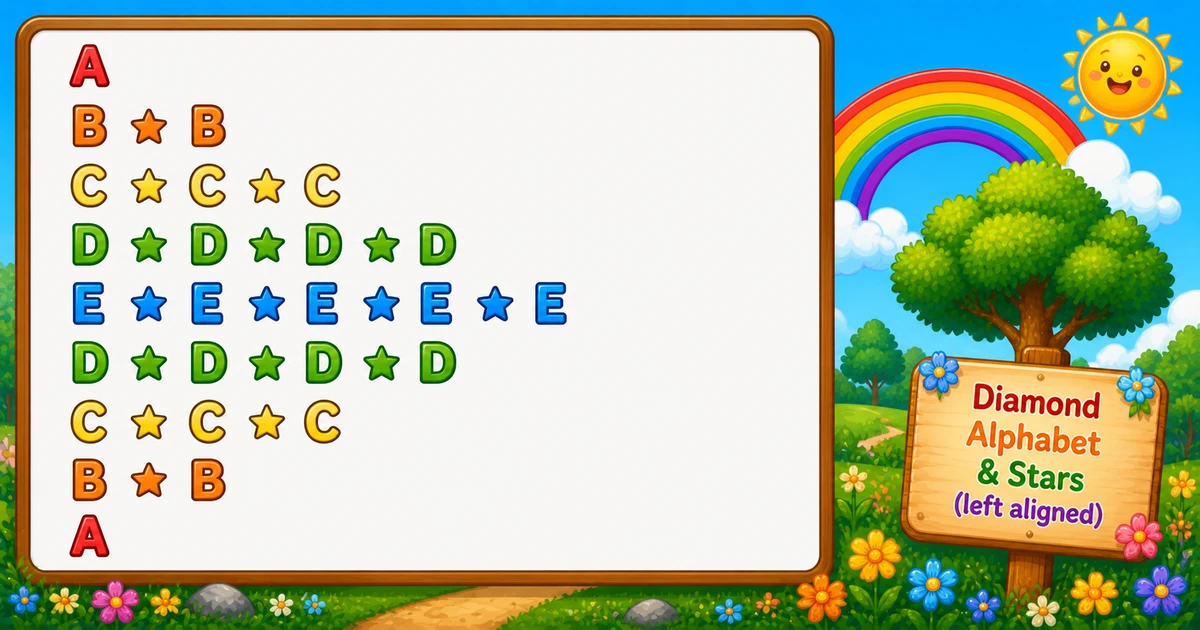
A diamond alphabet with stars widens then shrinks: each row repeats one letter with * between copies (B*B, C*C*C), mirrored so the widest middle row appears only once.
Remember
Rule: odd j → row letter; even j → '*'; upper 1..n then lower n-1..1

A
B*B
C*C*C
D*D*D*D
E*E*E*E*E
D*D*D*D
C*C*C
B*B
A     ← half height n = 5
Unlike Program 15 (stars filling a center gap between alphabet wings), here one letter owns the whole row and stars sit between letter copies.
Approach
How to Solve It
Print an upper half that grows, then a lower half that shrinks from $n - 1, alternating letter and star by column index.
One function owns the letter/* run; halves only choose $i
Less duplication, cleaner structure
Pseudocode
Pseudocode
for $i from 1 to $n:
    $ch = chr(ord('A') + $i - 1)
    for $j from 1 to 2*$i - 1:
        echo '*' if $j is even else $ch
    echo PHP_EOL
for $i from $n - 1 down to 1:
    (same inner loop)
Cheat sheet
Goal
Pattern
Upper half
for ($i = 1; $i <= $n; $i++)
Lower half
for ($i = $n - 1; $i >= 1; $i--)
Odd width
for ($j = 1; $j < $i * 2; $j++) → 2i-1 chars
Alternation
echo ($j % 2 == 0) ? "*" : $ch;
Row letter
$ch = chr(ord('A') + $i - 1);
End the row
echo PHP_EOL;
A–Z-safe height
Clamp $n to 1–26
Printing Letters vs Starting a New Line
API
Effect
Use for
echo
Stays on the same line
Each letter and each star
echo PHP_EOL
Ends the current line
After the alternating run
Print cells without a newline, then end the row once.
Try it
Live Preview
Change the half height and the diamond updates instantly — including middle letter and total rows.
Whole numbers from 1 to 8. Total rows = 2n - 1; middle letter is A + n - 1.
Live resultn = 5 · middle E · 9 rows
A
B*B
C*C*C
D*D*D*D
E*E*E*E*E
D*D*D*D
C*C*C
B*B
A
Trace
Worked Walkthrough — $n = 3
Trace each row height, the letter, the odd-width run, and where the mirror starts.
Half
$i
Letter
Width
Printed row
Upper
1
A
1
A
Upper
2
B
3
B*B
Upper
3
C
5
C*C*C
Lower
2
B
3
B*B
Lower
1
A
1
A
Lower half starts at $n - 1 so C*C*C is not printed twice. Width formula: 2i - 1.
Code
PHP Programs
Three complete programs: fixed $n = 5, CLI half-height input, and a print_row helper. Use View Output to reveal sample results.
Example 1 — Fixed Half Height 5
Odd $j prints the row letter; even $j prints *. Upper half prints 1..5, lower half prints 4..1.
1. One row printer.print_row($i) owns the letter/* alternation and the newline.
2. Halves only choose height. Upper loops 1..n; lower loops n-1..1 — no duplicated inner logic.
3. Easier to change. Want a different separator? Edit one function instead of two loops.
Edge Cases & Pitfalls
Check these before calling the solution done.
Lower from n
Doubled middle
Starting the lower half at $n reprints the widest row. Always start at $n - 1.
$j <= $i * 2
Even width
Using $j <= $i * 2 prints an extra character. Keep $j < $i * 2 for odd widths 1, 3, 5, …
Swap odd/even
Star first
Printing * on odd $j starts each row with a star. Letters belong on odd positions.
$n = 1
Single A
Output is just A; the lower half does not run — a good sanity check.
Past Z
Clamp to 26
Half height above 26 walks the middle letter past Z. Cap or reject the input.
Bad input
Use is_numeric
Casting non-numeric input to int becomes 0. Prefer is_numeric so empty or letter input does not silently fail.
Analysis
Time and Space Complexity
Program
Time
Extra space
Two-loop / helper forms
O(n²)
O(1)
Upper half prints 1 + 3 + … + (2n - 1) = n² characters; the lower half adds almost the same without the middle row — still quadratic in $n.
Remember
Key Takeaways
Two halves: grow 1..n, then shrink n-1..1 so the middle is unique.
Odd widths: each row prints 2i - 1 characters via $j < $i * 2.
Alternation: odd $j → letter; even $j → *.
Complexity:O(n²) time; O(1) extra space.
One line: for each row height up then down, echo letter and * alternating across an odd-width run.
Frequently Asked Questions
j runs 1,2,3,... Odd positions print the row letter and even positions print '*', producing lines like B*B and C*C*C.
The inner loop checks the position: even columns print '*', odd columns print the row letter. That alternates symbols cleanly.
That prints 2*i-1 characters per row (1,3,5,...), which makes the pattern widen toward the center.
The upper half already printed the widest row at i=n. Starting from n-1 mirrors without duplicating the middle row.
echo stays on the same line for each letter or star. echo PHP_EOL ends the row after the inner loop finishes.
Program 15 puts stars in the center of a symmetric alphabet row. This pattern repeats one letter per row and places stars between those letters, then mirrors vertically.
O(n²) for half height n because the total printed characters is proportional to 1+3+...+(2n-1) up and down.
Use trim(fgets(STDIN)) and check is_numeric($input) before casting to int, require n ≥ 1, and cap at 26 so row letters stay within A–Z.
🤔
Did you know?
Upper half prints rows 1..n; lower half prints n-1..1 so the widest row appears once. Each row runs j = 1..(2i-1). Odd j prints the row letter, even j prints *.