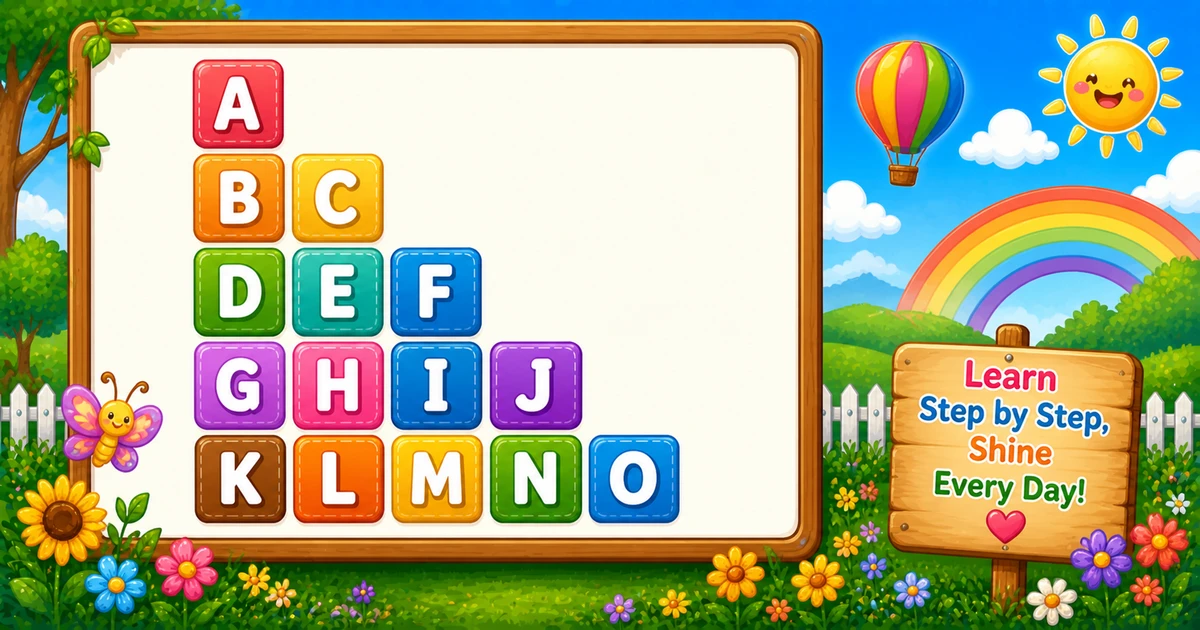
A sequential alphabet triangle grows like a right-angled star triangle, but letters keep advancing across the whole figure — they do not reset to A on each row.
Remember
Rule: one running char $k; echo then $k++
      Row $i prints $i letters

A
B C
D E F
G H I J
K L M N O     ← 5 rows (15 letters, A–O)
Contrast with Program 1, where every row starts over at A. Here a single $k lives outside the outer loop and only moves forward.
Approach
How to Solve It
Keep one letter cursor, print it on each cell, then advance — optionally separate letters with spaces.
Method
Idea
Best for
Spaced rows
echo $k, optional space, then $k++
Readable demos, interviews
Compact rows
Same $k++ logic without spaces
Denser output once the idea clicks
Pseudocode
Pseudocode
$k = 'A'
for $i from 1 to $rows:
    for $j from 1 to $i:
        echo $k (no newline)
        if $j < $i: echo " " (no newline)
        $k = next letter
    echo PHP_EOL
Cheat sheet
Goal
Pattern
Start the cursor
$k = 'A'; before the outer loop
Walk each row
for ($i = 1; $i <= $rows; $i++)
Print $i letters
for ($j = 1; $j <= $i; $j++)
Advance forever
echo $k; $k++;
Space between letters
if ($j < $i) echo " ";
End the row
echo PHP_EOL;
A–Z-safe height
$rows*($rows+1)/2 ≤ 26 → max 6 rows
Printing Letters vs Starting a New Line
API
Effect
Use for
echo
Stays on the same line
Each letter and each space
echo PHP_EOL
Ends the current line
After the inner loop
Print characters without a newline, then end the row once.
Try it
Live Preview
Change the row count and the sequential triangle updates instantly — including letter totals and the last letter used.
Whole numbers from 1 to 7. Six rows stay in A–Z (21 letters); seven needs 28 and continues past Z.
Live result5 rows · A–O · 15 letters
A
B C
D E F
G H I J
K L M N O
Trace
Worked Walkthrough — $rows = 4
Trace each outer value of $i and watch $k keep advancing — never reset.
$i
Letters printed
Printed row
$k after row
1
A
A
B
2
B, C
B C
D
3
D, E, F
D E F
G
4
G…J
G H I J
K
Total letters: 1 + 2 + 3 + 4 = 10 = 4×5/2. That triangular sum is why time is O(n²).
Code
PHP Programs
Three complete programs: fixed height with spaces, CLI input, and a compact no-space variant. Use View Output to reveal sample results.
Example 1 — Fixed $rows = 5
Hard-coded height with spaces between letters — ideal for first demos.
1. Same cursor.$k still starts at 'A' and advances after every letter.
2. Drop the spacer. Remove the if ($j < $i) echo " " line — the sequence is unchanged.
3. Same row break.echo PHP_EOL; still ends each row after the inner loop.
Edge Cases & Pitfalls
Check these before calling the solution done.
Reset $k each row
Program 1 by mistake
If you set $k = 'A' inside the outer loop, every row restarts at A. Keep $k outside.
$k++ once per row
Repeated letters
Increment inside the inner loop after each print. Advancing only once per row repeats the same letter across wide rows.
PHP_EOL inside
Column of letters
If echo PHP_EOL sits inside the inner loop, each letter lands on its own line. Call it only after the inner loop.
Past Z
Cap the height
Seven rows need 28 letters. Cap so n(n+1)/2 ≤ 26, or stop when $k > 'Z'.
$rows = 1
Single A
Output is just A — a good sanity check.
Bad input
Check is_numeric
Casting non-numeric input to int becomes 0. Prefer is_numeric and keep the triangular letter count in range.
Analysis
Time and Space Complexity
Program
Time
Extra space
Spaced / compact loops
O($rows²)
O(1)
Total letters printed = 1 + 2 + … + n = n(n+1)/2, which is still quadratic in n. Spaces add only a linear factor of the same order.
Remember
Key Takeaways
One cursor: declare $k before the outer loop and never reset it per row.
Print then advance:echo $k; $k++; on every inner-loop step.
Break the row:echo for letters/spaces; echo PHP_EOL after the inner loop.
Complexity:O(n²) time from the triangular letter count; O(1) extra space.
One line: for each row $i, echo the next $i letters from a shared cursor $k, then echo PHP_EOL.
Frequently Asked Questions
Because $k is updated after every printed character and is not reset inside the outer loop. That is what makes the sequence continuous across the triangle.
A single running character starts at A and increments after every print. Row 1 prints 1 character, row 2 prints 2, row 3 prints 3, so you see consecutive letters across the whole triangle.
Because each cell must print a new next letter. If you incremented only once per row, the wider rows would repeat the same letter.
echo sends output without adding a line break. echo PHP_EOL ends the current line with a portable newline. Letters (and optional spaces) use echo; the row break uses echo PHP_EOL after the inner loop.
1+2+…+n = n(n+1)/2. For 5 rows that is 15 letters (A through O).
O(n²) where n is the number of rows. Total echo calls for letters equal n(n+1)/2.
Plain $k++ continues past Z into the next ASCII/string values. Cap rows so n(n+1)/2 ≤ 26, or stop when $k > 'Z', if you want A–Z only.
Use trim(fgets(STDIN)) and check is_numeric($input) before casting to int, then clamp rows so the triangular letter count stays in range for your alphabet policy.
🤔
Did you know?
Unlike Program 1 (letters reset to A each row), this pattern uses one running character that increments after every print. Letters stay consecutive across the whole triangle: A, then B C, then D E F, and so on.