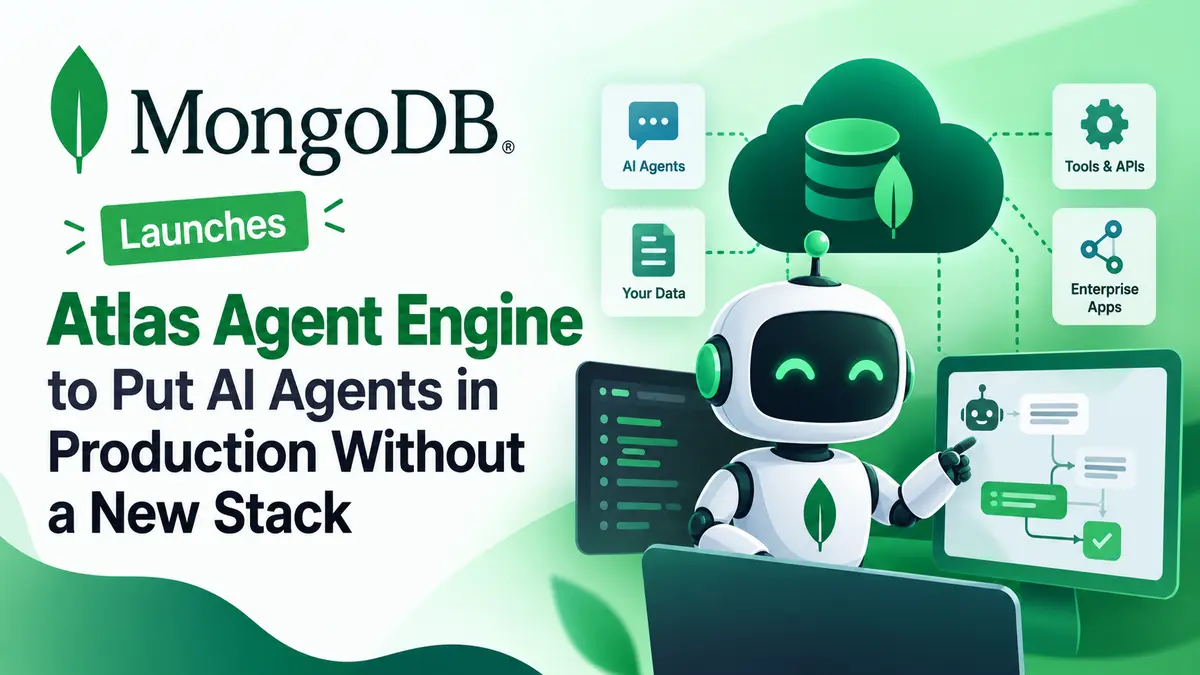
MongoDB launched Atlas Agent Engine in public preview on Sept. 29, 2026. The new service is designed for a problem many AI teams now face: their agent works in a test window, but falls apart when it meets real customers, private data, security rules, and months of conversation history.
MongoDB describes Atlas Agent Engine as a unified layer for agent execution, memory, retrieval, and governance. Teams can keep the models and frameworks they already use. The goal is to add the production plumbing around those tools without forcing companies to build another technology stack.
Why building an AI agent is easy—but running one is hard
A prototype needs only a model, a prompt, and a few tools. Ask it to summarize a document or check an order, and the demo may look impressive.
Production changes the rules. The agent must find accurate company data, remember earlier work, prove who authorized an action, stay inside security policies, record what it did, control costs, and recover when something fails. Each missing piece becomes another service for engineers to install and protect.
Prototype: model + prompt + basic tools.
Production: model + retrieval + memory + identity + security + governance + logs + cost controls + reliable execution.
Without a platform such as Agent Engine, a company may connect one system for the AI model, another for vector search, another for memory, and more services for authentication, logging, governance, and monitoring. A framework update can then break several connections at once.
What MongoDB is actually adding with Atlas Agent Engine
Atlas Agent Engine does not replace the AI model. Think of the model as the agent's brain. Agent Engine provides more of the workplace around that brain: trusted information, long-term notes, permission checks, an execution environment, and a record of every important action.
Its main pieces are modular, so teams can adopt only what they need:
- Agent RuntimeRuns agent work with governed execution and cost controls.
- Agent MemoryKeeps useful context so an agent does not start every task from zero.
- RetrievalFinds and ranks relevant business information through Voyage AI and MongoDB.
- GovernanceConnects actions to identities, policies, audit records, and guardrails.
How agent memory helps AI stop starting from zero
Imagine calling customer support about a damaged laptop. Without memory, the support agent asks for your order number and repeats the same questions every time you return. With memory, it can recall the earlier complaint, the photos you sent, and the replacement already approved.
AI agent memory works in a similar way. It saves useful context from earlier conversations or tasks and brings that context back when it matters. MongoDB says Agent Engine builds memory into the platform with Voyage AI embeddings and MongoDB's native retrieval, reducing the need to create separate memory infrastructure for every agent.
Retrieval gives the model facts it was never trained on
Memory is about what happened before. Retrieval is about finding the right information now. A support agent may need a current return policy. A banking agent may need the latest transactions. A coding agent may need the repository's current architecture notes.
Voyage AI turns text into numerical representations called embeddings. In simple terms, embeddings help a system find information by meaning, not only exact words. Reranking then sorts the results so the most useful passages appear first. MongoDB says this combination can improve accuracy while reducing the number of tokens sent to the model.
The governance layer answers: “What did the agent do?”
A smart answer is not enough for enterprise AI. Companies also need accountability. Atlas Agent Engine places identity, audit, guardrails, and cost controls behind one control plane.
According to MongoDB, each action is logged against a real identity—either a person or an agent—and governed by policies that cannot be quietly turned off. If an agent refunds money, changes a record, or calls another system, a reviewer should be able to see what happened and who authorized it.
Example: investigating a suspicious payment
An AI agent could retrieve recent transactions, remember earlier investigation notes, compare activity with known patterns, and follow company policy before recommending an action. It might gather evidence quickly, but a human analyst can still make the judgment call.
"We're excited about the potential for an intelligent agent, built on MongoDB's Atlas Agent Engine, to shrink the time between a problem emerging and our team acting on it, giving our analysts more time to focus on the judgment calls that matter most."
Jana Janarthanan, SVP Payment Engineering, Paysafe
No need to bet everything on one AI model
AI changes quickly. The best model for a job today may not be the best model next year. Lock-in becomes expensive when changing a model, framework, or cloud requires rebuilding the whole agent.
MongoDB says Atlas Agent Engine is neutral across models and frameworks and can run across clouds, in self-managed environments, or even on a laptop. Instead of replacing a team's existing tools, it adds execution, memory, governance, and cost control around them.
Where MCP and A2A fit
MCP, or Model Context Protocol, gives AI systems a common way to connect with data and tools. A2A, or Agent2Agent, helps different agents communicate and work together. MongoDB says Agent Engine is built on these open standards, so changing models or frameworks can be a configuration change instead of a full rebuild.
Example: a software development agent
A coding agent could retrieve project documentation through MCP, remember decisions from an earlier task, and ask a security-review agent for help through an agent-to-agent connection. Governance rules could limit it to approved repositories and record every change it attempts.
Public preview means “test it,” not “assume it is finished”
Atlas Agent Engine is in public preview. That means MongoDB has opened it to customers for evaluation and early use, but it is not being described as generally available. Preview services can change as feedback arrives, so teams should test reliability, security requirements, regional availability, and support expectations before using one for critical production work.
MongoDB says new and existing Atlas customers can get started now. Agent Runtime and Agent Memory use consumption-based pricing during preview, and usage draws from existing Atlas commitments. The announcement does not provide specific rates.
How Atlas Agent Engine fits into MongoDB’s bigger AI plan
Agent Engine sits on top of MongoDB's operational data platform and works with Voyage AI retrieval. MongoDB announced it alongside MongoDB 9.0 and Atlas Infinite. The company presents the products as connected layers: MongoDB 9.0 strengthens the database foundation, Atlas Infinite expands how it can scale, and Agent Engine gives AI agents a governed way to work with real-time data.
MongoDB also said it is joining the Linux Foundation's Open Secure AI Alliance and Agentic AI Foundation to support open software and standards for secure, interoperable agents.
Why this matters to developers and enterprises
- Developers: fewer separate systems may mean less integration code and fewer connections to maintain.
- AI engineers: built-in memory and retrieval can provide more useful context without rebuilding those layers for every agent.
- Enterprise teams: identity, policies, audit records, and cost controls are considered before launch rather than added after an incident.
- Companies building agents: model and framework neutrality can reduce the cost of changing direction as the market evolves.
- Existing MongoDB users: Agent Engine extends infrastructure and Atlas commitments they may already have instead of requiring an entirely separate data stack.
What to evaluate: Agent Engine is promising because it joins several difficult production layers. But it is still a preview. Teams should test it with their own data, policies, failure cases, cost limits, and model choices before making a long-term architecture decision.
Bottom line
MongoDB Atlas Agent Engine addresses the gap between an AI agent that works in a demo and one that can be trusted inside a business. Its strongest idea is not another model. It is the layer around the model: memory, retrieval, identity, governed execution, auditability, and freedom to change tools later.
The public preview now gives developers and enterprises a chance to test whether that unified approach is simpler than stitching the same pieces together themselves. The architecture is practical; real-world evaluation will show how well it performs across demanding production workloads.
Primary source: MongoDB press release: "MongoDB Launches Atlas Agent Engine to Put AI Agents in Production Without a New Stack" (Sept. 29, 2026)