JavaScript Inverted Triangle Star Pattern (Right-Aligned)
Beginner
6 min read
Updated: Sep 2026
3 programs
Live preview
Definition
What Is This Pattern?
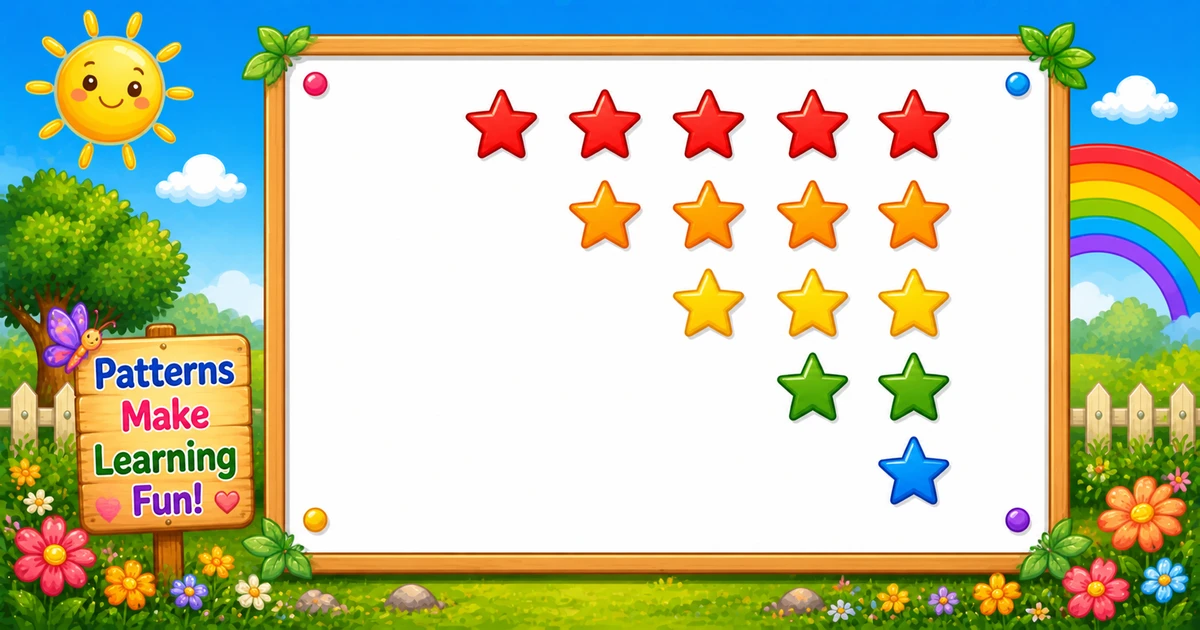
An inverted right-aligned triangle shrinks star counts while staying flush on the right: row i has i - 1 leading spaces and rows - i + 1 stars.
Remember
Rule: spaces = i - 1, stars = rows - i + 1

*****
 ****
  ***
   **
    *     ← 5 rows (spaces shown as blanks)
It combines Program 2’s shrinking stars with Program 3’s right alignment. Every row still has width rows before the newline.
Approach
How to Solve It
Two inner loops per row — spaces then stars — or the same formulas with String.repeat.
Method
Idea
Best for
Nested loops
j < i spaces, then k = i..rows stars
Learning, interviews, exams
String.repeat
Build spaces and stars as whole strings
Shorter demos once loops click
Pseudocode
Pseudocode
for i from 1 to rows:
    line = ""
    for j from 1 to i - 1:     // i - 1 spaces
        line += " "
    for k from i to rows:       // rows - i + 1 stars
        line += "*"
    print line
Cheat sheet
Goal
Pattern
Walk each row
for (let i = 1; i <= rows; i++)
Leading spaces
for (let j = 1; j < i; j++) line += " ";
Shrinking stars
for (let k = i; k <= rows; k++) line += "*";
Star count form
for (let k = 1; k <= rows - i + 1; k++)
Fixed width check
(i - 1) + (rows - i + 1) === rows
Row shortcut
console.log(" ".repeat(i - 1) + "*".repeat(rows - i + 1));
Printing Stars vs Starting a New Line
API
Effect
Use for
line += " " / line += "*"
Stays on the same row
Each space and each *
console.log(line)
Ends the current row
After spaces and stars for that row
Try it
Live Preview
Change the row count and the inverted right-aligned triangle updates instantly.
Whole numbers from 1 to 20. Each row has width rows (spaces + stars).
Live result5 rows · 15 stars
*****
 ****
  ***
   **
    *
Trace
Worked Walkthrough — rows = 4
Trace spaces, stars, and total width for each outer-loop value of i.
i
Spaces i - 1
Stars rows - i + 1
Width
Printed row
1
0
4
4
****
2
1
3
4
***
3
2
2
4
**
4
3
1
4
*
Total stars: 4 + 3 + 2 + 1 = 10 = 4×5/2. Width stays 4 on every row.
Code
JavaScript Programs
Three complete programs: fixed rows, prompt input, and a String.repeat shortcut. Use View Output for sample results, or Try It Yourself to edit and run in the playground.
Example 1 — Fixed rows = 5
Hard-coded height — ideal for first demos and screenshots.
JavaScript
let rows = 5;

for (let i = 1; i <= rows; i++) {
  let line = "";
  for (let j = 1; j < i; j++) {
    line += " ";
  }
  for (let k = i; k <= rows; k++) {
    line += "*";
  }
  console.log(line);
}
1. Set height.rows = 5 means five lines, each of width 5.
2. Outer loop picks the row.i runs from 1 to rows. Start a fresh line = "" each time.
3. Spaces then stars. Append i - 1 spaces (j < i), then stars for k = i..rows (that is rows - i + 1 stars).
4. Print the row.console.log(line) after both inner loops starts the next row.
When i = 1: 0 spaces + 5 stars. When i = 5: 4 spaces + 1 star.
Example 2 — User Input Version
Read the row count at runtime with prompt. Prefer validating with Number.isFinite (shown in the tip below).
JavaScript
let rows = parseInt(prompt("Enter the number of rows:"), 10);

for (let i = 1; i <= rows; i++) {
  let line = "";
  for (let j = 1; j < i; j++) {
    line += " ";
  }
  for (let k = i; k <= rows; k++) {
    line += "*";
  }
  console.log(line);
}
1. Prompt and parse. Ask for a row count, then convert with parseInt(..., 10).
2. Same nested-loop core. Only the source of rows changes — the print logic matches Example 1.
3. Safer input tip. Bare parseInt yields NaN on letters or Cancel. Prefer:
Safer input
let rows = parseInt(prompt("Enter the number of rows:"), 10);
if (!Number.isFinite(rows) || rows < 1) {
  console.log("Enter a positive whole number.");
} else {
  // run the pattern loops here
}
Example 3 — String.repeat + Explicit Count
Name the space and star counts, then build each row in one call.
JavaScript
let rows = 5;

for (let i = 1; i <= rows; i++) {
  let spaces = i - 1;
  let stars = rows - i + 1;
  console.log(" ".repeat(spaces) + "*".repeat(stars));
}
1. Compute both counts.spaces = i - 1 and stars = rows - i + 1 make the invert-and-align rule obvious.
2. Build and print. Concatenate the two repeat results and log the full row.
3. Learn loops first. Use Examples 1–2 when you need to show nested bounds; treat this as a polish shortcut afterward.
Edge Cases & Pitfalls
Check these before calling the solution done.
j <= i
One extra space
Space loop must be j < i (exactly i - 1 spaces). j <= i breaks the right edge.
Program 3 formulas
Grows instead
rows - i spaces and 1..i stars is Program 3. Here use i - 1 and rows - i + 1.
No spaces
Left-aligned invert
Skipping the space loop gives Program 2. Right alignment needs leading spaces.
console.log inside
Column of characters
If console.log is inside either inner loop, each character lands on its own line. Use line += for cells; log only after both loops.
rows = 1
Single star
0 spaces + 1 star — same tip case as the other triangle pages.
Bad prompt
Guard against NaN
Cancel or letters yield NaN — check Number.isFinite(rows) before looping.
Analysis
Time and Space Complexity
Program
Time
Extra space
Nested loops (Examples 1–2)
O(rows²)
O(rows) for the line string
String.repeat shortcut (Example 3)
O(rows²)
O(rows) per temporary row string
Each of n rows builds Θ(n) characters (spaces + stars). Star count alone is still n(n+1)/2.
Remember
Key Takeaways
Formulas:i - 1 spaces and rows - i + 1 stars.
Fixed width: spaces + stars = rows on every line.
Break the row:line += for spaces/stars; console.log after both loops.
Complexity:O(n²) time; O(n) for the row string.
One line: append i - 1 spaces, then rows - i + 1 stars — inverted and flush right.
Frequently Asked Questions
For each row i from 1 to rows, append i minus 1 spaces, then append stars with k running from i to rows inclusive. That prints rows minus i plus 1 stars. Row 1 has no spaces and rows stars; each later row adds one space and removes one star while keeping the same right edge.
The range i through rows has length rows minus i plus 1, which matches the star count. An equivalent loop is k from 1 to rows minus i plus 1.
Program 3 uses (rows - i) spaces and stars 1 through i. Program 4 uses (i - 1) spaces and stars i through rows. Same right alignment; star counts grow in Program 3 and shrink in Program 4.
Program 2 is left-aligned with shrinking stars. Program 4 adds growing leading spaces so the same shrinking star counts stay flush on the right.
line += stays on the same row with no newline between characters. console.log(line) ends the row after both inner loops finish.
O(n²) for n rows. Each row prints on the order of n characters; there are n rows.
Yes. console.log(' '.repeat(i - 1) + '*'.repeat(rows - i + 1)) builds each row without explicit inner character loops.
j from 1 to i-1 (written as j < i) prints exactly i - 1 spaces. Using j <= i would add one extra space and break the right edge.
🤔
Did you know?
This pattern merges Program 2’s shrinking star count with Program 3’s right alignment. Every row still has width rows: (i - 1) + (rows - i + 1) = rows.