Home JavaScript Number Patterns Program 45 JavaScript Star Cross Pattern (Over Zeros) Definition
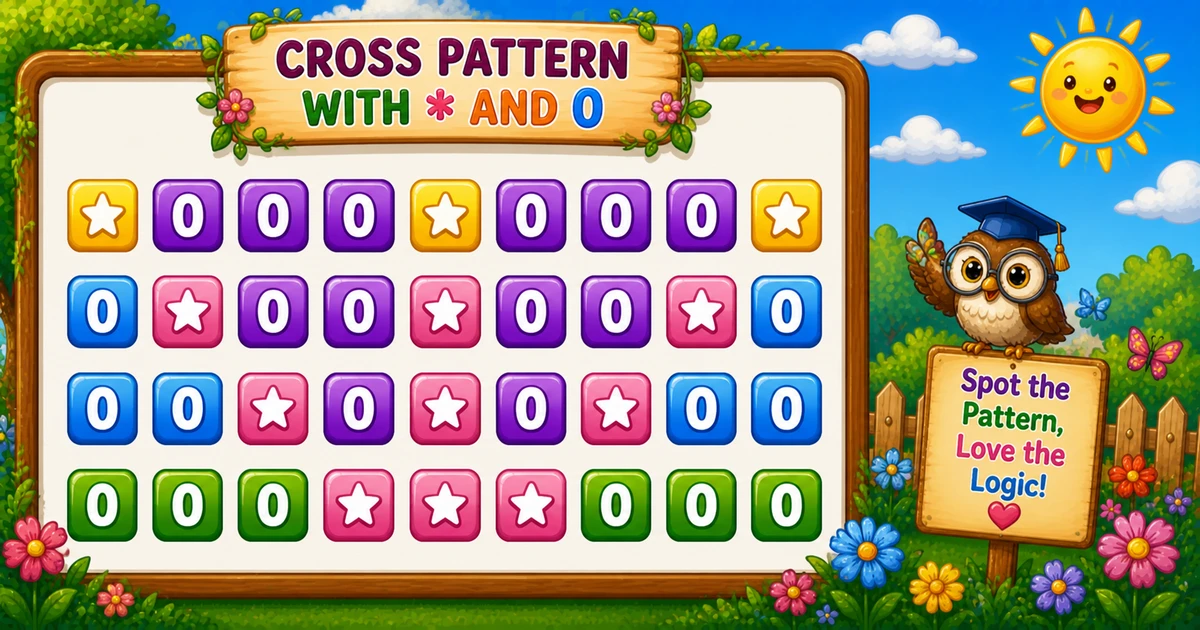
What Is This Pattern? An X pattern of * and 0 fills a grid: stars on both diagonals and the center column; zeros everywhere else.
Rule: * if i===j or j===mid or i===cols+1-j; else 0

*000*000*
0*00*00*0
00*0*0*00
000***000   ← rows = 4, cols = 9
Unlike Program 44 (number diamond), this pattern visits every cell and chooses a character with a three-part condition — total cells = rows × cols.
Approach
How to Solve It Nest loops over rows and columns. Compute mid, then append * or 0. End each row with console.log.
Method Idea Best for Diagonals + mid i===j / j===mid / anti-diagonalClassic X demos Diagonals only Drop the j===mid check Pure X contrast
Pseudocode mid = floor((cols + 1) / 2)
for i from 1 to rows:
line = ""
for j from 1 to cols:
if i == j or j == mid or i == cols + 1 - j:
append "*"
else:
append "0"
print line Cheat sheet Goal Pattern Walk grid for (let i = 1; i <= rows; i++) / for (let j = 1; j <= cols; j++)Center column const mid = Math.floor((cols + 1) / 2);Star test i === j || j === mid || i === cols + 1 - jStar / zero line += "*"; / line += "0";End the row console.log(line);
Printing Numbers vs Starting a New Line API Effect Use for line += …Stays on the same row Each cell (* or 0) console.log(line)Ends the current row After all columns in the row
Append without a newline, then end the row once.
Try it
Live Preview Change the row count (width becomes 2 × rows + 1) and the X updates instantly.
Trace
Worked Walkthrough With rows = 4, cols = 9, mid = 5 — trace why key cells print *.
Cell Why *? Rule (1,1)main diagonal i === j(1,5)center column j === mid(1,9)anti-diagonal i === cols + 1 - j(4,5)diagonal + mid meet all three can match
Every cell is decided once — total appends = rows × cols.
Code
JavaScript Programs Three complete programs: fixed 4×9, prompt size, and diagonals-only contrast. Use View Output for samples, or Try It Yourself to edit and run live.
1. Fixed grid 2. User input 3. Diagonals only Example 1 — Fixed rows = 4, cols = 9 Hard-coded size — diagonals plus center column of stars.
const rows = 4;
const cols = 9;
const mid = Math.floor((cols + 1) / 2);

for (let i = 1; i <= rows; i++) {
  let line = "";
  for (let j = 1; j <= cols; j++) {
    if (i === j || j === mid || i === cols + 1 - j) {
      line += "*";
    } else {
      line += "0";
    }
  }
  console.log(line);
} *000*000*
0*00*00*0
00*0*0*00
000***000 How It Works 1. Walk the grid. Outer loop is rows; inner loop is columns — both 1-based.
2. Find the center. mid = Math.floor((cols + 1) / 2) is column 5 when cols = 9.
3. Three star rules. Main diagonal (i === j), center column (j === mid), anti-diagonal (i === cols + 1 - j).
Example 2 — User Input Size Read rows and odd cols with prompt, then compute mid.
const rows = parseInt(prompt("Enter rows:"), 10);
const cols = parseInt(prompt("Enter cols (odd):"), 10);

if (!Number.isFinite(rows) || rows < 1 ||
    !Number.isFinite(cols) || cols < 1 || cols % 2 === 0) {
  console.log("Need positive rows and an odd cols.");
} else {
  const mid = Math.floor((cols + 1) / 2);
  for (let i = 1; i <= rows; i++) {
    let line = "";
    for (let j = 1; j <= cols; j++) {
      if (i === j || j === mid || i === cols + 1 - j) {
        line += "*";
      } else {
        line += "0";
      }
    }
    console.log(line);
  }
} How It Works 1. Prompt and validate. Require positive rows and an odd cols so a true center column exists.
2. Derive mid and anti-diagonal. mid and cols + 1 - j replace hard-coded 5 and 10 - j.
3. Same star core. Only the source of size changes — the if condition matches Example 1.
Example 3 — Diagonals Only Same grid; drop the center-column check for a pure X.
const rows = 4;
const cols = 9;

for (let i = 1; i <= rows; i++) {
  let line = "";
  for (let j = 1; j <= cols; j++) {
    if (i === j || i === cols + 1 - j) {
      line += "*";
    } else {
      line += "0";
    }
  }
  console.log(line);
} *0000000*
0*00000*0
00*000*00
000*0*000 How It Works 1. Two conditions only. Keep main and anti-diagonals; remove j === mid.
2. Center fills with zeros. Column 5 is no longer forced to * (except where a diagonal crosses it).
3. Clear contrast. Compare with Example 1 to see what the mid check added.
Edge Cases & Pitfalls Check these before calling the solution done.
even cols Prefer odd cols
Even width has no single center column. Prefer odd cols so mid is exact.
0-based Adjust anti-diagonal if indices start at 0
For 0-based loops use i + j === cols - 1 instead of i === cols + 1 - j.
rows > cols More rows than columns
The main diagonal exits the grid early. Keep rows <= cols for a clear X.
Bad input Validate parseInt
Check Number.isFinite, require rows >= 1, and insist on odd cols.
Analysis
Time and Space Complexity Program Time Extra space Fixed / diagonals (Examples 1, 3) O(rows × cols)O(cols) per row stringUser input (Example 2) O(rows × cols)O(cols) per row string
Every cell of the grid is visited once, so work is proportional to the product of rows and columns.
Remember
Key Takeaways Rule: * on diagonals and mid column; 0 elsewhere.
Size: prefer odd cols; mid = Math.floor((cols + 1) / 2); anti-diagonal uses cols + 1 - j.
Break the row: call console.log(line) only after all columns finish.
Complexity: O(rows × cols) — visit every cell once.
One line: nest two loops, append * on diagonals and mid, append 0 elsewhere, then log each row.
Frequently Asked Questions What pattern does this program print? An X-style grid: * on both diagonals and the center column, with 0 filling the remaining cells (classic demo: 4×9).
Why is the middle column j === 5? With cols = 9, mid = Math.floor((cols + 1) / 2) = 5. Checking j === mid draws the vertical center line.
How do the diagonals work? Main diagonal: i === j. Anti-diagonal: i === cols + 1 - j (for cols = 9 that is i === 10 - j).
What is the difference between line += and console.log? line += appends on the same row. console.log(line) ends the row after all columns finish.
How is this different from Program 44? Program 44 prints a centered number diamond. Program 45 prints a rectangular * / 0 grid using diagonal and center conditions.
Can I remove the center column? Yes — drop the j === mid check for a pure X of diagonals only — see Example 3.
What is the time complexity? O(rows × cols) because each cell is visited once.
Why prefer odd cols? Odd width gives a true single center column for mid. Even cols have no exact middle.
🤔
Did you know? Append * when i === j, j === mid, or i === cols + 1 - j; otherwise append 0. A rows × cols grid visits every cell once — total appends = rows × cols.
Next: Concentric Number Square Continue with the next pattern in the JavaScript number-pattern series.
Program 46 tutorial → About the author Developer, cloud engineer, and technical writer
I write practical tutorials so students and working developers can learn by doing—from databases and APIs to deployment on AWS.
12 people found this page helpful