Reverse Growing Number Pattern in Java

Beginner
⏱️ 8 min read
📚 Updated: Aug 2026
🎯 3 Code Examples
🚀 Live Preview
Inner loop j=rows…i

What You’ll Learn

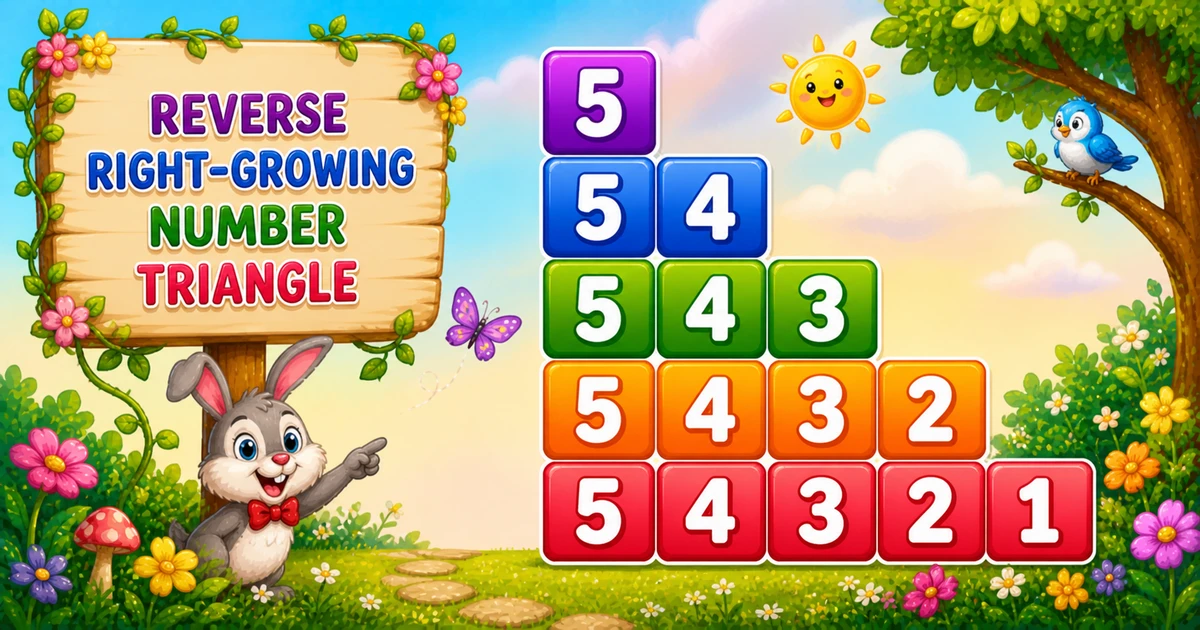
The Reverse Growing Number Pattern prints 5, 54, 543, 5432, 54321 — each row prints digits from rows down to i. This tutorial covers nested-loop logic, live preview, worked Java examples, edge cases, and O(n²) complexity.

Shape Rule

rows..i per row

Each row prints j from rows down to i with no spaces (e.g. when i = 3543).

Nested Loops

i = rows..1

Outer loop lowers i; inner loop runs j = rows..i.

print(j)

No spaces

System.out.print(j) concatenates digits on the same row.

Foundation

Series base

Stepping stone toward Floyd’s triangle, stars, and alphabet patterns.

Live Preview

1–20 rows

Pick a row count and draw the pattern instantly in the browser.

O(n²)

Complexity

Total digits ≈ n(n+1)/2 — quadratic time; extra memory stays O(1).

Introduction

A reverse growing number pattern grows each row by one digit on the right: 5, 54, 543, through 54321 for five rows. Row with index i prints digits from rows down to i.

In Java the outer loop runs i = rows..1, the inner loop prints j from rows down to i, then System.out.println() moves to the next line.

Why it matters?

It is a foundational nested-loop exercise — compare with Program 7 (growing reverse triangle) and continue to Program 9 (repeated number triangle).

Key Highlights

Counts down

Each row starts at rows and stops at i.

Growing rows

Inner loop j = rows..i lengthens each row.

vs Program 4

Program 4 shrinks rows (54321, 5432); Program 8 grows rows (5, 54, 543) with the same inner j = rows..i.

Series Foundation

Follow Program 4; continue to Program 6 (Reverse Growing) next.

In short: for each i from rows down to 1, print j from rows down to i, then System.out.println().

📝 Problem & Approach

Given a positive integer rows (e.g. 5), print a reverse growing number pattern: row i prints digits rows down to i with no spaces (e.g. when i = 3543).

Java
// rows = 5 (conceptual shape)
// 5
// 54
// 543
// 5432
// 54321

Inputs & Outputs

ItemTypeDescription
rowsintNumber of triangle lines — outer loop runs from rows down to 1.
iintOuter loop — current row index; sets where the inner loop stops.
jintInner loop — descending from rows down to i.

Minimal workflow

Pseudocode
for i from rows down to 1:
    for j from rows down to i:
        print j
    print newline

Approach comparison

ApproachIdeaBest for
Nested loops5, 54, 543, …Learning and interviews
User-input rowssc.nextInt();Flexible console programs
Spaced outputSystem.out.print(j + " ")Easier reading per row

⚡ Quick Reference

GoalPattern
Walk rowsfor (i = rows; i >= 1; i--)
Print digits rows..ifor (j = rows; j >= i; j--) System.out.print(j);
End the rowSystem.out.println();
Spaced digitsSystem.out.print(j + " ");
User inputsc.nextInt();
Program 4 contrastProgram 4 shrinks the prefix (54321, 5432); Program 8 grows it (5, 54, 543) with j = rows..i

📋 Outer Loop vs Inner Loop vs Combined

How descending outer i and inner j = rows..i work together.

Outer loop
for (i = rows; i >= 1; i--)

Lowers stop index i each row — triangle height.

Inner loop
for (j = rows; j >= i; j--)

Prints rows - i + 1 digits on each row.

Cell value
print(j)

Concatenate digits with no spaces — 123 not 1 2 3.

Learning tip
trace i=3

Dry-run when i=3: j=5,4,3 → prints 543.

Context

When This Pattern Shows Up

Reach for this pattern when teaching nested loops, growing inner bounds, and concatenated digit output.

  1. After Program 4

    Natural follow-up after Program 7’s growing reverse triangle — each row adds one more digit on the right.

  2. Nested-loop warm-up

    Outer/inner bound practice with an immediate visual check.

  3. Console I/O practice

    Combine loops with Scanner for a flexible row count.

  4. Gateway to variants

    Compare with Program 4 (shrinking rows), then continue to Program 9 (repeated triangle).

  5. Not a UI layout tool

    This is a console teaching pattern — not how you build modern app screens.

Key benefit: one small program that locks in nested loops, output sequencing, and O(n²) thinking.

🔮 Live Preview

Enter a row count and draw the reverse growing number pattern in the browser.

Try 5, 7, or 10. Larger values still work up to 20.

Live result
Press "Draw pattern".

Examples Gallery

Three complete Java programs — fixed rows = 5, Scanner input, and a spaced-output variant. Click View Output to reveal sample console results.

📚 Getting Started

Print five rows — inner loop prints rows..i on each line.

Example 1 — Fixed rows = 5

Hard-coded row count — inner loop prints from rows down to i.

Java
public class ReverseGrowingPattern {
    public static void main(String[] args) {
        int rows = 5;

        for (int i = rows; i >= 1; i--) {
            for (int j = rows; j >= i; j--) {
                System.out.print(j);
            }
            System.out.println();
        }
    }
}

How It Works

When i = 3, the inner loop prints 5, 4, 3 — output 543. When i = 1, output is 54321.

📈 User Input

Read the row count with Scanner instead of hard-coding 5.

Example 2 — User Input Version

Read rows with Scanner.nextInt(); same nested loops as Example 1.

Java
import java.util.Scanner;

public class ReverseGrowingPatternInput {
    public static void main(String[] args) {
        Scanner sc = new Scanner(System.in);
        System.out.print("Enter the number of rows: ");
        int rows = sc.nextInt();

        for (int i = rows; i >= 1; i--) {
            for (int j = rows; j >= i; j--) {
                System.out.print(j);
            }
            System.out.println();
        }

        sc.close();
    }
}

How It Works

Same nested-loop core as Example 1; only the source of rows changes.

⚡ Formatting Variant

Add spaces between digits for easier reading.

Example 3 — Spaced Output

Print a space after each digit with print(j + " ").

Java
public class ReverseGrowingPatternSpaced {
    public static void main(String[] args) {
        int rows = 5;

        for (int i = rows; i >= 1; i--) {
            for (int j = rows; j >= i; j--) {
                System.out.print(j + " ");
            }
            System.out.println();
        }
    }
}

How It Works

Same j = rows..i logic; only the output format adds spaces between digits.

🧠 How the Algorithm Prints Rows

1

Set up

System.out is built in; use Scanner when reading input. Set loop variables i, j with rows = 5.

Setup
2

Outer loop walks rows

for (i = rows; i >= 1; i--) — each row adds one more digit.

Row
3

Inner loop (j)

for (j = rows; j >= i; j--) — prints digits from i down to 1.

Inner
4

New line

System.out.println() ends the row after the inner loop finishes.

Break
=

reverse growing number pattern complete

Each row grows by one digit on the right — O(n²) time, O(1) extra memory.

🔎 Worked Walkthrough — row i = 3 (rows = 5)

Trace how lowering i lengthens each row toward 54321.

Row ij rangeOutput
555
45, 454
35, 4, 3543
25 … 25432
15 … 154321

After the inner loop, println() moves to the next row.

Use Cases

Where this tiny pattern (and its loop structure) shows up beyond the homework prompt.

1. Teaching Nested Loops

Clearest visual proof that outer and inner bounds interact.

Example: compare inner bounds with Program 4 and Program 7 and watch digit order change.

2. Pattern Series Base

Foundation for inverted, pyramid, diamond, and hollow variants.

Example: continue to Program 6 for the Reverse Growing pattern.

3. Console Formatting Drills

Practice System.out.print vs System.out.println() without complex math.

Example: put System.out.println() inside the inner loop by mistake.

4. Spaced Output

Add spaces between digits once the two-loop structure works.

Example: use System.out.print(j + " ") between digits on each row.

5. Complexity Intuition

Triangular totals make O(n²) concrete for beginners.

Example: count printed digits for rows = 5 — total is still 15 (1+2+3+4+5)).

6. Input Validation Labs

Pair the pattern with Scanner return checks and positive-row checks.

Example: reject rows <= 0 and re-prompt.

Pro Tip: when an interviewer asks for patterns, explain the outer/inner roles first — then write the loops. The story matters as much as the code.

Advantages

Why this pattern earns a permanent spot in beginner Java courses.

  1. 1. Instant Visual Feedback

    Wrong bounds show up immediately as a broken staircase.

  2. 2. Minimal Concepts

    Only loops and console output — no arrays or math libraries.

  3. 3. Easy to Extend

    Invert, center, hollow, or change the fill character with small edits.

  4. 4. O(1) Extra Memory

    Streaming output needs no storage beyond loop counters.

Pro Tip: trace i and j on paper for rows = 3 before coding — watch how each row grows by one digit.

Usage Tips

Small habits that keep number-pattern code clean.

  1. 1. Match Inner Bounds

    Outer loop counts down; inner loop must run j = rows..i so each row grows on the right.

  2. 2. Prefer Scanner

    Call sc.hasNextInt() so bad input does not leave rows uninitialized.

  3. 3. Keep System.out.println() Outside

    Only call System.out.println() after the inner loop finishes the row.

  4. 4. Use print(j) for Digits

    for (j = rows; j >= i; j--) System.out.print(j) concatenates digits on one line.

  5. 5. Dry-Run rows = 3

    Trace i = 1, 2, 3 on paper before coding the full rows = 5 demo.

Pro Tip: if the output is a vertical list of single digits per line, you almost certainly put System.out.println() inside the inner loop.

Common Pitfalls

Mistakes that commonly break Reverse Growing Number Pattern patterns.

  1. 1. Newline Inside the Inner Loop

    Each digit lands on its own line — you get a column, not a triangle.

    → Use System.out.print(j) for digits; System.out.println() only after the inner loop.

  2. 2. Ascending outer loop (Program 7)

    for (int i = 1; i <= rows; i++) with j = i..1 prints 1, 21, 321 — not 5, 54, 543.

    → Use for (int i = rows; i >= 1; i--) and for (j = rows; j >= i; j--).

  3. 3. Program 7 inner loop

    for (j = i; j >= 1; j--) builds 1, 21, 321 — not this reverse-growing pattern.

    → Use for (j = rows; j >= i; j--) so each row starts at rows.

  4. 4. Confused with Program 4 shrinking rows

    Program 4 prints the longest row first (54321). Program 8 prints the shortest row first (5) with the same j = rows..i range.

    → Check output order: growing rows need i counting down from rows.

  5. 5. Unchecked Scanner input

    Letters or empty input leave rows uninitialized.

    → Call sc.hasNextInt() and re-prompt on failure.

Edge Cases

Check these inputs before calling the solution done.

rows = 1

Single digit row

Output is just 1 on one line.

rows = 0

Empty pattern

Outer loop never runs — print nothing or show a message.

Negative

rows < 0

Treat as invalid; re-prompt instead of silent empty output.

rows = 2

Smallest triangle

Two rows: 1 and 21.

Bad input

Non-numeric Scanner input

Unchecked Scanner input leaves rows unset — call hasNextInt() first.

Large rows

Large row count

Each row prints i digits — total work grows as n(n+1)/2.

🎯 Practice Problems

Try these variations to lock in the pattern.

1. Compare Program 4

  • Program 4: fixed prefix 54321, 5432…
  • Review Program 4

2. Invert outer loop

  • Use for (i = rows; i >= 1; i--)
  • Same inner loop — tallest row first

3. Next in series

  • Continue with Program 9
  • Reverse growing pattern 5, 54, 543…

4. Spaced output

  • Use System.out.print(j + " ") between digits
  • Same loops, wider visual spacing

Notes

  • Descending inner loop. Outer loop: i = rows..1. Inner loop: j = rows..i with print(j).
  • System.out.print stays on the line; System.out.println() advances — mix them carefully.
  • Validate rows > 0 for interactive programs; rows = 1 should print a single 1.
  • Row i prints exactly i digits — compare with Program 4 where each row prints rows - i + 1 digits.

Quick Takeaway: outer loop i = rows..1, inner loop j = rows..i with System.out.print(j), then System.out.println().

⏱️ Time and Space Complexity

ProgramTimeExtra space
Nested loops (Examples 1–3)O(n²)O(1)
Spaced output (Example 3)O(n²)O(1)
Wrap Up

🎉 Conclusion

The Reverse Growing Number Pattern is a compact nested-loop lesson: outer loop lowers i while the inner loop prints digits rows down to i. Master the fixed-rows version, then try user input and spaced output.

Practice the three examples above, then continue to Program 9 for the repeated number triangle (1, 22, 333, 4444, 55555).

Each row prints rows..i — keep System.out.print(j) for digits and System.out.println() for the row break.

💡 Best Practices

✅ Do

  • Use for (i = rows; i >= 1; i--) in the outer loop
  • Inner: for (j = rows; j >= i; j--) prints digits i..1
  • Use System.out.print(j) for digits and System.out.println() after each row
  • Validate rows ≥ 1 for interactive programs
  • Call sc.hasNextInt() before using rows

❌ Don’t

  • Call System.out.println() inside the inner digit loop
  • Use Program 7’s ascending outer loop when you meant Program 8 — this pattern needs j-- from i
  • Forget println() inside the inner loop — digits must stay on one row
  • Ignore bad console input in user-facing demos
  • Skip the rows = 1 edge case

Key Takeaways

Knowledge Unlocked

Five things to remember about this reverse growing number pattern

Print the pattern the beginner-friendly way.

5
Core concepts
02

Outer loop

Counts down i

Code
03

Inner loop

j = rows down to i

Code
04

Newline

Ends each row

Shape
O 05

Complexity

O(n²) time

Analysis

❓ Frequently Asked Questions

When i = rows, the inner loop runs j from rows down to i (rows), so only one digit prints. Each later row lowers i, so more digits appear: 54, 543, and so on.
The outer loop runs i from rows down to 1. For each i, the inner loop runs j from rows down to i and prints j with System.out.print, then println ends the row.
Program 4 shrinks each row from rows down to i (54321, 5432, 543). Program 8 grows each row from one digit up to rows digits (5, 54, 543, 5432, 54321) using the same inner range j = rows..i.
Program 7 uses outer i = 1..rows and inner j = i..1 (1, 21, 321). Program 8 uses outer i = rows..1 and inner j = rows..i (5, 54, 543).
Yes. Print System.out.print(j + " ") inside the inner loop — see Example 3.
O(n²) for n rows. Total printed digits are 1+2+...+n = n(n+1)/2.
Use sc.hasNextInt() before sc.nextInt() so bad input does not throw InputMismatchException.
The outer loop never runs, so nothing is printed. Validate and prompt again if you want a clear user message.

Did you Know? 🔊

Outer loop counts i down from rows; inner loop prints j from rows down to i5, 54, 543, … O(n²) for n rows.

<<

Continue to Program 9

Move on to the repeated number triangle pattern in the Java number-pattern series.

Program 9 tutorial →

About the author

Mari Selvan M P
Mari Selvan M P 🔗

Developer, cloud engineer, and technical writer

  • Experience 12 years building web and cloud systems
  • Focus Full Stack Development, AWS, and Developer Education

I write practical tutorials so students and working developers can learn by doing—from databases and APIs to deployment on AWS.

12 people found this page helpful