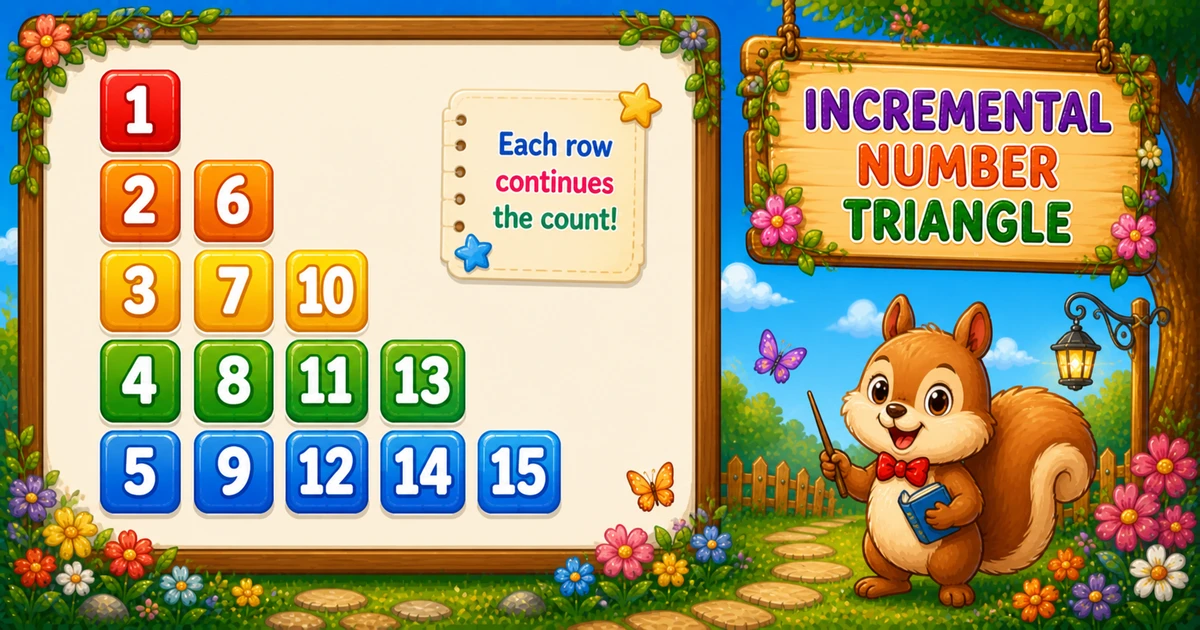
A diagonal-fill number triangle starts each row at index i, then builds later values with res = res + k where k begins at rows − 1 and shrinks.
Remember
Rule: for i = 1..rows
        start with i; k = rows - 1
        next values: res = res + k; k--

1
2 6
3 7 10
4 8 11 13
5 9 12 14 15     ← rows = 5
Unlike Program 54 (space-filled X diamond), here every cell holds a number — filled as if walking down diagonals of a triangle.
Approach
How to Solve It
Print i first on each row; for later columns add a decreasing step k.
Method
Idea
Best for
Fixed rows
Hard-code size; res + k steps
Labs and demos
Scanner input
Same logic; read rows at runtime
Interactive practice
Compact rows
StringBuilder without trailing space
Cleaner console output
Pseudocode
Pseudocode
for i from 1 to rows:
    k = rows - 1
    res = i
    for j from i to i+i-1:   // i values
        if i == j: print i
        else:
            res = res + k
            print res
            k = k - 1
    new line
Cheat sheet
Goal
Pattern
Set size
int rows = 5;
Reset step
int k = rows - 1; each row
First value
if (i == j) print(j);
Next value
res = res + k; print(res); k--;
Inner span
for (int j = i; j < i + i; j++)
Printing Numbers vs Starting a New Line
API
Effect
Use for
System.out.print
Stays on the same line
Each number in the row
System.out.println
Ends the line
After the inner loop finishes
Print values side by side, then break once per row.
Try it
Live Preview
Change the row count and the diagonal-fill triangle updates instantly.
Whole numbers from 3 to 8. Tap a chip or type a value — the preview redraws as you go.
Live resultrows = 5 · values = 15
1
2 6
3 7 10
4 8 11 13
5 9 12 14 15
Trace
Worked Walkthrough — rows = 5, row i = 3
Trace how res and k build 3 7 10.
Step
j
Action
Print
1
3
i == j → print start
3
2
4
res = 3 + 4; k → 3
7
3
5
res = 7 + 3; k → 2
10
Full row: 3 7 10. Each new row resets k to rows − 1 (here 4).
Code
Java Programs
Three complete programs: fixed rows = 5, Scanner input, and compact StringBuilder rows. Use View Output to reveal sample results.
Example 1 — Fixed rows = 5
Hard-coded size — each row uses res + k stepping with k = rows - 1.
Java
public class DiagonalFillNumberTriangle {
    public static void main(String[] args) {
        int rows = 5;

        for (int i = 1; i <= rows; i++) {
            int k = rows - 1;
            int res = i;

            for (int j = i; j < i + i; j++) {
                if (i == j) {
                    System.out.print(j + " ");
                } else {
                    res = res + k;
                    System.out.print(res + " ");
                    k--;
                }
            }
            System.out.println();
        }
    }
}
Output
1
2 6
3 7 10
4 8 11 13
5 9 12 14 15
How It Works
1. Start the row. When i == j, print i (stored in res).
2. Step forward. Later values use res = res + k, then k-- so each step is smaller.
3. Row length. The inner loop runs i times (j from i to i+i−1).
Example 2 — Scanner Input
Read rows at runtime. Same stepping logic.
Java
import java.util.Scanner;

public class DiagonalFillNumberTriangleInput {
    public static void main(String[] args) {
        Scanner sc = new Scanner(System.in);
        System.out.print("Enter rows: ");
        int rows = sc.nextInt();
        if (rows < 1) return;

        for (int i = 1; i <= rows; i++) {
            int k = rows - 1;
            int res = i;
            for (int j = i; j < i + i; j++) {
                if (i == j) System.out.print(j + " ");
                else {
                    res = res + k;
                    System.out.print(res + " ");
                    k--;
                }
            }
            System.out.println();
        }
        sc.close();
    }
}
Output (when user enters 5)
Enter rows: 5
1
2 6
3 7 10
4 8 11 13
5 9 12 14 15
How It Works
1. Prompt and guard. Read rows; exit early if it is less than 1.
2. Same math. Only the source of rows changes — k = rows - 1 still resets each row.
3. Safer input tip. Prefer:
Safer input
if (!sc.hasNextInt()) {
    System.out.println("Enter a positive integer.");
    return;
}
int rows = sc.nextInt();
if (rows < 1) {
    System.out.println("Enter a positive integer.");
    return;
}
Example 3 — Compact Rows
Same logic — StringBuilder joins values without a trailing space.
Java
public class DiagonalFillNumberTriangleCompact {
    public static void main(String[] args) {
        int rows = 5;

        for (int i = 1; i <= rows; i++) {
            int k = rows - 1;
            int res = i;
            StringBuilder row = new StringBuilder();

            for (int j = i; j < i + i; j++) {
                if (row.length() > 0) row.append(" ");
                if (i == j) row.append(j);
                else {
                    res = res + k;
                    row.append(res);
                    k--;
                }
            }
            System.out.println(row);
        }
    }
}
Output
1
2 6
3 7 10
4 8 11 13
5 9 12 14 15
How It Works
1. Same steps. Still start at i and add decreasing k offsets.
2. Cleaner spacing. Append a space only when the builder already has content — no trailing space.
3. Same shape. The triangle of numbers is identical; only end-of-row whitespace differs.
Edge Cases & Pitfalls
Check these before calling the solution done.
Forgot k reset
Wrong later rows
Set k = rows - 1 at the start of every row. Reusing a leftover k breaks the diagonal fill.
Skip k--
Constant steps
Without k--, every step adds the same offset and the triangle no longer matches the classic fill.
Wrong loop
Wrong count
Inner loop must run i times. j from i to i+i−1 (j < i + i) is the usual form.
rows = 1
Single value
Output is just 1.
rows = 0
Empty output
The outer loop never runs. Guard interactive input with rows >= 1.
Bad input
Use hasNextInt
nextInt() throws on letters — prefer hasNextInt() and require a positive integer.
Analysis
Time and Space Complexity
Program
Time
Extra space
Examples 1–2
O(n²)
O(1)
StringBuilder (Example 3)
O(n²)
O(n) per row
Total printed values for n rows: 1 + 2 + … + n = n(n+1)/2.
Remember
Key Takeaways
Rule: start at i; then res = res + k with k decreasing from rows − 1.
Reset: set k = rows - 1 at the start of every row.
Length: row i prints exactly i numbers.
Complexity:O(n²) prints for n rows.
One line: print i, then keep adding a shrinking step k to fill the diagonal triangle.
Frequently Asked Questions
Row 2 starts at 2 (when i==j). Next value: res=2+4=6 because k starts at rows-1=4.
k starts at rows-1 each row and decreases after each step. It is the offset added to res for the next number.
With 5 rows you print 1+2+3+4+5=15 numbers total — 15 is the final value on the last row.
Yes. Use a variable rows and set k = rows - 1 at the start of each row.
Exactly i numbers — the inner loop runs from j = i to j < i + i.
Build each row with StringBuilder and append spaces only between values — see Example 3.
O(n²) for n rows because you print n(n+1)/2 numbers in total.
Use sc.hasNextInt() before sc.nextInt() so bad input does not throw InputMismatchException.
🤔
Did you know?
Each row starts with index i, then adds decreasing step sizes via res = res + k where k starts at rows - 1. Row i prints exactly i numbers.