Java Increasing Number Triangle Pattern (Right-Aligned)
Beginner
7 min read
Updated: Sep 2026
3 programs
Live preview
Definition
What Is This Pattern?
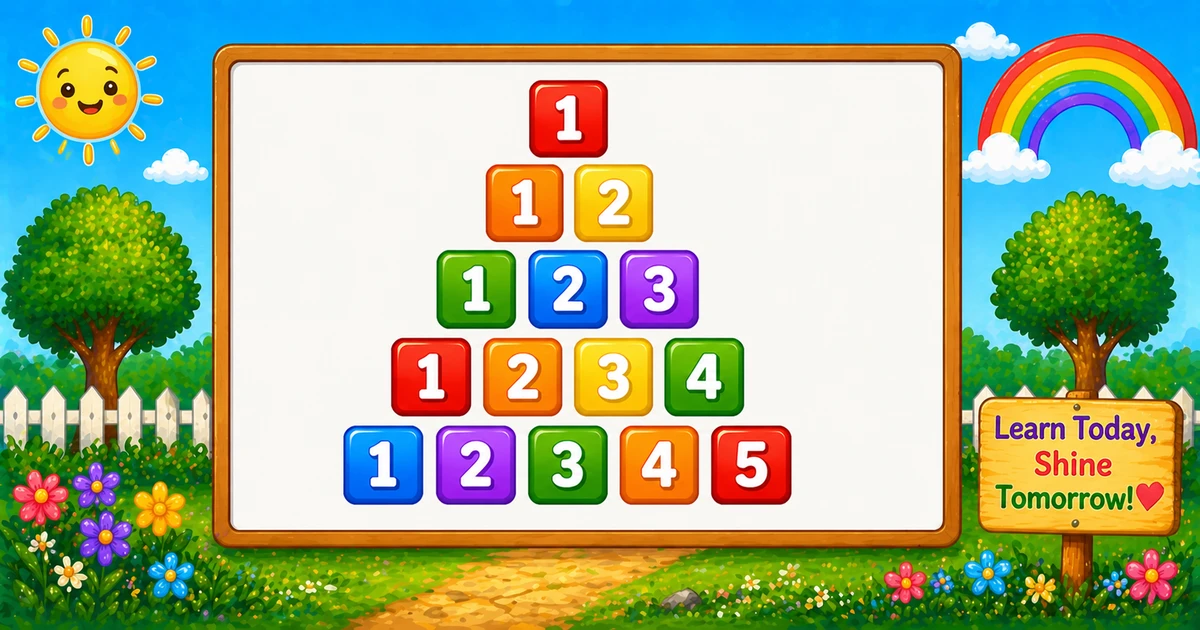
A right-aligned increasing number triangle prints 1, then 1 2, then 1 2 3, up to rows — with leading spaces so shorter rows sit to the right.
Remember
Rule: for i from 1 to rows,
      print (rows - i) spaces, then format("%2d", k) for k = 1..i

     1
    1 2
   1 2 3
  1 2 3 4
 1 2 3 4 5     ← rows = 5
Unlike Program 42 (hollow square grid), here each row grows by one number and pads from the left.
Approach
How to Solve It
Walk i from 1 to rows; print rows − i spaces, then numbers 1..i with %2d.
Method
Idea
Best for
Spaces + numbers
Space loop for indent; number loop for 1..i
Learning, interviews, exams
Left-aligned
Skip the space loop; print only 1..i
When you want a left-growing triangle
Pseudocode
Pseudocode
for i from 1 to rows:
    for j from rows down to i + 1:
        print " "
    for k from 1 to i:
        print k (width 2)
    print newline
Cheat sheet
Goal
Pattern
Walk rows
for (int i = 1; i <= rows; i++)
Leading spaces
for (int j = rows; j > i; j--) print(" ")
Print numbers
System.out.format("%2d", k); for k = 1..i
End the row
System.out.println();
Spaces on row i
rows - i
Printing Numbers vs Starting a New Line
API
Effect
Use for
System.out.print / format
Stays on the same line
Spaces and each number
System.out.println
Ends the current line
After spaces and numbers finish
Print values without a newline, then end the row once.
Try it
Live Preview
Change the row count and the right-aligned triangle updates instantly.
Whole numbers from 3 to 9. Tap a chip or type a value — the preview redraws as you go.
Live resultrows = 5 · 15 numbers
     1
    1 2
   1 2 3
  1 2 3 4
 1 2 3 4 5
Trace
Worked Walkthrough — rows = 5
Trace spaces (rows − i) and numbers (1..i) for each row.
i
Spaces
Numbers
Printed row
1
4
1
1
2
3
1 2
1 2
3
2
1 2 3
1 2 3
4
1
1..4
1 2 3 4
5
0
1..5
1 2 3 4 5
Total numbers = 1 + 2 + 3 + 4 + 5 = 15 — the triangular number n(n+1)/2.
Code
Java Programs
Three complete programs: fixed rows = 5, Scanner input, and a left-aligned variant. Use View Output to reveal sample results.
Example 1 — Fixed rows = 5
Hard-coded size — space loop for indent, number loop with %2d.
Java
public class RightAlignedNumberTriangle {
    public static void main(String[] args) {
        int rows = 5;

        for (int i = 1; i <= rows; i++) {
            for (int j = rows; j > i; j--)
                System.out.print(" ");
            for (int k = 1; k <= i; k++)
                System.out.format("%2d", k);
            System.out.println();
        }
    }
}
Output
     1
    1 2
   1 2 3
  1 2 3 4
 1 2 3 4 5
How It Works
1. Outer loop.i is both the row index and how many numbers to print.
2. Space loop. Prints rows − i single spaces so the row shifts right.
3. Number loop.format("%2d", k) prints 1..i in fixed-width columns.
When i = 1: four spaces + 1. When i = 3: two spaces + 1 2 3.
Example 2 — Rows Input
Read rows at runtime. Same space-and-number core.
Java
import java.util.Scanner;

public class RightAlignedNumberTriangleInput {
    public static void main(String[] args) {
        Scanner sc = new Scanner(System.in);
        System.out.print("Enter the number of rows: ");
        int rows = sc.nextInt();
        if (rows < 1) return;

        for (int i = 1; i <= rows; i++) {
            for (int j = rows; j > i; j--)
                System.out.print(" ");
            for (int k = 1; k <= i; k++)
                System.out.format("%2d", k);
            System.out.println();
        }
        sc.close();
    }
}
Output (when user enters 5)
Enter the number of rows: 5
     1
    1 2
   1 2 3
  1 2 3 4
 1 2 3 4 5
How It Works
1. Prompt and guard. Read rows; exit early if it is less than 1.
2. Same core. Only the source of rows changes from a literal to user input.
3. Safer input tip. Prefer:
Safer input
if (!sc.hasNextInt()) {
    System.out.println("Enter a positive integer.");
    return;
}
int rows = sc.nextInt();
if (rows < 1) {
    System.out.println("Enter a positive integer.");
    return;
}
Example 3 — Left-Aligned Triangle
Drop the space loop — numbers alone create a left-growing triangle.
Java
public class LeftAlignedNumberTriangle {
    public static void main(String[] args) {
        int rows = 5;

        for (int i = 1; i <= rows; i++) {
            for (int k = 1; k <= i; k++)
                System.out.format("%2d", k);
            System.out.println();
        }
    }
}
Output
 1
 1 2
 1 2 3
 1 2 3 4
 1 2 3 4 5
How It Works
1. Same numbers. Still print k = 1..i with %2d.
2. No indent. Without the space loop, every row starts at the left.
3. Compare tip. Put Examples 1 and 3 side by side to see what the space loop changes.
Edge Cases & Pitfalls
Check these before calling the solution done.
println inside
Column of numbers
If println is inside either inner loop, each value lands on its own line. Use print/format for cells; println only after the row.
No spaces
Left-aligned by accident
Skipping the space loop removes the right alignment — which is Example 3 on purpose.
No %2d
Crowded columns
Plain print(k) makes two-digit values crowd earlier columns.
No println
One long line
Forgetting println() after the row glues every number onto one endless line.
rows = 1
Single number
Output is just one formatted 1 on a single line.
Bad input
Use hasNextInt
nextInt() throws on letters — prefer hasNextInt() and require a positive integer.
Analysis
Time and Space Complexity
Program
Time
Extra space
Right / left triangle (Examples 1–3)
O(n²)
O(1)
Total numbers = n(n+1)/2 — still quadratic. Only loop counters are stored.
Remember
Key Takeaways
Rule: print rows − i spaces, then numbers 1..i with %2d.
Indent first: the space loop creates the right alignment.
Break the row: call println only after both inner loops.
Complexity:O(n²) time; O(1) extra space.
One line: for each row, print rows − i spaces, then format("%2d", k) for k = 1..i, then println().
Frequently Asked Questions
Each row prints leading spaces before the numbers. As i grows, the space count (rows - i) shrinks, pushing rows to align on the right.
The outer loop sets the row index i. An inner loop prints k from 1 to i on every row.
for (j = rows; j > i; j--) prints rows-i spaces before the numbers, creating the right alignment.
Remove the leading-space loop. Printing only numbers 1..i naturally left-aligns the triangle — see Example 3.
%2d prints each number in a two-character field so columns stay aligned when values reach two digits.
O(n²) for n rows because total printed numbers are 1+2+…+n = n(n+1)/2.
Use sc.hasNextInt() before sc.nextInt() so bad input does not throw InputMismatchException.
You get a single row with just the number 1 (with optional leading spaces depending on alignment).
🤔
Did you know?
Each row prints numbers 1..i and leading spaces push the row to the right — fewer spaces as i grows, which creates the right-aligned triangle.