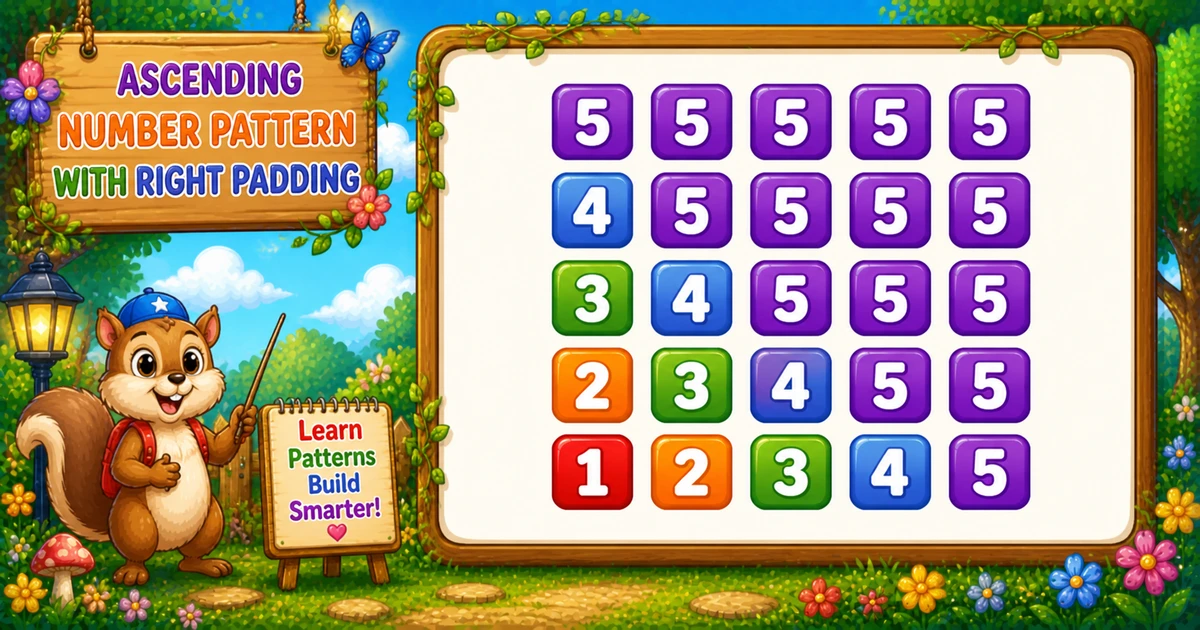
A fill-with-n number triangle prints an ascending run from the row start to n, then pads the rest of the row with n so every line has the same width.
Remember
Rule: for i from n down to 1,
      print i..n, then pad with n until width = n

5 5 5 5 5
4 5 5 5 5
3 4 5 5 5
2 3 4 5 5
1 2 3 4 5     ← n = 5
Two inner loops do the work: sequence (j from i to n) then fill (i - 1 times with n). Companion to Program 18 (parity-based streams) — here the focus is fixed-width padding.
Approach
How to Solve It
Descend the outer start, print the ascending run, then pad to width n.
Method
Idea
Best for
Sequence + fill
Print i..n, then pad with n
Learning, interviews, exams
Custom fill
Same sequence; pad with a separate constant
When the fill value should differ from n
Pseudocode
Pseudocode
for i from n down to 1:
    for j from i to n:
        print j
    for j from 1 to i - 1:
        print n
    print newline
1. Prompt and read. Ask for a width, then store it with sc.nextInt().
2. Same two-loop core. Both the sequence end bound and the fill value use n.
3. Safer input tip. Prefer:
Safer input
if (!sc.hasNextInt()) {
    System.out.println("Enter a positive whole number.");
    return;
}
int n = sc.nextInt();
if (n < 1) {
    System.out.println("Enter a positive whole number.");
    return;
}
Example 3 — Custom Fill Constant
Pad with fill = 9 while the sequence still runs up to n = 5.
Java
public class FillWithCustomConstant {
    public static void main(String[] args) {
        int n = 5;
        int fill = 9;

        for (int i = n; i >= 1; i--) {
            for (int j = i; j <= n; j++)
                System.out.print(j + " ");

            for (int j = 1; j < i; j++)
                System.out.print(fill + " ");

            System.out.println();
        }
    }
}
Output
5 9 9 9 9
4 5 9 9 9
3 4 5 9 9
2 3 4 5 9
1 2 3 4 5
How It Works
1. Same sequence. Still print j from i to n.
2. Different pad. The second loop prints fill instead of n.
3. Same width. Each row still has exactly n numbers.
Edge Cases & Pitfalls
Check these before calling the solution done.
No fill
Uneven widths
Skipping the second loop leaves short top rows. Every row must print n numbers.
j <= i
Wrong pad count
The fill loop must be j < i (runs i - 1 times). Using j <= i over-pads.
println inside
Column of numbers
If println is inside either inner loop, each number lands on its own line. Use print for numbers; println only after both loops.
n = 1
Single 1
Output is just 1 — fill never runs. A good sanity check.
n ≤ 0
Empty output
The outer loop never runs. Validate and require n ≥ 1.
Bad input
Use hasNextInt
nextInt() throws on letters — prefer hasNextInt() and require a positive whole number.
Analysis
Time and Space Complexity
Program
Time
Extra space
Sequence + fill (Examples 1–3)
O(n²)
O(1)
Each of n rows prints exactly n numbers — total n² prints, still quadratic in n.
Remember
Key Takeaways
Rule: for i from n down to 1, print i..n, then pad with n.
Fixed width: every row prints exactly n numbers.
Break the row: call println only after both inner loops.
Complexity:O(n²) time; O(1) extra space.
One line: for each start i, print i..n, pad with n to width n, then println().
Frequently Asked Questions
When i = 5, the sequence loop prints j = 5 once, then the fill loop runs 4 times — all values are 5, so the row is 5 5 5 5 5.
The first inner loop prints the increasing sequence i..n. The second fills remaining positions with n so every row has the same width.
When i = 1, the sequence loop prints j = 1 to 5 and the fill loop runs zero times — no padding needed.
System.out.print stays on the same line with a trailing space. System.out.println ends the current line. Numbers use print; the row break uses println after both inner loops.
Replace n in the second loop with a separate fill constant — Example 3 on this page pads with 9 while the sequence still runs to 5.
Rows will have different widths — the top row may be short while the bottom row is full length.
O(n²) for width n because each of n rows prints n numbers.
Use sc.hasNextInt() before sc.nextInt(), require n ≥ 1, and reject non-numeric input — see Example 2 notes.
🤔
Did you know?
Each row prints an ascending sequence i..n, then pads with n so every row has width n. The second inner loop runs i - 1 times — still O(n²) total prints.