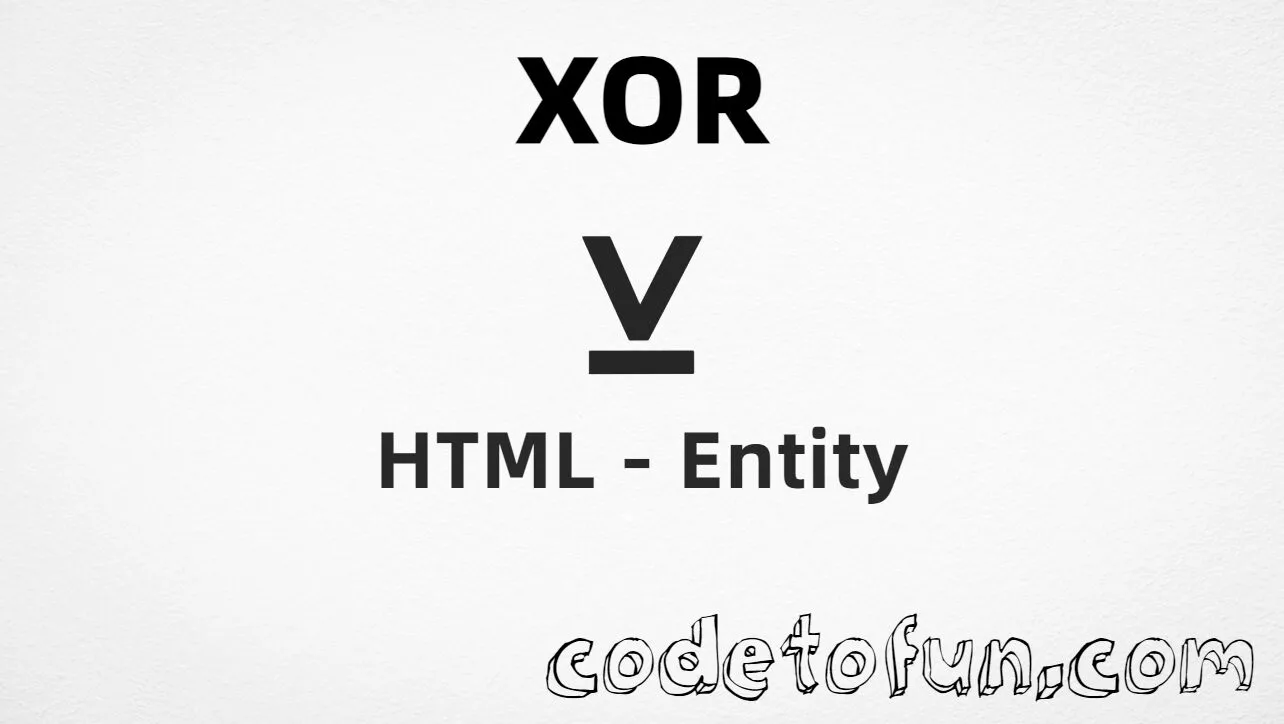
Using Named Entity: ⊻
Using Hex Code: ⊻
Using HTML Code: ⊻
Using CSS Entity: ⊻
A ⊻ B
How It Works
1. Named:⊻ is the clearest HTML form for U+22BB.
2. Hex:U+22BB → ⊻ in HTML. Same glyph as the named entity.
3. Decimal: same code point as 8891 → ⊻. Same glyph as hex and named.
4. CSS: use \22BB in content (not an HTML entity). #point::after appends that ⊻ after the paragraph text.
5. Sample:A ⊻ B shows typical exclusive-OR notation.
Pitfalls & Tips
Common mistakes when working with U+22BB.
vs ∨
XOR ≠ logical OR
∨ (∨, U+2228) is inclusive OR. ⊻ (⊻) is exclusive OR.
vs ⊕
Not circled plus
Some texts write XOR as ⊕ (⊕). That is U+2295 — a different character from U+22BB.
vs ^
Not the caret
Programming languages often use ^ for bitwise XOR. That is ASCII U+005E, not the math symbol ⊻.
CSS vs HTML
Do not mix escapes
\22BB belongs in CSS strings. ⊻ / ⊻ / ⊻ belong in HTML.
A11y
Add nearby words
Pair the glyph with label text (for example A ⊻ B or “XOR”) when it stands alone.
Semicolon
End references
Always finish with ; — write ⊻, not &veebar.
Compatibility
Browser Support
XOR (U+22BB) and its entity forms (⊻, ⊻, ⊻, CSS \\22BB) are supported in all mainstream browsers. Visible glyphs depend on Mathematical Operators font coverage.
✓ Universal support
XOR (⊻)
Encode with named, hex, decimal, CSS escape, or type the character — same code point everywhere encoding is supported.
100%Browser coverage
Google ChromeSupported
Yes
Microsoft EdgeSupported
Yes
Mozilla FirefoxSupported
Yes
Apple SafariSupported
Yes
OperaSupported
Yes
Internet ExplorerIE 9+
Yes
U+22BB / ⊻Full support
Bottom line: Prefer ⊻ in HTML. Use \\22BB only inside CSS content. Do not confuse with ∨, ⊕, or ASCII ^.
Remember
Key Takeaways
Unicode: this symbol is U+22BB (decimal 8891) — glyph ⊻.
HTML: prefer ⊻ — or use ⊻ / ⊻.
Use ⊻ (named), ⊻ (hex), ⊻ (decimal), type ⊻ directly in UTF-8, or the CSS escape \22BB in content. Prefer ⊻ in normal HTML.
U+22BB (XOR). Hex 22BB, decimal 8891. It belongs to Mathematical Operators (U+2200–U+22FF).
Yes. Use ⊻. Numeric forms ⊻ and ⊻ also work.
No. ⊻ is U+22BB (⊻, XOR). ∨ is U+2228 (∨, logical OR). ⊕ is U+2295 (⊕, circled plus). Related logic symbols, different code points.
Use it in Boolean algebra and logic when you need the exclusive-OR operator written as a vee with a bar — for example A ⊻ B.
HTML entities (⊻, ⊻, or ⊻) go in markup. The CSS escape \22BB goes in stylesheet strings (usually content on ::before/::after).
🤔
Did you know?
XOR is Unicode U+22BB (decimal 8891) — official name XOR in Mathematical Operators. HTML5 provides ⊻ (vee with a bar below). Prefer it for readable source. Used in Boolean algebra and logic for exclusive OR. Do not confuse it with logical OR ∨ (∨, U+2228) or circled plus ⊕ (⊕, U+2295), which some texts also use for XOR.