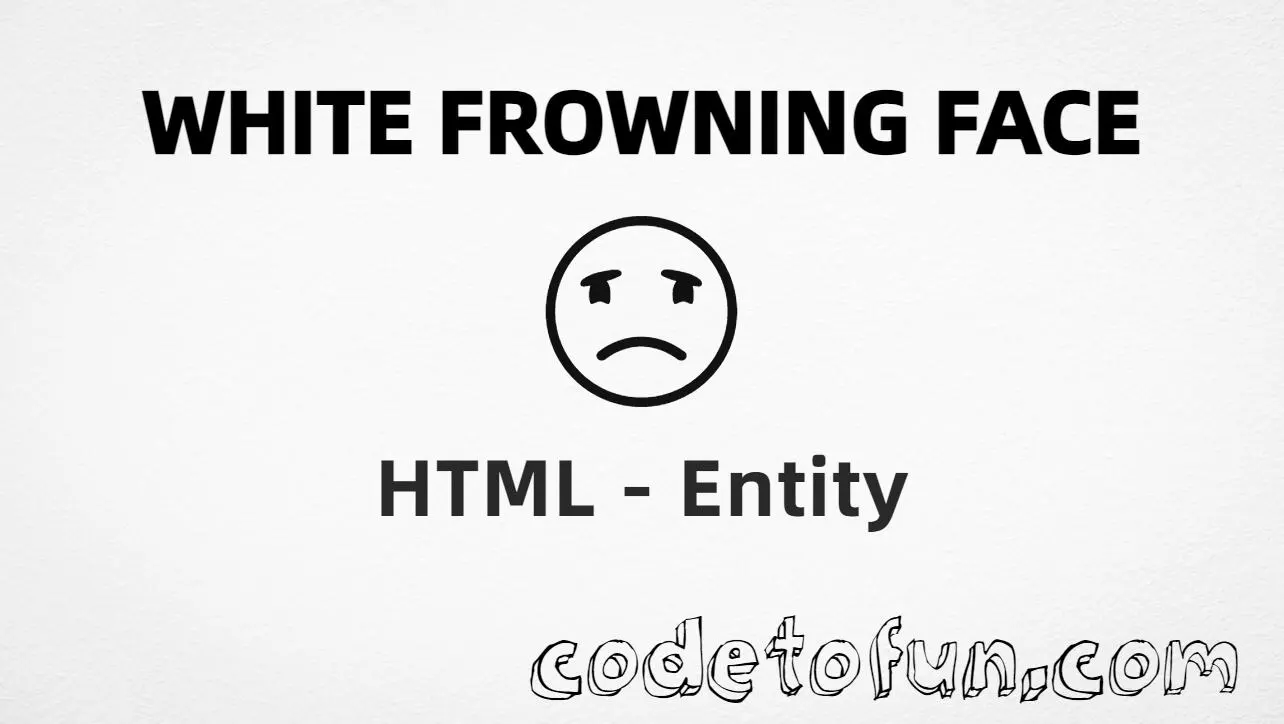
White frowning face (☹) is Unicode U+2639 (WHITE FROWNING FACE) in the Miscellaneous Symbols block. It is a classic outline sad-face emoticon — useful for feedback UI and vintage-style emotion. HTML5 has no named entity for this character.
Remember
Character     ☹
Unicode       U+2639
Hex entity    ☹
Decimal       ☹
CSS escape    \2639
Named entity  (none)
Not the same  ☺ U+263A (white smiling face)
All of these produce the same glyph: ☹. Prefer typing ☹ in UTF-8 when you can; use numeric or CSS forms for generated content.
White frowning face using Hex Code: ☹
White frowning face using HTML Code: ☹
White frowning face using CSS Entity: ☹
Typed directly: ☹
How It Works
1. Hex:U+2639 → ☹ in HTML. The browser turns it into ☹.
2. Decimal: same code point as 9785 → ☹. Same result as hex.
3. CSS: use \2639 in content (not an HTML entity). #point::after appends that ☹ after the paragraph text.
4. Typed ☹: fine in UTF-8 source. There is no named entity for this symbol.
Pitfalls & Tips
Common mistakes when working with white frowning face (☹).
☺
Not smiling face
☹ is sad. For the happy outline face use ☺ (U+263A).
Emoji
Not modern emoji
🙁 (U+1F641) is a different, colorful emoji character — not U+2639.
Named?
No named entity
HTML5 does not define a named entity for U+2639. Use numeric forms when an entity is required.
a11y
Say “Sad”
Screen readers may not announce the face clearly. Pair the glyph with visible or visually hidden text.
Fonts
Check glyph support
Some fonts omit classic face symbols. Provide a fallback stack that includes a symbol-capable font.
Semicolon
End references
Always finish with ; — write ☹, not ☹.
Compatibility
Browser Support
White frowning face (U+2639) and its entity forms (☹, ☹, CSS \\2639) are supported in all mainstream browsers. Glyph quality depends on font support for Miscellaneous Symbols.
✓ Universal support
White Frowning Face (☹)
Type ☹, or encode with hex, decimal, or CSS escape — same glyph everywhere encoding is supported.
100%Browser coverage
Google ChromeSupported
Yes
Microsoft EdgeSupported
Yes
Mozilla FirefoxSupported
Yes
Apple SafariSupported
Yes
OperaSupported
Yes
Internet ExplorerAll versions
Yes
U+2639 / entitiesFull support
Bottom line: Prefer a typed ☹ or ☹ / ☹ for markup. Use \\2639 only inside CSS content.
Remember
Key Takeaways
Unicode: white frowning face is U+2639 (decimal 9785).
HTML: prefer typing ☹, or use ☹ / ☹.
CSS: use \2639 inside content for generated icons.
Watch out: no named entity; ☹ ≠ ☺; not the modern emoji.
One line:U+2639 → type ☹ / ☹ / ☹ / CSS \2639.
Frequently Asked Questions
Use ☹ (hex), ☹ (decimal), or the CSS escape \2639 in the content property. All render ☹. You can also paste ☹ directly if your file is UTF-8. There is no named HTML entity.
U+2639 (hex 2639, decimal 9785). Unicode names it WHITE FROWNING FACE. It belongs to the Miscellaneous Symbols block (U+2600–U+26FF).
No. HTML5 does not define a named entity for this symbol. Use ☹ or ☹ in markup, or \2639 in CSS.
☹ (U+2639) is the classic outline frowning face. ☺ (U+263A) is white smiling face. 🙁 (U+1F641) is the modern slightly frowning face emoji. They are different code points.
HTML entities (☹ or ☹) go in markup. The CSS escape \2639 is used in stylesheets (usually in the content property of ::before/::after). Both render ☹.
Use ☹ for vintage-style emotion, feedback UI, and classic emoticon looks. Prefer modern emoji when you want colorful emoji presentation. Always pair the glyph with visible text when emotion matters for accessibility.
🤔
Did you know?
White frowning face is Unicode U+2639 (decimal 9785) in the Miscellaneous Symbols block — official name WHITE FROWNING FACE. HTML5 has no named entity for it. It is a classic outline sad face — not the same as ☺ (white smiling face) or the emoji 🙁.