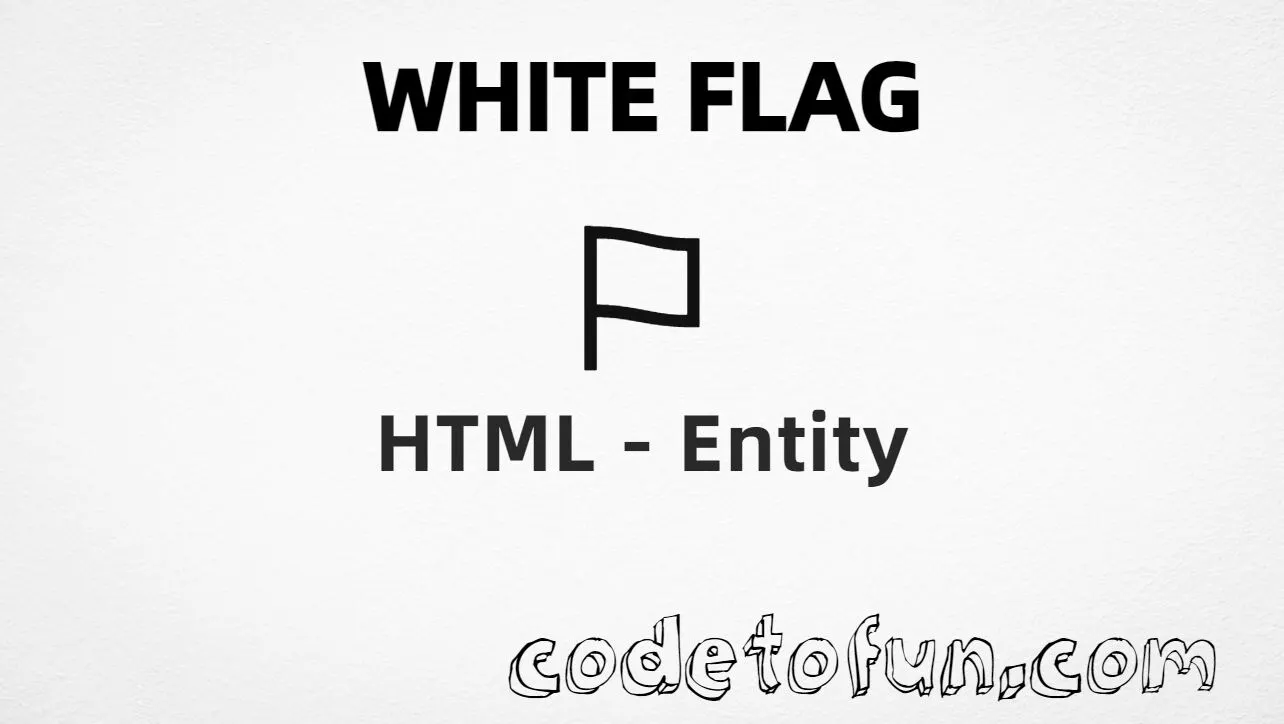
White flag (⚐) is Unicode U+2690 (WHITE FLAG) in the Miscellaneous Symbols block. It is an outline flag on a pole — often used for surrender, truce, or game UI markers. HTML5 has no named entity for this character.
Remember
Character     ⚐
Unicode       U+2690
Hex entity    ⚐
Decimal       ⚐
CSS escape    \2690
Named entity  (none)
Not the same  ⚑ U+2691 (black flag)
All of these produce the same glyph: ⚐. Prefer typing ⚐ in UTF-8 when you can; use numeric or CSS forms for generated content.
One page that shows ⚐ with hex, decimal, CSS escape, and a typed character. Use View Output or open the live editor.
Hex + Decimal + CSS + Typed
Four ways to produce ⚐ in a single document.
html
<!DOCTYPE html>
<html lang="en">
<head>
<meta charset="UTF-8">
<title>White Flag (⚐) in HTML</title>
<style>
#point::after {
content: "\2690";
}
</style>
</head>
<body>
<p>White flag using Hex Code: ⚐</p>
<p>White flag using HTML Code: ⚐</p>
<p id="point">White flag using CSS Entity: </p>
<p>Typed directly: ⚐</p>
</body>
</html>
U+1F3F3 is the waving white flag emoji — a different character from U+2690.
Named?
No named entity
HTML5 does not define a named entity for U+2690. Use numeric forms when an entity is required.
a11y
Say “White flag”
Screen readers may not announce the symbol clearly. Pair the glyph with visible or visually hidden text.
Fonts
Check glyph support
Some fonts omit Miscellaneous Symbols flags. Provide a fallback stack that includes a symbol-capable font.
Semicolon
End references
Always finish with ; — write ⚐, not ⚐.
Compatibility
Browser Support
White flag (U+2690) and its entity forms (⚐, ⚐, CSS \\2690) are supported in all mainstream browsers. Glyph quality depends on font support for Miscellaneous Symbols.
✓ Universal support
White Flag (⚐)
Type ⚐, or encode with hex, decimal, or CSS escape — same glyph everywhere encoding is supported.
100%Browser coverage
Google ChromeSupported
Yes
Microsoft EdgeSupported
Yes
Mozilla FirefoxSupported
Yes
Apple SafariSupported
Yes
OperaSupported
Yes
Internet ExplorerAll versions
Yes
U+2690 / entitiesFull support
Bottom line: Prefer a typed ⚐ or ⚐ / ⚐ for markup. Use \\2690 only inside CSS content.
Remember
Key Takeaways
Unicode: white flag is U+2690 (decimal 9872).
HTML: prefer typing ⚐, or use ⚐ / ⚐.
CSS: use \2690 inside content for generated icons.
Watch out: no named entity; ⚐ ≠ ⚑; not the waving emoji.
One line:U+2690 → type ⚐ / ⚐ / ⚐ / CSS \2690.
Frequently Asked Questions
Use ⚐ (hex), ⚐ (decimal), or the CSS escape \2690 in the content property. All render ⚐. You can also paste ⚐ directly if your file is UTF-8. There is no named HTML entity.
U+2690 (hex 2690, decimal 9872). Unicode names it WHITE FLAG. It belongs to the Miscellaneous Symbols block (U+2600–U+26FF).
No. HTML5 does not define a named entity for this symbol. Use ⚐ or ⚐ in markup, or \2690 in CSS.
⚐ (U+2690) is the outline white flag symbol. ⚑ (U+2691) is black flag. The waving white flag emoji is U+1F3F3 (often shown with a variation selector). They are different code points.
HTML entities (⚐ or ⚐) go in markup. The CSS escape \2690 is used in stylesheets (usually in the content property of ::before/::after). Both render ⚐.
Use ⚐ for game UI, surrender/truce indicators, and symbolic content. Prefer the emoji form only when you specifically want a colorful emoji. Pair the glyph with visible text for accessibility.
🤔
Did you know?
White flag is Unicode U+2690 (decimal 9872) in the Miscellaneous Symbols block — official name WHITE FLAG. HTML5 has no named entity for it. It is an outline flag on a pole — not the same as ⚑ (black flag) or the waving white flag emoji 🏳.