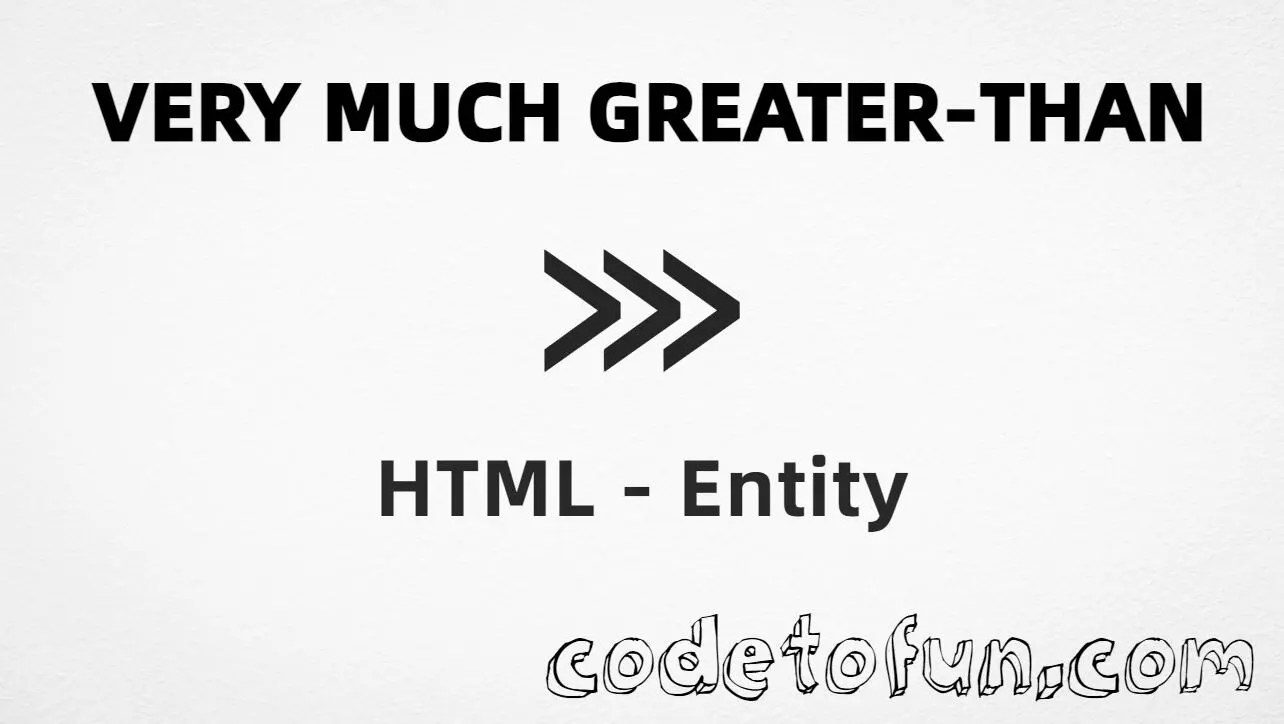
Very much greater-than (⋙) is the mathematical relation at Unicode U+22D9. HTML5 provides ⋙ and ⋙. Do not confuse it with much greater-than ≫ (≫) or ordinary > (>).
Remember
Character     ⋙
Unicode       U+22D9
Named entity  ⋙  (also ⋙)
Hex entity    ⋙
Decimal       ⋙
CSS escape    \22D9
Not the same  ≫ (≫) · > · >>>
Named, hex, decimal, CSS, and a typed character all produce the same glyph: ⋙. Prefer ⋙ or ⋙ in mathematical HTML. For the opposite relation see very much less-than; for double ≫ see much greater-than.
Using Named Entity: ⋙
Using Hex Code: ⋙
Using HTML Code: ⋙
Using CSS Entity: ⋙
Relation: x ⋙ y
How It Works
1. Named:⋙ (or ⋙) is the clearest HTML form and renders ⋙. Note: ≫ (two g’s) is much greater-than ≫, not this symbol.
2. Hex:U+22D9 → ⋙ in HTML. Same result as the named entity.
3. Decimal: same code point as 8921 → ⋙. Same result as hex and named.
4. CSS: use \22D9 in content (not an HTML entity). #point::after appends that ⋙ after the paragraph text.
Pitfalls & Tips
Common mistakes when working with very much greater-than.
Prefer
Use ⋙ or ⋙
Either named form is clearer than numeric references and is defined in HTML5.
vs ≫
≫ ≠ ⋙
≫ / ≫ is ≫ (U+226B). ⋙ / ⋙ is ⋙ (U+22D9). Count the g’s.
vs >
Not ordinary greater-than
> is > (U+003E). Use ⋙ only when you need the triple symbol.
vs >>>
Not three ASCII characters
Typing >>> creates three greater-than signs. Use ⋙ for the single ⋙ symbol.
CSS vs HTML
Do not mix escapes
\22D9 belongs in CSS. ⋙ / ⋙ / ⋙ belong in HTML.
Semicolon
End references
Always finish with ; — write ⋙, not &Gg.
Compatibility
Browser Support
Very much greater-than (U+22D9) and its entity forms (⋙, ⋙, ⋙, ⋙, CSS \\22D9) are supported in all mainstream browsers with a Unicode-capable font.
✓ Universal support
Very Much Greater Than (⋙)
Encode with named, hex, decimal, or CSS escape — or type ⋙ directly in UTF-8 HTML.
100%Browser coverage
Google ChromeSupported
Yes
Microsoft EdgeSupported
Yes
Mozilla FirefoxSupported
Yes
Apple SafariSupported
Yes
OperaSupported
Yes
Internet ExplorerIE 9+
Yes*
U+22D9 / ⋙Full support
Bottom line: Prefer ⋙ or ⋙ in mathematical HTML. Use \\22D9 only inside CSS content.
Remember
Key Takeaways
Unicode: very much greater-than is U+22D9 (decimal 8921).
HTML: prefer ⋙ or ⋙.
CSS: use \22D9 inside content for generated text.
Lookalikes: not ≫ (≫), not > (>), not ASCII >>>.
Use ⋙ or ⋙ (named), ⋙ (hex), ⋙ (decimal), or the CSS escape \22D9 in the content property. All render ⋙. Prefer ⋙ or ⋙ in mathematical HTML.
U+22D9 (VERY MUCH GREATER-THAN). Hex 22D9, decimal 8921. It belongs to the Mathematical Operators block.
Yes. HTML5 defines ⋙ and ⋙ for ⋙.
Use it for mathematical inequalities where one quantity is very much larger than another — a stronger comparison than much greater-than (≫).
HTML entities (⋙, ⋙, or ⋙) go in markup. The CSS escape \22D9 is used in stylesheets (usually in the content property of ::before/::after). Both render ⋙.
No. Very much greater-than is ⋙ (⋙, U+22D9). Much greater-than is ≫ (≫, U+226B). Three ASCII >>> characters are not the same as the single ⋙ symbol.
🤔
Did you know?
Very much greater-than is Unicode U+22D9 (decimal 8921) — VERY MUCH GREATER-THAN in Mathematical Operators. HTML5 provides ⋙ and ⋙. It is not the same as much greater-than ≫ / ≫ (≫, U+226B), ordinary > (>), or three ASCII >>> characters.