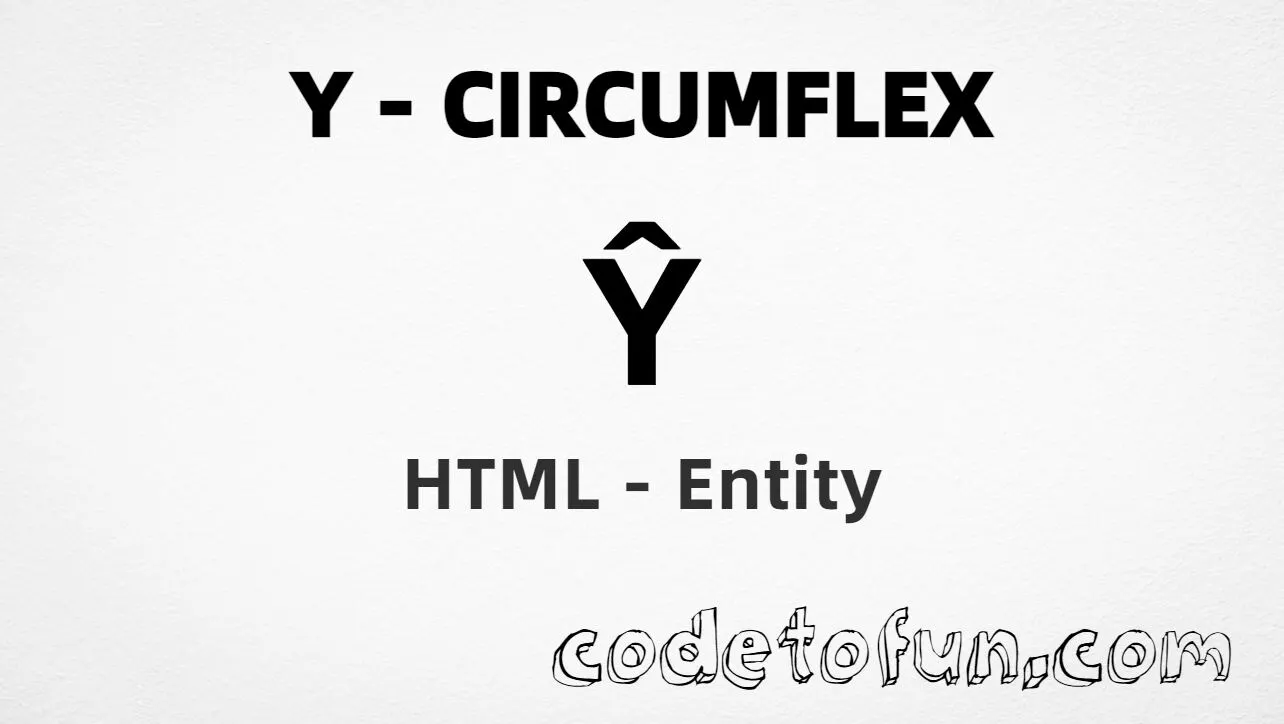
HTML Entity for Uppercase Y Circumflex (Ŷ)

Beginner
5 min read
Updated: Sep 2026
1 example
Unicode U+0176

What Is Uppercase Y Circumflex?

Uppercase Y circumflex (Ŷ) is the Unicode character at U+0176 in Latin Extended-A. Official name: LATIN CAPITAL LETTER Y WITH CIRCUMFLEX — a capital Y with a circumflex (ˆ) above, used especially in Welsh.

Remember
Character     Ŷ
Unicode       U+0176
Named entity  Ŷ  (capital Y)
Hex entity    Ŷ
Decimal       Ŷ
CSS escape    \0176
Not the same  ŷ · Ý · Y

Prefer Ŷ in HTML markup — the capital Y in the name matters. Numeric forms and typing Ŷ in UTF-8 also work. For the lowercase letter, use ŷ (ŷ).

Quick Reference

One table for every form you will actually use.

FormCodeWhere it goes
Named entityŶHTML markup (preferred)
Direct characterŶHTML text (UTF-8)
Hex entityŶHTML markup
Decimal entityŶHTML markup
CSS escape\0176Stylesheet content
Lowercase (related)ŷ (U+0177)Named ŷ

When to Use Which

SituationUse
Capital Y with circumflex (Ŷ)Ŷ or type Ŷ
Lowercase y with circumflex (ŷ)ŷ (ŷ)
Capital Y with acute (Ý)Ý (Ý)
Capital Y with diaeresis (Ÿ)Ÿ (Ÿ)
Plain capital YY (U+0059)
Generated text via ::before / ::aftercontent: "\0176"

Live Preview

Uppercase Y circumflex rendered alone and next to related letters.

Large glyph Ŷ
Notation TŶ
Compared Ŷ  |  ŷ  |  Ý
Hint Compare: Circumflex Ŷ | Lower ŷ | Acute Ý | Plain Y
With entities Named: Ŷ | Hex: Ŷ | Decimal: Ŷ

Complete HTML Example

One page that shows the letter with named, hex, decimal, CSS escape, and a typed character. Use View Output or open the live editor.

Named + Hex + Decimal + CSS + Typed

Five ways to produce Ŷ, plus a short Welsh word example.

html
<!DOCTYPE html>
<html lang="en">
<head>
  <meta charset="UTF-8">
  <title>Uppercase Y Circumflex (Ŷ)</title>
  <style>
    #point::after {
      content: "\0176";
    }
  </style>
</head>
<body>
  <p>Using Named Entity: &Ycirc;</p>
  <p>Using Hex Code: &#x176;</p>
  <p>Using HTML Code: &#374;</p>
  <p id="point">Using CSS Entity: </p>
  <p>Typed directly: Ŷ</p>
  <p lang="cy">Word: T&Ycirc;</p>
</body>
</html>
Try It Yourself

How It Works

1. Named: &Ycirc; (capital Y) is the clearest HTML form for U+0176. Lowercase &ycirc; is a different character (ŷ).

2. Hex: U+0176 → &#x176; in HTML. Same glyph as the named entity.

3. Decimal: same code point as 374 → &#374;. Same glyph as hex and named.

4. CSS: use \0176 in content (not an HTML entity). #point::after appends that Ŷ after the paragraph text.

5. Typed / word: paste Ŷ in UTF-8, or build Welsh forms like T&Ycirc; with lang="cy".

Pitfalls & Tips

Common mistakes when working with U+0176.

Case

&Ycirc; ≠ &ycirc;

&Ycirc; → Ŷ (capital). &ycirc; → ŷ (lowercase). Entity names are case-sensitive.

vs Ý

Not an acute

Ý (&Yacute;) has an acute (´). Ŷ has a circumflex (ˆ) — different marks.

vs Y

Not plain capital Y

Keyboard Y is U+0059. Use U+0176 only when you need the circumflex form.

Encoding

Keep UTF-8 declared

Latin Extended-A letters display reliably with <meta charset="UTF-8">. Prefer named entities when the source file encoding is uncertain.

CSS vs HTML

Do not mix escapes

\0176 belongs in CSS strings. &Ycirc; / &#x176; / &#374; belong in HTML.

A11y

Use real language context

When Ŷ appears in Welsh words, keep surrounding text and lang accurate (for example cy) so screen readers get useful context.

Browser Support

Uppercase Y circumflex (U+0176) and its entity forms (&Ycirc;, &#x176;, &#374;, CSS \\0176) are supported in all mainstream browsers. Latin Extended-A glyphs are widely available in system fonts.

✓ Universal support

Uppercase Y Circumflex (&#x0176;)

Encode with named, hex, decimal, CSS escape, or type the character — same code point everywhere encoding is supported.

100% Browser coverage
Google Chrome Supported
Yes
Microsoft Edge Supported
Yes
Mozilla Firefox Supported
Yes
Apple Safari Supported
Yes
Opera Supported
Yes
Internet Explorer IE 9+
Yes
U+0176 / &Ycirc; Full support

Bottom line: Prefer &Ycirc; (capital Y) in HTML. Use \\0176 only inside CSS content. Do not confuse with &ycirc; (ŷ), acute Ý, or plain Y.

Key Takeaways

  • Unicode: uppercase Y circumflex is U+0176 (decimal 374) — glyph Ŷ.
  • HTML: prefer &Ycirc; (capital Y) — also &#x176; / &#374;.
  • CSS: use \0176 inside content for generated text.
  • Meaning: Ŷ is capital circumflex — not ŷ (&ycirc;), not Ý (acute), not plain Y.

One line: U+0176 → &Ycirc; / &#x176; / &#374; / CSS \0176.

Frequently Asked Questions

Use &Ycirc; (named), &#x176; (hex), &#374; (decimal), type Ŷ directly in UTF-8, or the CSS escape \0176 in content. Prefer &Ycirc; in normal HTML.
U+0176 (LATIN CAPITAL LETTER Y WITH CIRCUMFLEX). Hex 176, decimal 374. It belongs to Latin Extended-A (U+0100–U+017F).
Yes. Use &Ycirc; (capital Y). Numeric forms &#374; and &#x176; also work. Note: &ycirc; (lowercase) is a different letter (ŷ).
No. Ŷ is U+0176 (&Ycirc;, capital circumflex). ŷ is U+0177 (&ycirc;). Ý is U+00DD (&Yacute;, acute).
Use it for Welsh and other orthographies that need capital Ŷ — not as a substitute for Ý, Ÿ, or plain Y.
HTML entities (&Ycirc;, &#374;, or &#x176;) go in markup. The CSS escape \0176 goes in stylesheet strings (usually content on ::before/::after).

Did you know?

Uppercase Y circumflex is Unicode U+0176 (decimal 374) — glyph Ŷ in Latin Extended-A (U+0100–U+017F). HTML5 names it &Ycirc; (capital Y). Official name: LATIN CAPITAL LETTER Y WITH CIRCUMFLEX. Lowercase is &ycirc; (ŷ, U+0177). Common in Welsh. Do not confuse with acute Ý (&Yacute;) or diaeresis Ÿ (&Yuml;).

Next: Uppercase Y Diaeresis

Learn the HTML entity for uppercase Y with diaeresis (U+0178).

Continue tutorial →

About the author

Mari Selvan M P
Mari Selvan M P 🔗

Developer, cloud engineer, and technical writer

  • Experience 12 years building web and cloud systems
  • Focus Full Stack Development, AWS, and Developer Education

I write practical tutorials so students and working developers can learn by doing—from databases and APIs to deployment on AWS.

8 people found this page helpful