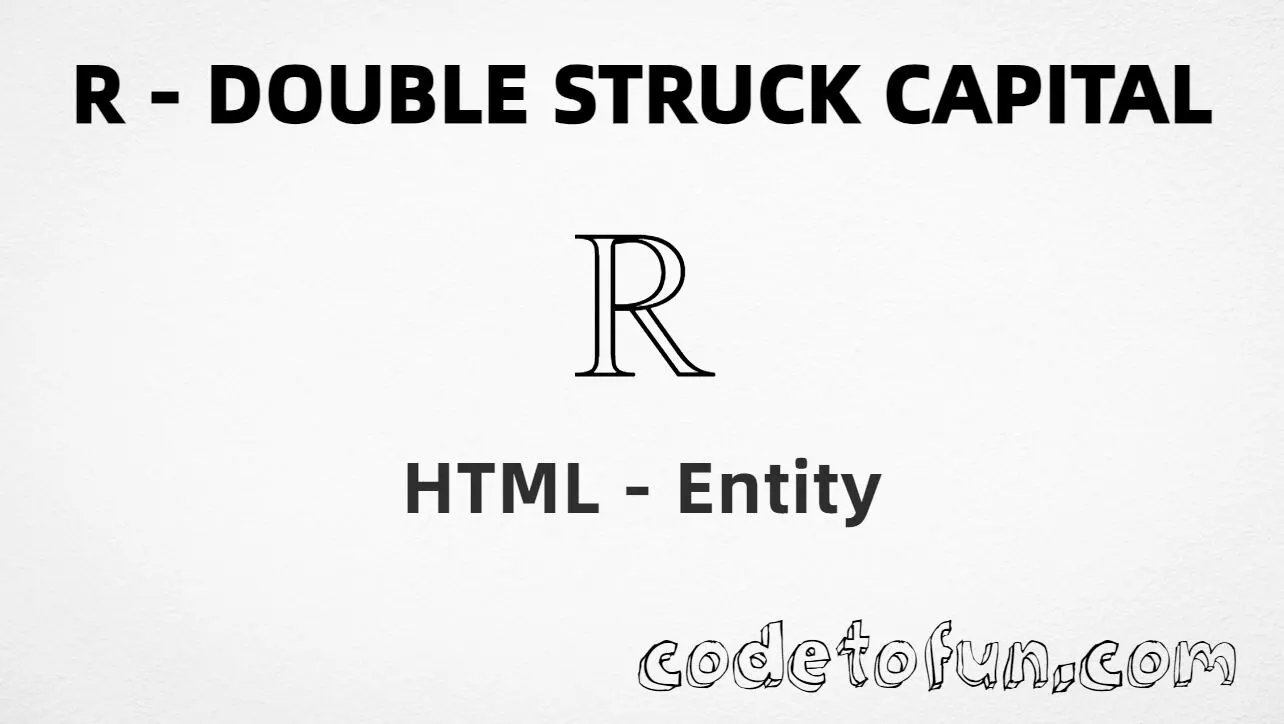
HTML Entity for Uppercase R Double Struck Capital (ℝ)
Beginner
5 min read
Updated: Sep 2026
1 example
Unicode U+211D
Definition
What Is the Uppercase R Double Struck Capital Entity?
Uppercase R Double Struck Capital (ℝ) is the Unicode character at U+211D (DOUBLE-STRUCK CAPITAL R) in Letterlike Symbols. It is the blackboard-bold capital R commonly used for the set of real numbers.
Remember
Character     ℝ
Unicode       U+211D
Hex entity    ℝ
Decimal       ℝ
Named         ℝ  ℝ
CSS escape    \211D
Official name DOUBLE-STRUCK CAPITAL R
All of these produce the same glyph: ℝ. Compare with ordinary Uppercase R (U+0052) and ℜ (U+211C, ℜ).
Prefer U+211D over styling a plain R with a double-struck font when the semantics require the letterlike symbol.
Fonts
Check Letterlike coverage
Some fonts omit U+211D. Prefer fonts with good Letterlike Symbols / math support.
CSS vs HTML
Do not mix escapes
\211D belongs in CSS. Named/numeric entities belong in HTML.
Semicolon
End references
Always finish with ; — write ℝ, not &Ropf.
Compatibility
Browser Support
Uppercase R Double Struck Capital / DOUBLE-STRUCK CAPITAL R (U+211D) and its entity forms (ℝ, ℝ, ℝ, ℝ, CSS \\211D) are supported in all mainstream browsers. Glyph shape depends on the font.
✓ Universal support
Uppercase R Double Struck Capital
Encode with named, hex, decimal, or CSS escape — or paste the character in UTF-8 HTML.
100%Browser coverage
Google ChromeSupported
Yes
Microsoft EdgeSupported
Yes
Mozilla FirefoxSupported
Yes
Apple SafariSupported
Yes
OperaSupported
Yes
Internet ExplorerAll versions
Yes
U+211D / entitiesFull support
Bottom line: Prefer ℝ or ℝ for readable markup; use \\211D only inside CSS content. Do not confuse with ℜ (ℜ).
Remember
Key Takeaways
Unicode: this character is U+211D (decimal 8477) — DOUBLE-STRUCK CAPITAL R.
HTML: prefer ℝ / ℝ, or use ℝ / ℝ.
Use ℝ or ℝ (named), ℝ (hex), ℝ (decimal), or the CSS escape \211D in the content property. All render U+211D.
U+211D (hex 211D, decimal 8477). Unicode names it DOUBLE-STRUCK CAPITAL R. It belongs to Letterlike Symbols and commonly denotes the set of real numbers.
Yes. HTML5 defines ℝ and ℝ — both map to U+211D. Prefer ℝ when meaning the real-numbers set; ℝ is shorter.
ℝ is U+211D (ℝ, double-struck R). ℜ is U+211C (ℜ, black-letter capital R), often used for the real part of a complex number. They are different characters.
Use it in mathematical text for the real numbers set (ℝ), set theory, or other double-struck notation. Prefer ℝ or ℝ for readable markup.
HTML entities (ℝ, ℝ, or ℝ) go in markup. The CSS escape \211D is used in stylesheets (usually in the content property of ::before/::after). Both render the same glyph.
🤔
Did you know?
This character is Unicode U+211D (decimal 8477) — official name DOUBLE-STRUCK CAPITAL R in Letterlike Symbols. HTML5 defines ℝ and ℝ. In mathematics it commonly denotes the set of real numbers ℝ. Do not confuse with ℜ (U+211C, black-letter ℜ).