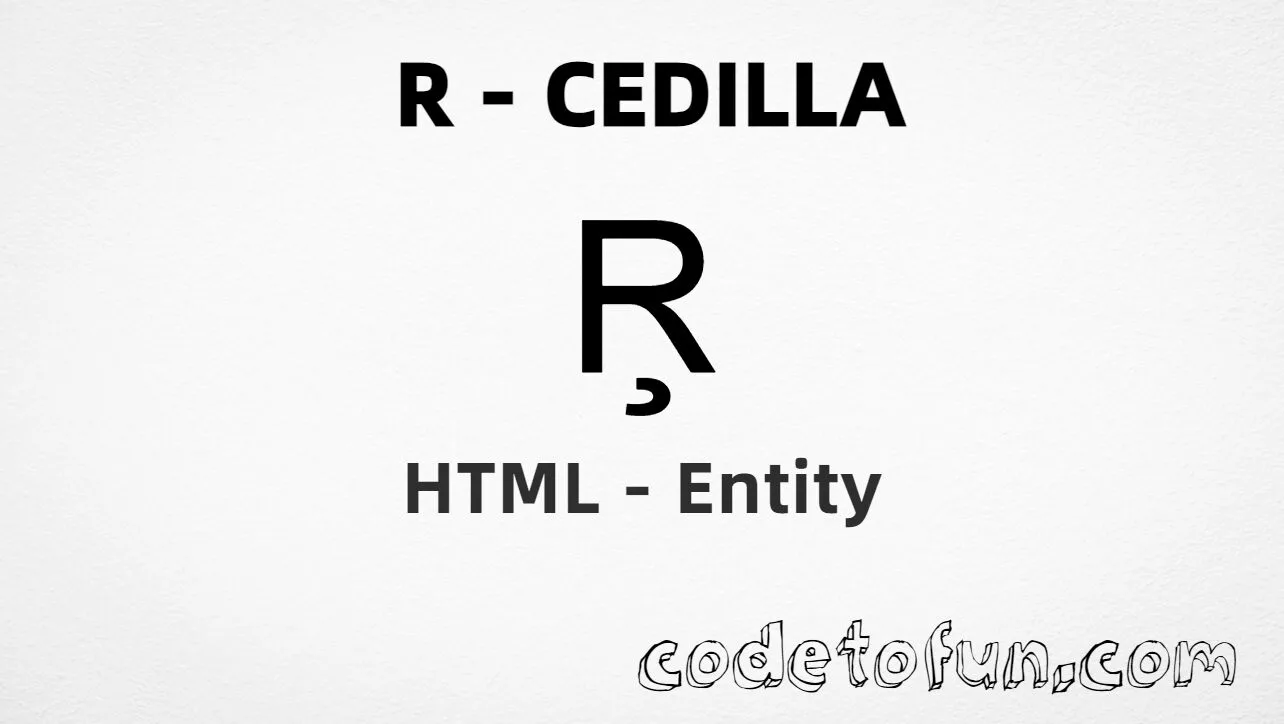
HTML Entity for Uppercase R Cedilla (Ŗ)

Beginner
5 min read
Updated: Sep 2026
1 example
Unicode U+0156

What Is Uppercase R Cedilla?

Uppercase R Cedilla (Ŗ) is the Latin Extended-A character at Unicode U+0156 (LATIN CAPITAL LETTER R WITH CEDILLA). HTML5 names it Ŗ. Use it for historical Latvian orthography and linguistic text that needs Ŗ.

Remember
Character     Ŗ
Unicode       U+0156
Named entity  Ŗ
Hex entity    Ŗ
Decimal       Ŗ
CSS escape    \0156
Not the same  ŗ (ŗ) · R · Ř

Named, hex, decimal, CSS, and a typed character all produce the same glyph: Ŗ. Prefer Ŗ or Ŗ in HTML markup. For the lowercase form see ŗ; for R with caron see uppercase R caron.

Quick Reference

One table for every form you will actually use.

FormCodeWhere it goes
Named entityŖHTML markup (best default)
Hex entityŖHTML markup
Decimal entityŖHTML markup
CSS escape\0156Stylesheet content
Direct characterŖUTF-8 HTML text
Lowercase pairŗ (U+0157)Small letter r with cedilla

When to Use Which

SituationUse
Capital R with cedillaŖ or Ŗ
Numeric-only markupŖ or Ŗ
Generated text via ::before / ::aftercontent: "\0156"
Lowercase r with cedillaUse ŗ (U+0157)
Plain capital RType R (U+0052)
R with caron (Czech / Slovak)Use Ř (U+0158)

Live Preview

Ŗ rendered alone and next to related look-alikes.

Example Case pair: Ŗ / ŗ
Large glyph Ŗ
Named entity Ŗ → Ŗ
vs look-alikes Ŗ  |  ŗ  |  R  |  Ř
With entities Named: Ŗ | Hex: Ŗ | Decimal: Ŗ

Complete HTML Example

One page that shows Uppercase R Cedilla with named, hex, decimal, CSS escape, and a typed character. Use View Output or open the live editor.

Named + Hex + Decimal + CSS + Typed

Five ways to display Ŗ in HTML and CSS.

html
<!DOCTYPE html>
<html lang="en">
<head>
  <meta charset="UTF-8">
  <title>Uppercase R Cedilla (Ŗ)</title>
  <style>
    #point::after {
      content: "\0156";
    }
  </style>
</head>
<body>
  <p>Built with Named: &Rcedil;</p>
  <p>Built with Hex: &#x0156;</p>
  <p>Built with Decimal: &#342;</p>
  <p id="point">Built with CSS: </p>
  <p>Typed: Ŗ</p>
  <p lang="lv">Case pair: &Rcedil; / &rcedil;</p>
</body>
</html>
Try It Yourself

How It Works

1. Named: &Rcedil; is the HTML5 name for U+0156 → Ŗ (case-sensitive: capital R).

2. Hex / decimal: &#x0156; or &#342; insert the same code point.

3. Typed: in a UTF-8 document you can paste Ŗ directly — same glyph, no entity.

4. CSS: use \0156 in content (not an HTML entity). #point::after appends that Ŗ after the paragraph text.

5. Case pair: lowercase is &rcedil; (U+0157, ŗ) — see lowercase R cedilla.

Pitfalls & Tips

Common mistakes when working with Uppercase R Cedilla.

Case

Named entity is case-sensitive

&Rcedil; is Ŗ. &rcedil; is ŗ. Do not mix them.

Plain R

Not the same as plain R

Plain R (U+0052) has no cedilla. Do not substitute it when Ŗ is required.

Ř

Not R with caron

U+0158 (Ř, &Rcaron;) uses a caron, not a cedilla. See uppercase R caron.

Latvian

Mostly historical in Latvian

Modern Latvian usually writes plain R. Use Ŗ when reproducing older orthography or specialized linguistic text.

CSS vs HTML

Do not mix escapes

\0156 belongs in CSS strings. &Rcedil; / &#x0156; / &#342; belong in HTML.

Fonts

Need Latin Extended-A coverage

Some fonts omit U+0156. Prefer fonts that cover Latin Extended-A (U+0100–U+017F).

Browser Support

Uppercase R Cedilla (U+0156) and its entity forms (&Rcedil;, &#x0156;, &#342;, CSS \\0156) are supported in all mainstream browsers when the page is UTF-8 and the font covers Latin Extended-A.

✓ Universal support

Uppercase R Cedilla (Ŗ)

Encode with named, hex, decimal, CSS escape, or type the character — same Unicode code point everywhere.

100% Browser coverage
Google Chrome Supported
Yes
Microsoft Edge Supported
Yes
Mozilla Firefox Supported
Yes
Apple Safari Supported
Yes
Opera Supported
Yes
Internet Explorer All versions
Yes
U+0156 / &Rcedil; Full support

Bottom line: Prefer &Rcedil; in HTML text. Use &#x0156; / &#342; as equivalents, and \\0156 only inside CSS content. Glyph display depends on font coverage.

Key Takeaways

  • Unicode: this letter is U+0156 (decimal 342) — glyph Ŗ.
  • HTML: prefer &Rcedil; — also &#x0156; / &#342;.
  • CSS: use \0156 inside content for generated text.
  • Watch out: Ŗ ≠ plain R ≠ R caron Ř ≠ ŗ.

One line: U+0156 → &Rcedil; / &#x0156; / &#342; / CSS \0156.

Frequently Asked Questions

Use &Rcedil; (named), &#x0156; (hex), &#342; (decimal), or the CSS escape \0156 in the content property. All render Ŗ. Prefer &Rcedil; or &#x0156; for readable markup.
U+0156 (LATIN CAPITAL LETTER R WITH CEDILLA). Hex 0156, decimal 342, named entity &Rcedil;. It belongs to Latin Extended-A (U+0100–U+017F).
Yes. HTML5 defines &Rcedil; for U+0156. It is case-sensitive — write Rcedil with a capital R. Lowercase &rcedil; is a different character (ŗ).
U+0156 (&Rcedil;) is capital R with a cedilla. U+0052 is plain R. U+0158 (&Rcaron;) is R with a caron (háček) — a different accent.
Use it for historical Latvian orthography and linguistic text that needs capital R with cedilla — not as a substitute for plain R or for Czech/Slovak Ř.
HTML entities (&Rcedil;, &#342;, or &#x0156;) go in markup. The CSS escape \0156 is used in stylesheets (usually in the content property of ::before/::after). Both render Ŗ.

Did you know?

Uppercase R Cedilla is Unicode U+0156 (decimal 342) — glyph Ŗ (LATIN CAPITAL LETTER R WITH CEDILLA) in Latin Extended-A. HTML5 names it &Rcedil; (case-sensitive — capital R). Prefer it for older Latvian orthography and linguistic text. Do not confuse it with lowercase &rcedil; (ŗ), plain R, or R caron (&Rcaron;, Ř).

Next: Uppercase R Double Grave

Learn the HTML entity for R with double grave — next in this sequence.

Continue tutorial →

CODETOFUN NEWS

Stay Ahead in Tech

Get the latest IT news, programming updates, and technology trends directly on your phone.

Your daily dose of tech, straight to your feed.

About the author

Mari Selvan M P
Mari Selvan M P 🔗

Developer, cloud engineer, and technical writer

  • Experience 12 years building web and cloud systems
  • Focus Full Stack Development, AWS, and Developer Education

I write practical tutorials so students and working developers can learn by doing—from databases and APIs to deployment on AWS.

8 people found this page helpful