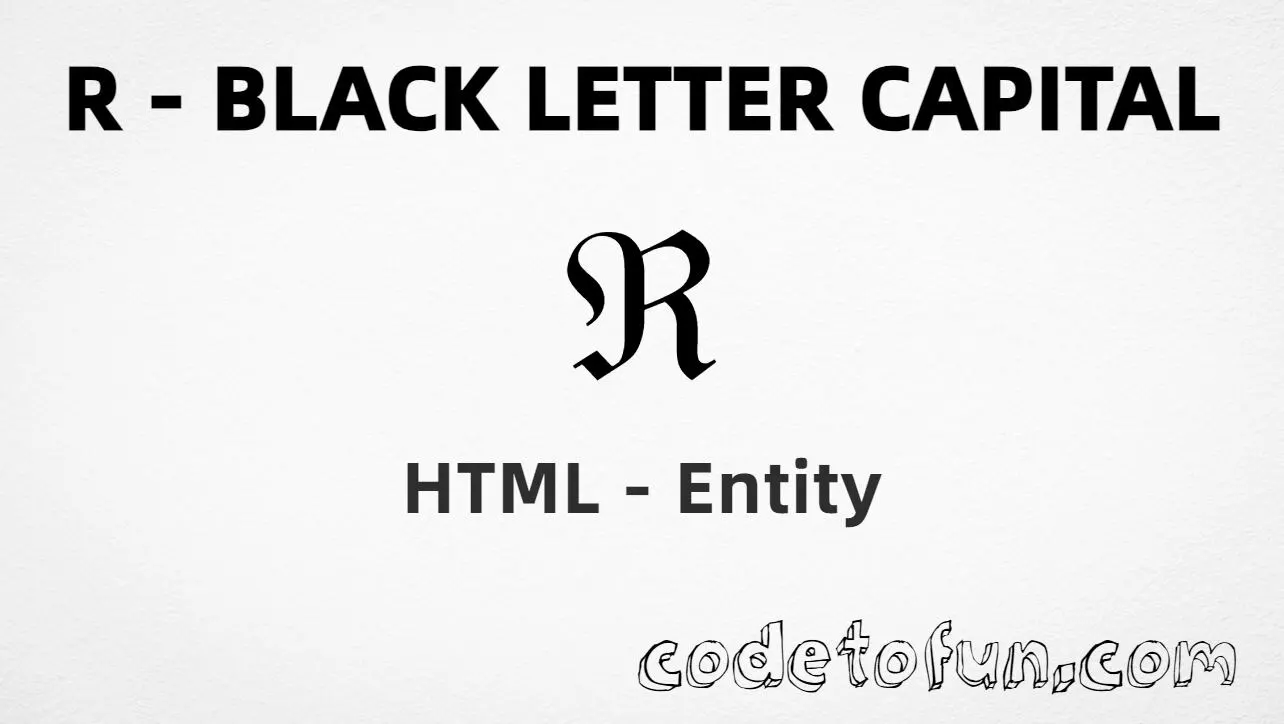
HTML Entity for Uppercase R Black Letter Capital (ℜ)
Beginner
5 min read
Updated: Sep 2026
1 example
Unicode U+211C
Definition
What Is Uppercase R Black Letter Capital?
Uppercase R black letter capital (ℜ) is the Unicode character at U+211C (BLACK-LETTER CAPITAL R) in Letterlike Symbols — a Fraktur-style R used in mathematical notation, most often for the real part of a complex number.
Remember
Character     ℜ
Unicode       U+211C
Named entity  ℜ  (also ℜ · ℜ · ℜ)
Hex entity    ℜ
Decimal       ℜ
CSS escape    \211C
Not the same  R · ℝ · Ŕ · ℑ
Prefer ℜ in HTML markup (aliases ℜ, ℜ, and ℜ also work). Numeric forms and typing ℜ in UTF-8 also work. Use a math-capable font when the black-letter shape matters. Do not confuse this with plain R, double-struck ℝ, or R acute Ŕ.
Using Named Entity: ℜ
Using Hex Code: ℜ
Using HTML Code: ℜ
Using CSS Entity: ℜ
Typed directly: ℜ
Real part: ℜ(z)
How It Works
1. Named:ℜ is the clearest HTML form for U+211C (from “real part”). Aliases ℜ, ℜ, and ℜ produce the same glyph.
2. Hex:U+211C → ℜ in HTML. Same glyph as the named entity.
3. Decimal: same code point as 8476 → ℜ. Same glyph as hex and named.
4. CSS: use \211C in content (not an HTML entity). #point::after appends that ℜ after the paragraph text.
5. Typed / math: paste ℜ in UTF-8, or write ℜ(z) for a short real-part label.
Pitfalls & Tips
Common mistakes when working with U+211C.
vs R
Not a plain capital R
ASCII R (U+0052) is not letterlike. Use ℜ when you need the black-letter real-part symbol.
vs ℝ
Not double-struck R
ℝ (ℝ) is blackboard-bold R for real numbers. ℜ is black-letter for the real part. See uppercase R double struck.
vs bold
Not CSS bold or Fraktur font alone
Styling a letter is not the same as U+211C. This is a dedicated letterlike character.
Fonts
Letterlike coverage varies
Some fonts fall back to a plain or odd R. Prefer Cambria Math, STIX, or another math font for ℜ.
CSS vs HTML
Do not mix escapes
\211C belongs in CSS strings. ℜ / ℜ / ℜ belong in HTML.
Math
Mark math context
For formulas, wrap math in appropriate markup (for example MathML or a math role) so assistive tech can treat it as math.
Compatibility
Browser Support
Black-letter capital R (U+211C) and its entity forms (ℜ, ℜ, ℜ, ℜ, ℜ, ℜ, CSS \\211C) are supported in all mainstream browsers. Visible glyphs depend on Letterlike Symbols font coverage.
✓ Universal support
Uppercase R Black Letter Capital (ℜ)
Encode with named, hex, decimal, CSS escape, or type the character — same code point everywhere encoding is supported.
100%Browser coverage
Google ChromeSupported
Yes
Microsoft EdgeSupported
Yes
Mozilla FirefoxSupported
Yes
Apple SafariSupported
Yes
OperaSupported
Yes
Internet ExplorerIE 9+
Yes
U+211C / ℜFull support
Bottom line: Prefer ℜ in HTML. Use \\211C only inside CSS content. Do not confuse with plain R or ℝ (ℝ).
Remember
Key Takeaways
Unicode: black-letter R is U+211C (decimal 8476) — glyph ℜ.
Use ℜ (named), ℜ (hex), ℜ (decimal), type ℜ directly in UTF-8, or the CSS escape \211C in content. Prefer ℜ in normal HTML. Aliases ℜ, ℜ, and ℜ also work.
U+211C (BLACK-LETTER CAPITAL R). Hex 211C, decimal 8476. It belongs to Letterlike Symbols (U+2100–U+214F).
Yes. Use ℜ (preferred). Numeric forms ℜ and ℜ also work. HTML5 also defines ℜ, ℜ, and ℜ for the same character.
No. ℜ is black-letter capital R (U+211C, ℜ). Plain R is U+0052. ℝ is double-struck capital R (ℝ, U+211D).
Use it in mathematical notation for the real part of a complex number (for example ℜ(z)), or whenever letterlike black-letter R is required — not as a substitute for plain R.
HTML entities (ℜ, ℜ, or ℜ) go in markup. The CSS escape \211C goes in stylesheet strings (usually content on ::before/::after).
🤔
Did you know?
Black-letter capital R is Unicode U+211C (decimal 8476) — glyph ℜ in Letterlike Symbols (U+2100–U+214F). HTML5 names it ℜ (also ℜ, ℜ, ℜ). Official name: BLACK-LETTER CAPITAL R. In mathematics it usually denotes the real part of a complex number. Prefer a math-capable font for the Fraktur look.