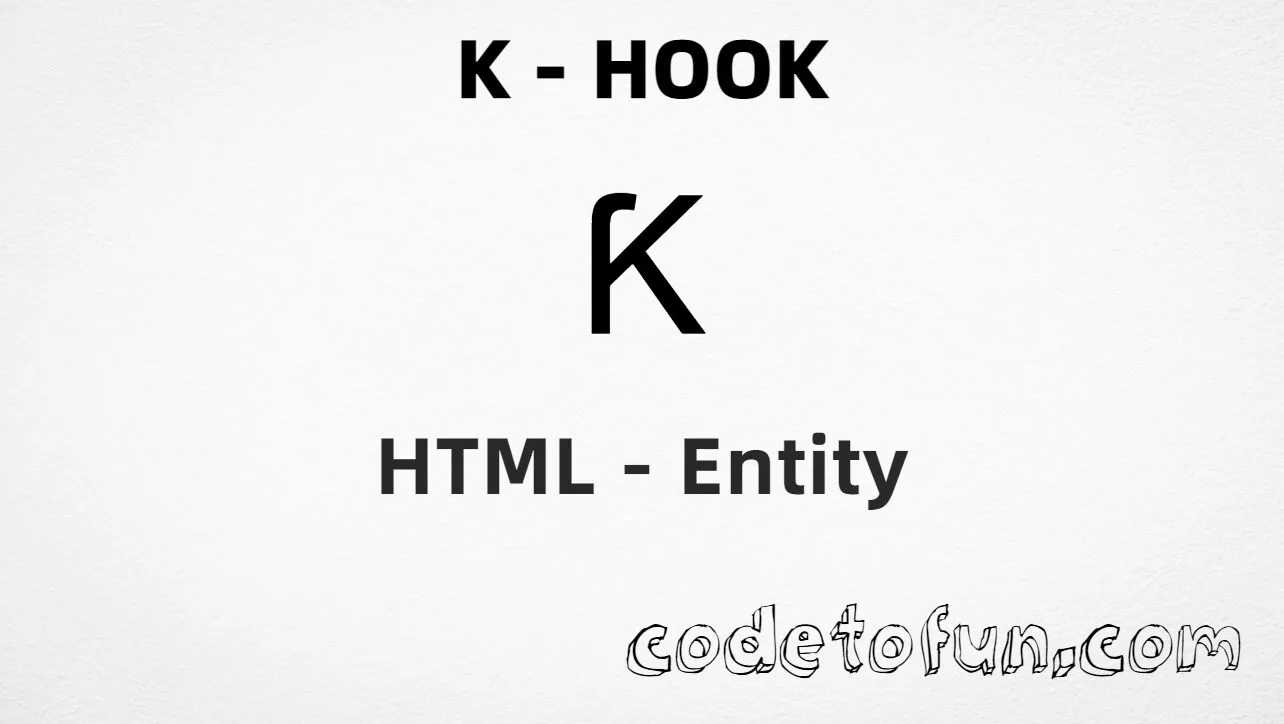
Uppercase K Hook (Ƙ) is the Latin Extended-B character at Unicode U+0198 (LATIN CAPITAL LETTER K WITH HOOK). A hook on capital K distinguishes it from plain K. There is no named HTML entity — use hex or decimal codes for Hausa orthography and phonetic text.
Remember
Character     Ƙ
Unicode       U+0198
Named entity  (none)
Hex entity    Ƙ
Decimal       Ƙ
CSS escape    \0198
Not the same  K · Ķ · ƙ
Hex, decimal, CSS, and a typed character all produce the same glyph: Ƙ. Prefer Ƙ in HTML markup. For plain capital K see uppercase K; for the lowercase pair see lowercase K hook (U+0199).
Some fonts omit U+0198. Prefer fonts that cover Latin Extended-B (U+0180–U+024F).
CSS vs HTML
Do not mix escapes
\0198 belongs in CSS strings. Ƙ / Ƙ belong in HTML.
Case
Case is significant
Ƙ (U+0198) and ƙ (U+0199) are different characters. Use the case your content requires.
Compatibility
Browser Support
Uppercase K Hook (U+0198) and its entity forms (Ƙ, Ƙ, CSS \\0198) are supported in all mainstream browsers when the page is UTF-8 and the font covers Latin Extended-B.
✓ Universal support
Uppercase K Hook (Ƙ)
Encode with hex, decimal, CSS escape, or type the character — same Unicode code point everywhere.
100%Browser coverage
Google ChromeSupported
Yes
Microsoft EdgeSupported
Yes
Mozilla FirefoxSupported
Yes
Apple SafariSupported
Yes
OperaSupported
Yes
Internet ExplorerAll versions
Yes
U+0198 / entitiesFull support
Bottom line: Prefer Ƙ in HTML text. Use Ƙ as an equivalent, and \\0198 only inside CSS content. Glyph display depends on font coverage.
Remember
Key Takeaways
Unicode: this letter is U+0198 (decimal 408) — glyph Ƙ.
HTML: use Ƙ / Ƙ — no named entity.
CSS: use \0198 inside content for generated text.
Watch out: Ƙ ≠ plain K ≠ K cedilla Ķ.
One line:U+0198 → Ƙ / Ƙ / CSS \0198 (no named entity).
Frequently Asked Questions
Use Ƙ (hex), Ƙ (decimal), or the CSS escape \0198 in content. You can also type Ƙ directly in UTF-8 HTML. There is no named HTML entity for U+0198.
U+0198 (LATIN CAPITAL LETTER K WITH HOOK). Hex 0198, decimal 408. It belongs to Latin Extended-B (U+0180–U+024F).
No. HTML5 does not define &Khook; or any other name for this character. Use Ƙ or Ƙ instead.
U+0198 (Ƙ) is capital K with a hook. U+004B is plain K. U+0136 (Ķ) is K with a cedilla — a different mark used in Latvian.
Use it for Hausa orthography, African-language text, and phonetic content that needs capital K with hook — not as a substitute for plain K.
HTML entities (Ƙ or Ƙ) go in markup. The CSS escape \0198 is used in stylesheets (usually in the content property of ::before/::after). Both render Ƙ.
🤔
Did you know?
Uppercase K Hook is Unicode U+0198 (decimal 408) — glyph Ƙ (LATIN CAPITAL LETTER K WITH HOOK) in Latin Extended-B. HTML5 has no named entity — use Ƙ / Ƙ. Used in Hausa orthography and related phonetic notation. Do not confuse it with plain K or K cedilla (Ķ).