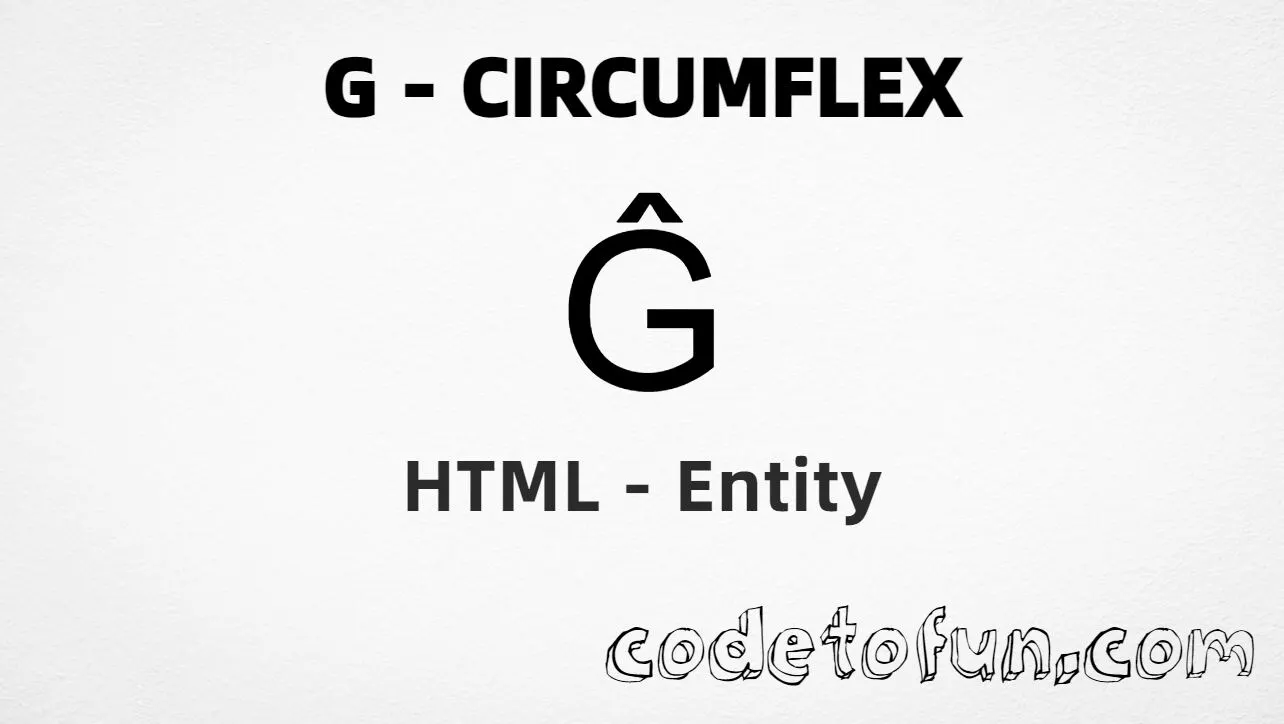
Uppercase G Circumflex (Ĝ) is the Unicode character at U+011C (LATIN CAPITAL LETTER G WITH CIRCUMFLEX) in Latin Extended-A. It is used in Esperanto orthography.
Remember
Character     Ĝ
Unicode       U+011C
Hex entity    Ĝ
Decimal       Ĝ
Named         Ĝ
CSS escape    \011C
Official name LATIN CAPITAL LETTER G WITH CIRCUMFLEX
Lowercase     U+011D (ĝ)
All of these produce the same glyph: Ĝ. Compare with ordinary Uppercase G (U+0047).
Using Hex Code: Ĝ
Using HTML Code: Ĝ
Using Named Entity: Ĝ
Using CSS Entity: Ĝ
Ĝojo, Ĝis
How It Works
1. Hex / decimal:U+011C → Ĝ or Ĝ in HTML.
2. Named:Ĝ is the readable HTML5 alias for the same code point.
3. CSS: use \011C in content (not an HTML entity). #point::after appends that glyph after the paragraph text.
4. Language sample:lang="eo" marks Esperanto context for assistive tech and hyphenation.
Pitfalls & Tips
Common mistakes when working with this character.
Named
Prefer Ĝ
The named entity is easier to read than numeric forms. Keep the trailing semicolon.
Look-alikes
Not plain G
U+011C includes the circumflex. Do not replace it with U+0047 when spelling requires Ĝ.
Case
Use the correct case pair
Lowercase is ĝ (U+011D). Case is case-sensitive in named entities: Ĝ ≠ ĝ.
Combining
Prefer the precomposed form
Use U+011C rather than G + combining circumflex unless you have a specific normalization reason.
CSS vs HTML
Do not mix escapes
\011C belongs in CSS. Named/numeric entities belong in HTML.
Semicolon
End references
Always finish with ; — write Ĝ, not &Gcirc.
Compatibility
Browser Support
Uppercase G Circumflex / LATIN CAPITAL LETTER G WITH CIRCUMFLEX (U+011C) and its entity forms (Ĝ, Ĝ, Ĝ, CSS \\011C) are supported in all mainstream browsers. Glyph shape depends on Latin Extended-A font coverage.
✓ Universal support
Uppercase G Circumflex
Encode with named, hex, decimal, or CSS escape — or paste the character in UTF-8 HTML.
100%Browser coverage
Google ChromeSupported
Yes
Microsoft EdgeSupported
Yes
Mozilla FirefoxSupported
Yes
Apple SafariSupported
Yes
OperaSupported
Yes
Internet ExplorerAll versions
Yes
U+011C / entitiesFull support
Bottom line: Prefer Ĝ for readable markup; use \\011C only inside CSS content.
Remember
Key Takeaways
Unicode: this character is U+011C (decimal 284) — LATIN CAPITAL LETTER G WITH CIRCUMFLEX.
HTML: prefer Ĝ, or use Ĝ / Ĝ.
CSS: use \011C inside content for generated text.
Watch out: lowercase is ĝ; U+011C ≠ U+0047 (plain G).
One line:U+011C → Ĝ / Ĝ / CSS \011C.
Frequently Asked Questions
Use Ĝ (named), Ĝ (hex), Ĝ (decimal), or the CSS escape \011C in the content property. All render U+011C. You can also paste the character directly when your file is UTF-8.
U+011C (hex 011C, decimal 284). Unicode names it LATIN CAPITAL LETTER G WITH CIRCUMFLEX. It belongs to Latin Extended-A and is used in Esperanto.
Yes. HTML5 defines Ĝ for the uppercase form. The lowercase form uses ĝ (U+011D).
U+011C is capital G with a circumflex (Ĝ). U+0047 is ordinary capital G. Do not substitute plain G when the circumflex is required for correct spelling.
The case pair is U+011D (LATIN SMALL LETTER G WITH CIRCUMFLEX, ĝ). Use ĝ, ĝ, or ĝ.
HTML entities (Ĝ, Ĝ, or Ĝ) go in markup. The CSS escape \011C is used in stylesheets (usually in the content property of ::before/::after). Both render the same glyph.
🤔
Did you know?
This character is Unicode U+011C (decimal 284) — official name LATIN CAPITAL LETTER G WITH CIRCUMFLEX in Latin Extended-A. HTML5 defines the named entity Ĝ. Its lowercase pair is U+011D (ĝ).