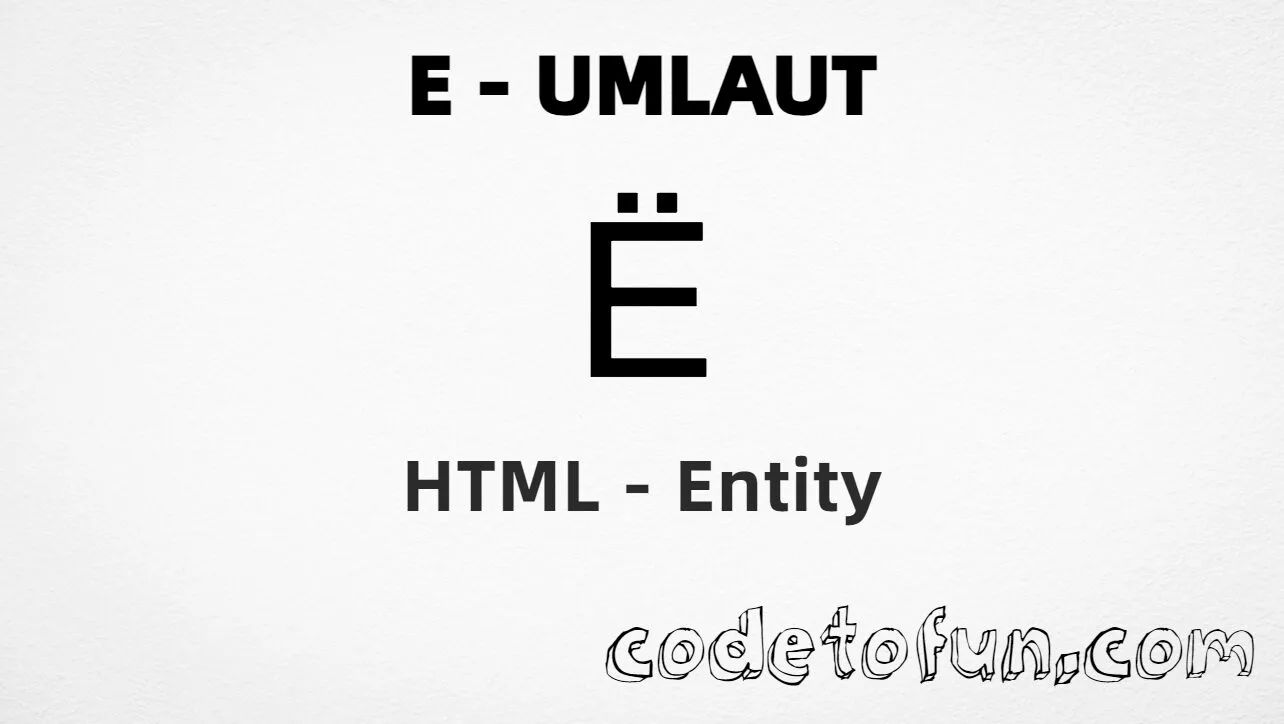
Uppercase E umlaut (Ë) is the Unicode character at U+00CB in Latin-1 Supplement. Official name: LATIN CAPITAL LETTER E WITH DIAERESIS — a capital E with two dots above (umlaut / diaeresis), common in Albanian, French, Dutch, and Luxembourgish.
Remember
Character     Ë
Unicode       U+00CB
Named entity  Ë  (capital E)
Hex entity    Ë
Decimal       Ë
CSS escape    \00CB
Not the same  ë · É · E
Prefer Ë in HTML markup — the capital E in the name matters. Numeric forms and typing Ë in UTF-8 also work. For the lowercase letter, use ë (ë).
É (É) has one mark leaning right. Umlaut / diaeresis is two dots (Ë).
vs E
Not a plain capital E
ASCII E (U+0045) has no dots. Use Ë when the language requires the diaeresis.
Name
Umlaut vs diaeresis
Unicode calls it diaeresis; many languages call the same glyph an umlaut. The HTML entity is still Ë.
CSS vs HTML
Do not mix escapes
\00CB belongs in CSS strings. Ë / Ë / Ë belong in HTML.
A11y
Mark the language
When Ë appears in real words, set lang on the element or page so screen readers pronounce names and titles correctly.
Compatibility
Browser Support
Uppercase E umlaut (U+00CB) and its entity forms (Ë, Ë, Ë, CSS \\00CB) are supported in all mainstream browsers. Visible glyphs are standard in Latin-1 capable fonts.
✓ Universal support
Uppercase E Umlaut (Ë)
Encode with named, hex, decimal, CSS escape, or type the character — same code point everywhere encoding is supported.
100%Browser coverage
Google ChromeSupported
Yes
Microsoft EdgeSupported
Yes
Mozilla FirefoxSupported
Yes
Apple SafariSupported
Yes
OperaSupported
Yes
Internet ExplorerAll versions
Yes
U+00CB / ËFull support
Bottom line: Prefer Ë (capital E) in HTML. Use \\00CB only inside CSS content. Do not confuse with ë (ë).
Remember
Key Takeaways
Unicode: uppercase E umlaut is U+00CB (decimal 203) — glyph Ë.
HTML: prefer Ë (capital E) — also Ë / Ë.
CSS: use \00CB inside content for generated text.
Meaning:Ë is capital diaeresis — not ë (ë), not É (É).
Use Ë (named), Ë (hex), Ë (decimal), type Ë directly in UTF-8, or the CSS escape \00CB in content. Prefer Ë in normal HTML.
U+00CB (LATIN CAPITAL LETTER E WITH DIAERESIS). Hex CB, decimal 203. It belongs to Latin-1 Supplement (U+0080–U+00FF).
Yes. Use Ë (capital E). Numeric forms Ë and Ë also work. Note: ë (lowercase) is a different letter (ë).
No. Ë is U+00CB (Ë, capital diaeresis). ë is U+00EB (ë). É is U+00C9 (É, capital acute).
Use it for Albanian, French, Dutch, Luxembourgish, and other languages that need Ë in titles, names, and uppercase text — not as a substitute for plain E.
HTML entities (Ë, Ë, or Ë) go in markup. The CSS escape \00CB goes in stylesheet strings (usually content on ::before/::after).
🤔
Did you know?
Uppercase E umlaut (diaeresis) is Unicode U+00CB (decimal 203) — glyph Ë in Latin-1 Supplement (U+0080–U+00FF). HTML5 names it Ë (capital E). Official name: LATIN CAPITAL LETTER E WITH DIAERESIS. Lowercase is ë (ë, U+00EB). Common in Albanian, French, Dutch, and Luxembourgish.