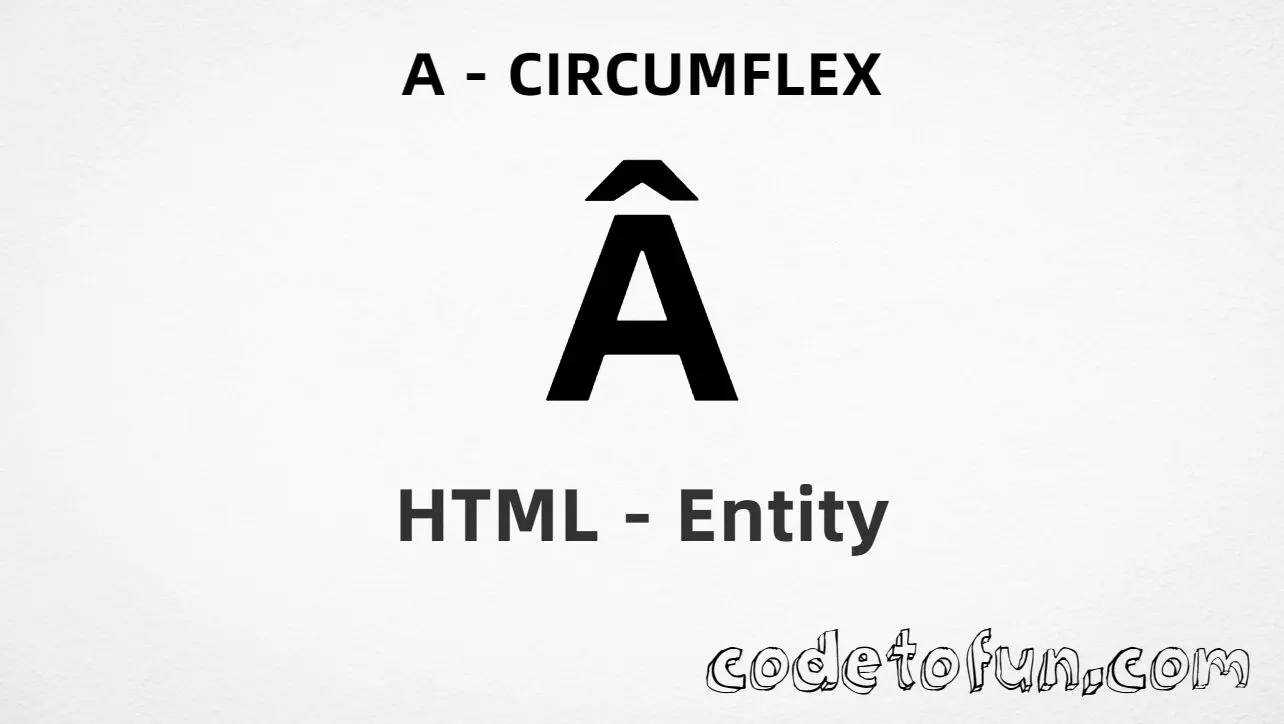
Uppercase A circumflex (Â) is the Unicode character at U+00C2 in Latin-1 Supplement. Official name: LATIN CAPITAL LETTER A WITH CIRCUMFLEX — a capital A with a pointed hat (^ shape), used in French, Portuguese, Welsh, and Romanian.
Remember
Character Â
Unicode U+00C2
Named entity  (capital A)
Hex entity Â
Decimal Â
CSS escape \00C2
Not the same â · Ǎ · Ă
Prefer  in HTML markup — the capital A in the name matters. Numeric forms and typing  in UTF-8 also work. For the lowercase letter, use â (â).
Using Named Entity: Â
Using Hex Code: Â
Using HTML Code: Â
Using CSS Entity: Â
Typed directly: Â
Label: Âge
How It Works
1. Named:Â (capital A) is the clearest HTML form for U+00C2. Lowercase â is a different character (â).
2. Hex:U+00C2 → Â in HTML. Same glyph as the named entity.
3. Decimal: same code point as 194 → Â. Same glyph as hex and named.
4. CSS: use \00C2 in content (not an HTML entity). #point::after appends that  after the paragraph text.
5. Typed / label: paste  in UTF-8, or build French words like Âge with lang="fr".
Pitfalls & Tips
Common mistakes when working with U+00C2.
Case
 ≠ â
 →  (capital). â → â (lowercase). Entity names are case-sensitive.
vs Ǎ
Not a caron
Ǎ (&Acaron;) is a háček. Â is a pointed circumflex — do not swap them in Pinyin vs French/Portuguese.
vs Ă
Not a breve
Ă (Ă) is a short curved mark (Romanian). The circumflex looks similar in some fonts but is a different character.
Encoding
Keep UTF-8 declared
Latin-1 letters display reliably with <meta charset="UTF-8">. Prefer named entities when the source file encoding is uncertain.
CSS vs HTML
Do not mix escapes
\00C2 belongs in CSS strings. Â / Â / Â belong in HTML.
A11y
Use real language context
When  appears in real words (e.g. French), keep surrounding text and lang accurate so screen readers get useful context.
Compatibility
Browser Support
Uppercase A circumflex (U+00C2) and its entity forms (Â, Â, Â, CSS \\00C2) are supported in all mainstream browsers. Latin-1 Supplement glyphs are widely available in system fonts.
✓ Universal support
Uppercase A Circumflex (Â)
Encode with named, hex, decimal, CSS escape, or type the character — same code point everywhere encoding is supported.
100%Browser coverage
Google ChromeSupported
Yes
Microsoft EdgeSupported
Yes
Mozilla FirefoxSupported
Yes
Apple SafariSupported
Yes
OperaSupported
Yes
Internet ExplorerAll versions
Yes
U+00C2 / ÂFull support
Bottom line: Prefer  (capital A) in HTML. Use \\00C2 only inside CSS content. Do not confuse with â (â) or &Acaron; (Ǎ).
Remember
Key Takeaways
Unicode: uppercase A circumflex is U+00C2 (decimal 194) — glyph Â.
HTML: prefer  (capital A) — also  / Â.
CSS: use \00C2 inside content for generated text.
Meaning:Â is capital circumflex — not â (â), not Ǎ (&Acaron;).
Use  (named),  (hex),  (decimal), type  directly in UTF-8, or the CSS escape \00C2 in content. Prefer  in normal HTML.
U+00C2 (LATIN CAPITAL LETTER A WITH CIRCUMFLEX). Hex C2, decimal 194. It belongs to Latin-1 Supplement (U+0080–U+00FF).
Yes. Use  (capital A). Numeric forms  and  also work. Note: â (lowercase) is a different letter (â).
No. Â is U+00C2 (Â, capital circumflex). â is U+00E2 (â). Ǎ is U+01CD (&Acaron;, caron / háček).
Use it for French, Portuguese, Welsh, Romanian, and other languages that need  in titles, names, and uppercase text — not as a substitute for caron Ǎ or breve Ă.
HTML entities (Â, Â, or Â) go in markup. The CSS escape \00C2 goes in stylesheet strings (usually content on ::before/::after).
🤔
Did you know?
Uppercase A circumflex is Unicode U+00C2 (decimal 194) — glyph  in Latin-1 Supplement (U+0080–U+00FF). HTML5 names it  (capital A). Official name: LATIN CAPITAL LETTER A WITH CIRCUMFLEX. Lowercase is â (â, U+00E2). Common in French, Portuguese, Welsh, and Romanian. Do not confuse with caron Ǎ (&Acaron;) or breve Ă (Ă).