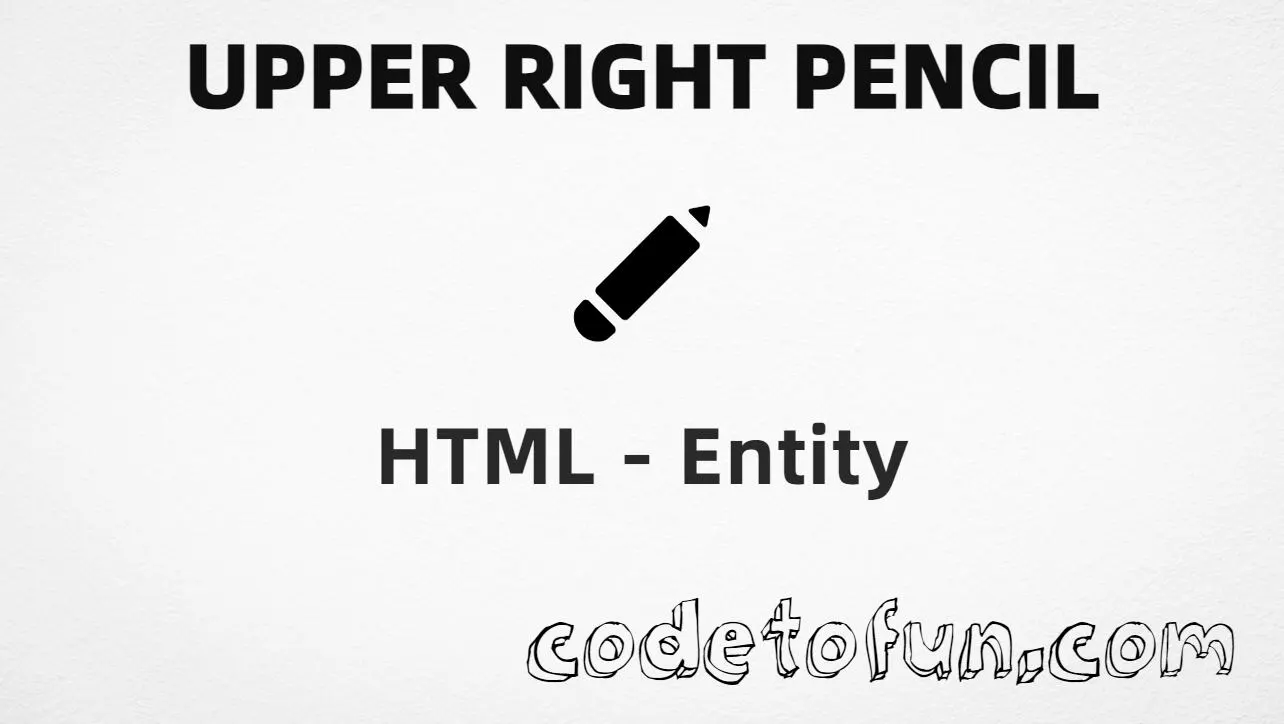
Upper Right Pencil (✐) is the Unicode character at U+2710 (WHITE NIB) in Dingbats. It is commonly used as a pencil or writing icon for notes, annotations, and edit actions.
Remember
Character     ✐
Unicode       U+2710
Hex entity    ✐
Decimal       ✐
CSS escape    \2710
Named entity  (none)
Official name WHITE NIB
All of these produce the same glyph: ✐. Related writing symbols: Lower Right Pencil (U+270E) and Pencil (U+270F).
Using Hex Code: ✐
Using HTML Code: ✐
Using CSS Entity: ✐
Typed directly: ✐
✐ Edit note
How It Works
1. Hex:U+2710 → ✐ in HTML. The browser turns it into the glyph.
2. Decimal: same code point as 10000 → ✐. Same result as hex.
3. CSS: use \2710 in content (not an HTML entity). #point::after appends that glyph after the paragraph text.
4. Typed / label: fine in UTF-8 pages. The ✐ Edit note line shows a common UI pattern.
Pitfalls & Tips
Common mistakes when working with this symbol.
Named?
No named entity
HTML5 does not define a named entity for U+2710. Use numeric forms.
Look-alikes
Pick the right writing glyph
U+2710 is WHITE NIB. U+270E is lower-right pencil. U+270F is pencil. Do not swap them.
Name
Official Unicode name
Unicode calls this WHITE NIB. This site’s page title “Upper Right Pencil” matches the common UI reading of the glyph.
CSS vs HTML
Do not mix escapes
\2710 belongs in CSS. ✐ / ✐ belong in HTML.
A11y
Do not rely on the icon alone
Screen readers may not name this symbol clearly. Keep labels like “Edit” next to the glyph.
Semicolon
End references
Always finish with ; — write ✐, not ✐.
Compatibility
Browser Support
Upper Right Pencil / WHITE NIB (U+2710) and its numeric entity forms (✐, ✐, CSS \\2710) are supported in all mainstream browsers. Glyph shape depends on the font.
✓ Universal support
Upper Right Pencil
Encode with hex, decimal, or CSS escape — or paste the character in UTF-8 HTML.
100%Browser coverage
Google ChromeSupported
Yes
Microsoft EdgeSupported
Yes
Mozilla FirefoxSupported
Yes
Apple SafariSupported
Yes
OperaSupported
Yes
Internet ExplorerAll versions
Yes
U+2710 / entitiesFull support
Bottom line: Use ✐ or ✐ for the Unicode glyph, and \\2710 only inside CSS content. Pair with a text label for accessibility.
Remember
Key Takeaways
Unicode: this symbol is U+2710 (decimal 10000) — WHITE NIB.
HTML: use ✐ or ✐ when you need an entity.
One line:U+2710 → ✐ / ✐ / CSS \2710.
Frequently Asked Questions
Use ✐ (hex), ✐ (decimal), or the CSS escape \2710 in the content property. All render U+2710. You can also paste the character directly when your file is UTF-8.
U+2710 (hex 2710, decimal 10000). Unicode names it WHITE NIB. It belongs to Dingbats (U+2700–U+27BF) and is commonly used as a pencil or edit icon.
No. HTML5 does not define a named entity for this character. Use numeric references like ✐ or ✐.
U+2710 is WHITE NIB (often called upper-right pencil). U+270E is lower-right pencil. U+270F is pencil. They are different Dingbats writing symbols.
HTML entities (✐ or ✐) go in markup. The CSS escape \2710 is used in stylesheets (usually in the content property of ::before/::after). Both render the same glyph.
Use it for edit, note, or annotate UI cues. Always pair the glyph with clear labels such as “Edit” for accessibility.
🤔
Did you know?
This symbol is Unicode U+2710 (decimal 10000) — official name WHITE NIB in Dingbats. HTML5 has no named entity. Related writing symbols include lower-right pencil U+270E and pencil U+270F.