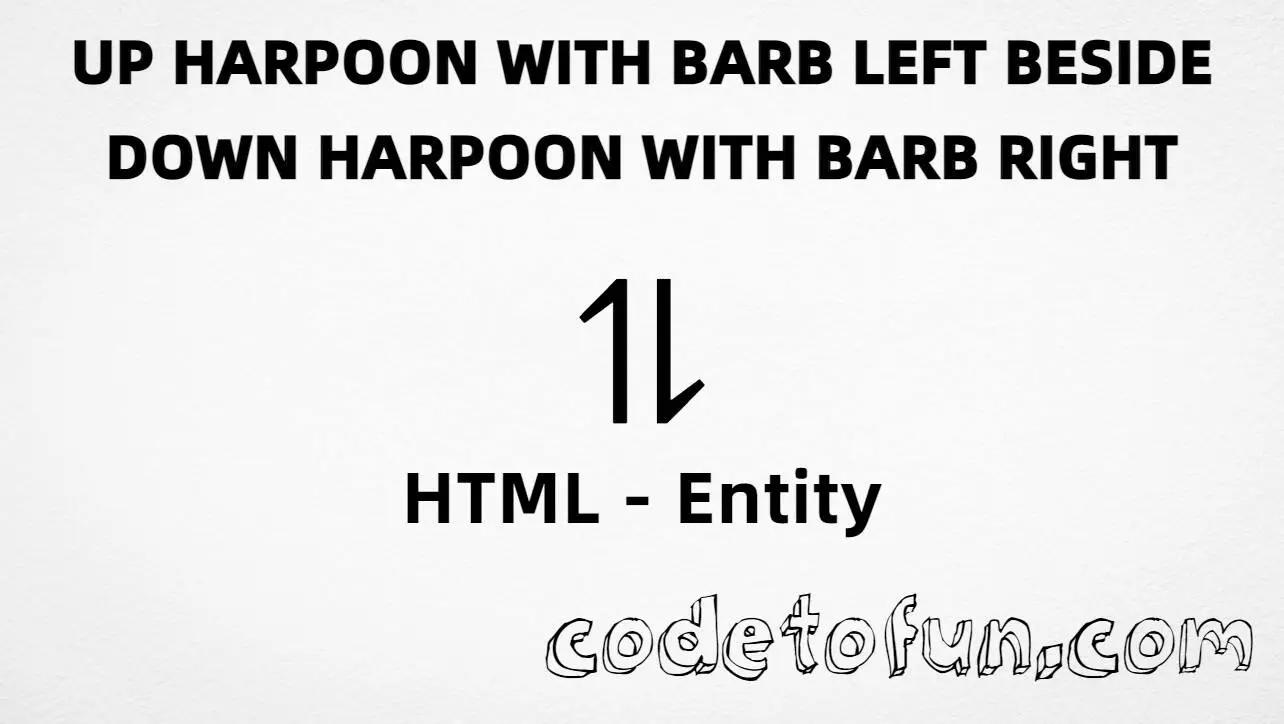
HTML Entity for Up Harpoon Barb Left Beside Down Harpoon Barb Right (⥮)
Beginner
5 min read
Updated: Sep 2026
1 example
Unicode U+296E
Definition
What Is Up Harpoon Barb Left Beside Down Harpoon Barb Right?
This paired harpoon (⥮) is the Unicode character at U+296E in Supplemental Arrows-B. Official name: UPWARDS HARPOON WITH BARB LEFT ABOVE DOWNWARDS HARPOON WITH BARB RIGHT — an up harpoon (barb left) stacked above a down harpoon (barb right).
Remember
Character     ⥮
Unicode       U+296E
Named entity  ⥮
Hex entity    ⥮
Decimal       ⥮
CSS escape    \296E
Not the same  ⥯ · ⇕ · ↿
Prefer ⥮ in HTML markup. Numeric forms and typing ⥮ in UTF-8 also work. For the mirror pair, use ⥯ (⥯).
Using Named Entity: ⥮
Using Hex Code: ⥮
Using HTML Code: ⥮
Using CSS Entity: ⥮
Typed directly: ⥮
Notation: f ⥮ g
How It Works
1. Named:⥮ is the clearest HTML form for U+296E.
2. Hex:U+296E → ⥮ in HTML. Same glyph as the named entity.
3. Decimal: same code point as 10606 → ⥮. Same glyph as hex and named.
4. CSS: use \296E in content (not an HTML entity). #point::after appends that ⥮ after the paragraph text.
5. Typed / notation: paste ⥮ in UTF-8, or write f ⥮ g for a short math label.
Pitfalls & Tips
Common mistakes when working with U+296E.
vs ⥯
Not the mirror pair
⥯ (⥯) flips the stack. Do not swap ⥮ and ⥯.
vs ⇕
Not a double arrow
⇕ (⇕) is a thick double up-down arrow. ⥮ is two harpoons stacked, each with one barb.
Name
Remember ⥮
The name hints at up-down harpoon. Prefer ⥮ over inventing long names.
Fonts
Needs Supplemental Arrows-B coverage
Many UI fonts omit paired harpoons. Prefer a stack that includes a math or symbols font if the glyph must always show.
CSS vs HTML
Do not mix escapes
\296E belongs in CSS strings. ⥮ / ⥮ / ⥮ belong in HTML.
A11y
Name the relation in context
Screen readers may announce this unevenly. Prefer nearby plain-language text such as “up-down harpoon pair” when the symbol carries meaning.
Compatibility
Browser Support
Paired harpoon (U+296E) and its entity forms (⥮, ⥮, ⥮, CSS \\296E) are supported in all mainstream browsers. Visible glyphs depend on Supplemental Arrows-B font coverage.
✓ Universal support
Paired Harpoons (⥮)
Encode with named, hex, decimal, CSS escape, or type the character — same code point everywhere encoding is supported.
100%Browser coverage
Google ChromeSupported
Yes
Microsoft EdgeSupported
Yes
Mozilla FirefoxSupported
Yes
Apple SafariSupported
Yes
OperaSupported
Yes
Internet ExplorerAll versions
Yes
U+296E / ⥮Full support
Bottom line: Prefer ⥮ in HTML. Use \\296E only inside CSS content. Do not confuse with ⥯ (⥯).
Remember
Key Takeaways
Unicode: this paired harpoon is U+296E (decimal 10606) — glyph ⥮.
HTML: prefer ⥮ — also ⥮ / ⥮.
CSS: use \296E inside content for generated text.
Meaning:⥮ up-left above down-right — not ⥯ (⥯), not ⇕ (⇕).
Use ⥮ (named), ⥮ (hex), ⥮ (decimal), type ⥮ directly in UTF-8, or the CSS escape \296E in content. Prefer ⥮ in normal HTML.
U+296E (UPWARDS HARPOON WITH BARB LEFT ABOVE DOWNWARDS HARPOON WITH BARB RIGHT). Hex 296E, decimal 10606. It belongs to Supplemental Arrows-B (U+2900–U+297F).
Yes. Use ⥮ (or ⥮). Numeric forms ⥮ and ⥮ also work.
No. ⥮ is U+296E (⥮, up-left above down-right harpoons). ⇕ is U+21D5 (⇕, double arrow). ⥯ is U+296F (⥯, the mirror pair).
Use it in math or physics diagrams that need this exact stacked harpoon pair — not as a substitute for a plain up-down double arrow ⇕.
HTML entities (⥮, ⥮, or ⥮) go in markup. The CSS escape \296E goes in stylesheet strings (usually content on ::before/::after).
🤔
Did you know?
This paired harpoon is Unicode U+296E (decimal 10606) — glyph ⥮ in Supplemental Arrows-B (U+2900–U+297F). HTML5 names it ⥮ (also ⥮). Official name: UPWARDS HARPOON WITH BARB LEFT ABOVE DOWNWARDS HARPOON WITH BARB RIGHT. Do not confuse with the mirror U+296F (⥯, ⥯) or double arrow U+21D5 (⇕, ⇕).