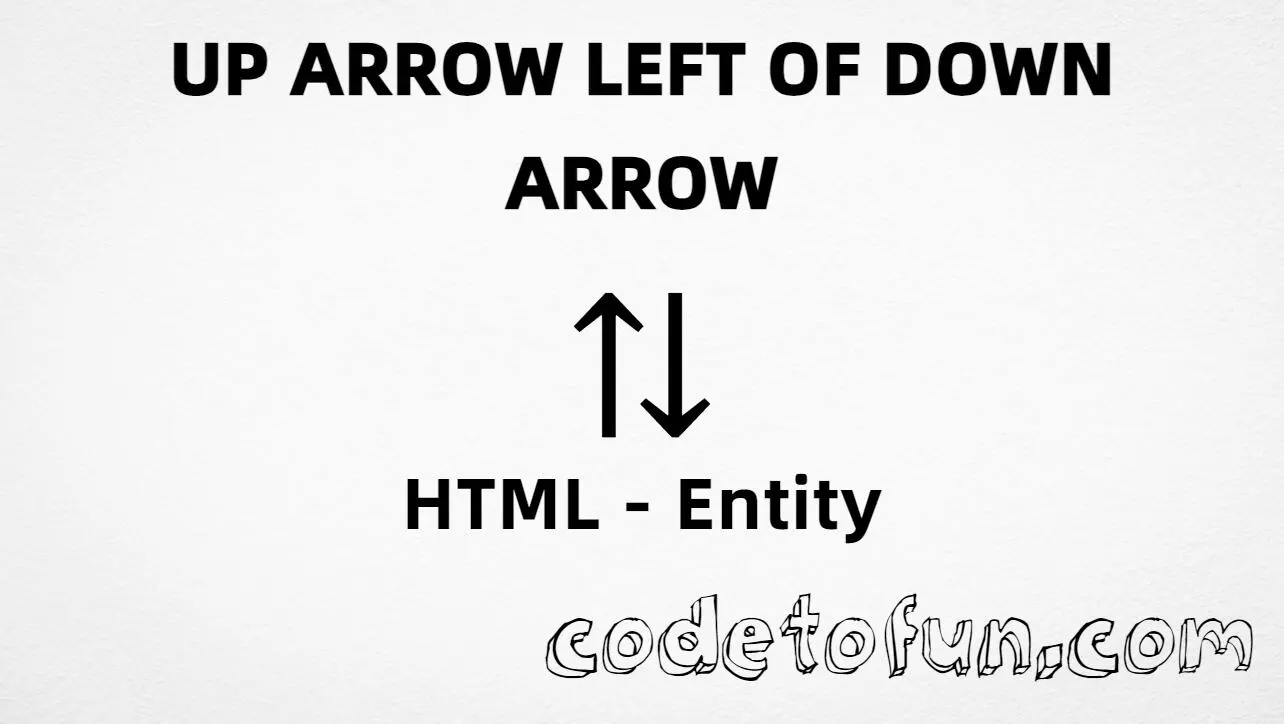
HTML Entity for Up Arrow Left Down Arrow (⇅)

What You'll Learn
How to display the Up Arrow Left Down Arrow (⇅) in HTML using hexadecimal, decimal, the named entity ⇅, and CSS escape methods. This character is U+21C5 (UP DOWN ARROW) in the Arrows block (U+2190–U+21FF)—a bidirectional vertical arrow used in sort controls, scroll indicators, and expand/collapse UI.
Render it with ⇅, ⇅, ⇅, or CSS escape \21C5. Compare ↑ (up arrow, ↑) and ↓ (down arrow, ↓) for single-direction arrows.
⚡ Quick Reference — Up Arrow Left Down Arrow
U+21C5Arrows block
⇅Hexadecimal reference
⇅Decimal reference
⇅HTML5 named entity for U+21C5
Name Value
──────────── ──────────
Unicode U+21C5
Hex code ⇅
HTML code ⇅
Named entity ⇅
CSS code \21C5
Official name UP DOWN ARROW
Related U+2191 = Up (↑); U+2193 = Down (↓)
Block Arrows (U+2190–U+21FF)Complete HTML Example
A simple example showing ⇅ with hex, decimal, named entity, and CSS content escape:
<!DOCTYPE html>
<html>
<head>
<style>
#point::after{
content: "\21C5";
}
</style>
</head>
<body>
<p>Up Down Arrow (hex): ⇅</p>
<p>Up Down Arrow (decimal): ⇅</p>
<p>Up Down Arrow (entity): ⇅</p>
<p id="point">Up Down Arrow (CSS): </p>
</body>
</html>🌐 Browser Support
U+21C5 is widely supported in modern browsers when rendered with a font that includes Arrows:
👀 Live Preview
See the Up Arrow Left Down Arrow (⇅) in UI contexts:
🧠 How It Works
Hexadecimal Code
⇅ uses the Unicode hexadecimal value 21C5 to display the Up Down Arrow. The x prefix indicates hexadecimal format.
Decimal HTML Code
⇅ uses the decimal Unicode value 8645 to display the same character.
Named HTML Entity
⇅ is the HTML5 named entity for U+21C5. It is easy to read in source and resolves to the same character (⇅).
CSS Entity
\21C5 is used in CSS stylesheets in the content property of pseudo-elements like ::before and ::after.
Same visual result
All four methods produce: ⇅. Unicode U+21C5 in the Arrows block (U+2190–U+21FF). Ideal for bidirectional vertical movement in sort and scroll UI.
Use Cases
The Up Arrow Left Down Arrow (⇅) is commonly used in:
Table headers and data grids indicating sortable columns in both directions.
Scroll bars and controls showing both upward and downward scrolling.
Accordions and collapsible sections with bidirectional vertical movement.
Buttons and interactive elements needing bidirectional vertical cues.
Icon sets and design systems with up-down arrow symbols.
Dashboards and software interfaces with vertical navigation controls.
💡 Best Practices
Do
- Use
⇅for readable markup, or⇅/⇅ - Add
aria-labelwhen the arrow conveys sort or scroll meaning - Pair with labels in sortable table headers and scroll controls
- Use
\21C5in CSS::before/::afterfor sort icons - Serve pages with UTF-8 (
<meta charset="utf-8">)
Don’t
- Confuse ⇅ (
⇅) with separate ↑ and ↓ stacked manually - Use U+021C5 or CSS
\021C5—the correct value is U+21C5 and\21C5 - Put CSS escape
\21C5in HTML text nodes - Rely on the symbol alone without context in accessibility-critical UIs
- Assume decorative fonts include all Arrows glyphs
Key Takeaways
Named entity available: ⇅
⇅ ⇅For CSS stylesheets, use \21C5 in content
Unicode U+21C5 — UP DOWN ARROW
Single arrows: ↑ ↑ and ↓ ↓
Four methods, one glyph — widely supported in modern browsers
❓ Frequently Asked Questions
⇅ (hex), ⇅ (decimal), ⇅ (named entity), or \21C5 in CSS content. All produce ⇅.U+21C5 (UP DOWN ARROW). Arrows block (U+2190–U+21FF). Hex 21C5, decimal 8645. A bidirectional vertical arrow.⇅ is easier to read in source than ⇅ or ⇅, but all produce ⇅. The named entity is part of the HTML5 entity set for arrows.⇅, ⇅, or ⇅) go in markup. The CSS escape \21C5 is used in stylesheets, typically in the content property of pseudo-elements.Explore More HTML Entities!
Discover 1500+ HTML character references — arrows, symbols, math operators, and more.
8 people found this page helpful