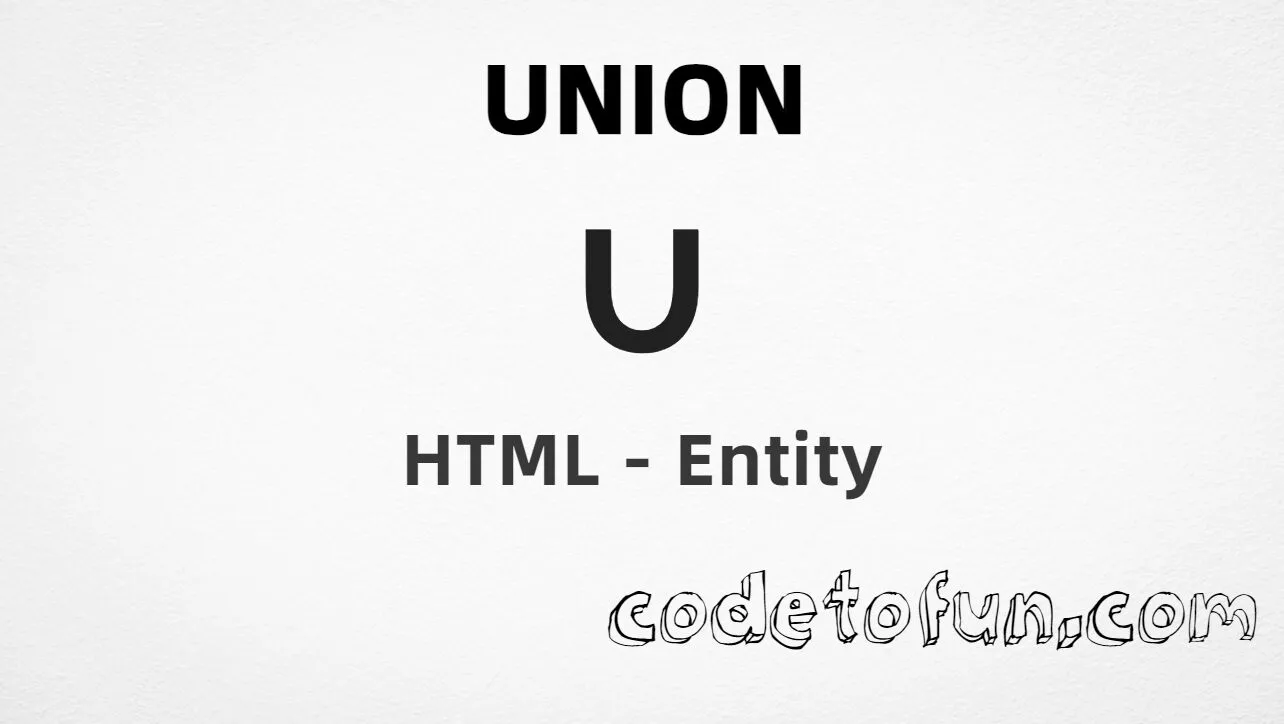
HTML Entity for Union (∪)

What You'll Learn
How to display the Union symbol (∪) in HTML using named, hexadecimal, decimal, and CSS entity methods. This character is U+222A (UNION) in the Mathematical Operators block (U+2200–U+22FF)—the set union operator combining all elements from two sets.
Render it with ∪, ∪, ∪, or CSS escape \222A. Compare ∩ (intersection, U+2229, ∩) or ⋃ (n-ary union, U+22C3, ⋃) for related set operators.
⚡ Quick Reference — Union
U+222AMathematical Operators block
∪Hexadecimal reference
∪Decimal reference
∪Standard HTML entity
Name Value
──────────── ──────────
Unicode U+222A
Hex code ∪
HTML code ∪
Named entity ∪
CSS code \222A
Meaning Set union (binary)
Related U+2229 = intersection (∩, ∩)
U+22C3 = n-ary union (⋃, ⋃)
Block Mathematical Operators (U+2200–U+22FF)Complete HTML Example
A simple example showing ∪ using the named entity, hexadecimal code, decimal HTML code, and a CSS content escape:
<!DOCTYPE html>
<html>
<head>
<style>
#point::after{
content: "\222A";
}
</style>
</head>
<body>
<p>Union (named): ∪</p>
<p>Union (hex): ∪</p>
<p>Union (decimal): ∪</p>
<p id="point">Union (CSS): </p>
</body>
</html>🌐 Browser Support
U+222A and the ∪ named entity are supported in modern browsers when rendered with a font that includes Mathematical Operators:
👀 Live Preview
See the Union symbol (∪) in mathematical and set-theory contexts:
🧠 How It Works
Named HTML Entity
∪ is the most readable method for displaying the Union symbol. It is part of the standard HTML mathematical entity set.
Hexadecimal Code
∪ uses the Unicode hexadecimal value 222A to display the Union symbol.
Decimal HTML Code
∪ uses the decimal Unicode value 8746 to display the same character.
CSS Entity
\222A is used in CSS stylesheets in the content property of pseudo-elements like ::before and ::after.
Same visual result
All four methods produce: ∪. Unicode U+222A in the Mathematical Operators block. Prefer ∪ for readable source. Serve HTML as UTF-8.
Use Cases
The Union symbol (∪) is commonly used in:
Combining elements from two sets in mathematical notation.
Equations, formulas, and proofs in academic content.
Research documents and scholarly publications.
Boolean algebra and formal logic notation.
Textbooks, tutorials, and Venn diagram explanations.
Technical documentation and educational platforms.
💡 Best Practices
Do
- Use
∪for readable HTML in mathematical markup - Use math-friendly fonts (Cambria Math, STIX, Latin Modern Math)
- Pair ∪ with set names or variables for screen reader context
- Use
⋃(U+22C3) for indexed families of sets - Serve pages with UTF-8 (
<meta charset="utf-8">)
Don’t
- Confuse ∪ (union U+222A) with ∩ (intersection U+2229) or ⋃ (n-ary union U+22C3)
- Use U+0222A or CSS
\0222A—the correct value is U+222A and\222A - Put CSS escape
\222Ain HTML text nodes - Use a plain U character or letter U as a substitute for ∪
- Assume decorative fonts include Mathematical Operators glyphs
Key Takeaways
Preferred named entity renders ∪
∪Numeric HTML references also work
∪ ∪For CSS stylesheets, use \222A in content
Unicode U+222A — UNION (set union)
Four methods, one glyph — Mathematical Operators block
❓ Frequently Asked Questions
∪ (named), ∪ (hex), ∪ (decimal), or \222A in CSS content. All four produce ∪.U+222A (UNION). Mathematical Operators block (U+2200–U+22FF). Hex 222A, decimal 8746, named entity ∪. Represents set union in mathematics.∪ renders U+222A (∪), the binary set union. ⋃ renders U+22C3 (⋃), the n-ary union operator for indexed families of sets. Different characters for different mathematical contexts.∪ is the most readable method in HTML source. Numeric codes (∪ or ∪) are equally valid. CSS escape \222A belongs in stylesheets.Explore More HTML Entities!
Discover 1500+ HTML character references — math operators, set theory, symbols, and more.
8 people found this page helpful