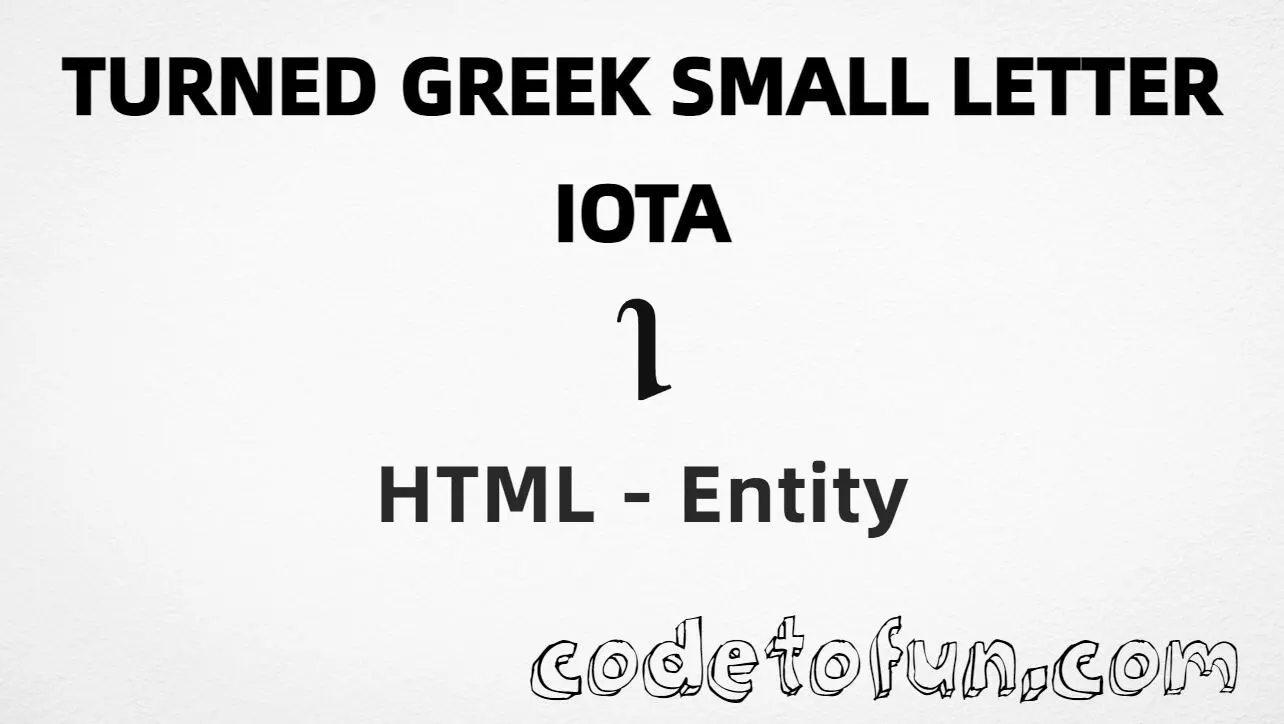
HTML Entity for Turned Greek Small Letter Iota (℩)
Beginner
5 min read
Updated: Sep 2026
1 example
Unicode U+2129
Definition
What Is the Turned Greek Small Letter Iota Entity?
Turned Greek Small Letter Iota (℩) is the Letterlike Symbols character at Unicode U+2129 (TURNED GREEK SMALL LETTER IOTA). It is a turned form of iota used mainly in phonetic and linguistic notation.
Remember
Character     ℩
Unicode       U+2129
Hex entity    ℩
Decimal       ℩
Named entity  ℩
CSS escape    \2129
Not the same  ι (ι) · ƍ (U+018D)
All of these produce the same glyph: ℩. Prefer ℩ when you want an explicit entity (names are case-sensitive — write it exactly).
Using Hex Code: ℩
Using HTML Code: ℩
Using Named Entity: ℩
Using CSS Entity: ℩
[℩]
How It Works
1. Hex:U+2129 → ℩ in HTML. The browser turns it into ℩.
2. Decimal: same code point as 8489 → ℩. Same result as hex.
3. Named:℩ is the HTML5 name for this character.
4. CSS: use \2129 in content (not an HTML entity). #point::after appends that ℩ after the paragraph text.
Pitfalls & Tips
Common mistakes when working with Turned Greek Small Letter Iota.
Look-alikes
℩ ≠ ι
℩ is the turned Letterlike form. ι is ordinary Greek small iota.
Name
Match the spelling exactly
Use ℩ (two is). ι maps to a different character.
Fonts
Glyph may be missing
Letterlike Symbols coverage varies. Test on your target devices or provide a fallback font.
CSS vs HTML
Do not mix escapes
\2129 belongs in CSS. ℩ / ℩ / ℩ belong in HTML.
A11y
Add nearby words
Pair the glyph with label text (for example [℩]) or use aria-label when it stands alone.
Semicolon
End references
Always finish with ; — write ℩, not &iiota.
Compatibility
Browser Support
Turned Greek Small Letter Iota (U+2129) and its entity forms (℩, ℩, ℩, CSS \\2129) are supported in all modern browsers. Glyph coverage depends on the font.
✓ Universal encoding
Turned Greek Small Letter Iota (℩)
Encode with named, hex, decimal, or CSS escape — or type ℩ directly in UTF-8 HTML.
100%Browser coverage
Google ChromeSupported
Yes
Microsoft EdgeSupported
Yes
Mozilla FirefoxSupported
Yes
Apple SafariSupported
Yes
OperaSupported
Yes
Internet ExplorerIE 9+
Yes*
U+2129 / ℩Full support
Bottom line: Prefer ℩ for readable HTML. Use \\2129 only inside CSS content.
Use ℩ (named), ℩ (hex), ℩ (decimal), or the CSS escape \2129 in the content property. You can also type ℩ directly in UTF-8 HTML.
U+2129 (TURNED GREEK SMALL LETTER IOTA). Hex 2129, decimal 8489. It belongs to Letterlike Symbols (U+2100–U+214F).
Yes. ℩ is the HTML5 named entity. You can also use ℩ or ℩. Do not confuse ℩ with ι.
Use it in phonetic and linguistic notation when you need the turned iota letterlike symbol. Prefer ℩ for readable HTML.
HTML entities (℩, ℩, or ℩) go in markup. The CSS escape \2129 is used in stylesheets (usually in the content property of ::before/::after). Both render ℩.
ι (U+03B9) is the ordinary Greek small letter iota (ι). ℩ (U+2129) is TURNED GREEK SMALL LETTER IOTA — a Letterlike Symbols character used mainly in phonetic contexts.
🤔
Did you know?
Turned Greek Small Letter Iota is Unicode U+2129 (decimal 8489) — TURNED GREEK SMALL LETTER IOTA. HTML5 provides ℩. Prefer it for readable source. Do not confuse it with Greek small iota ι (U+03B9) or turned delta U+018D (ƍ).