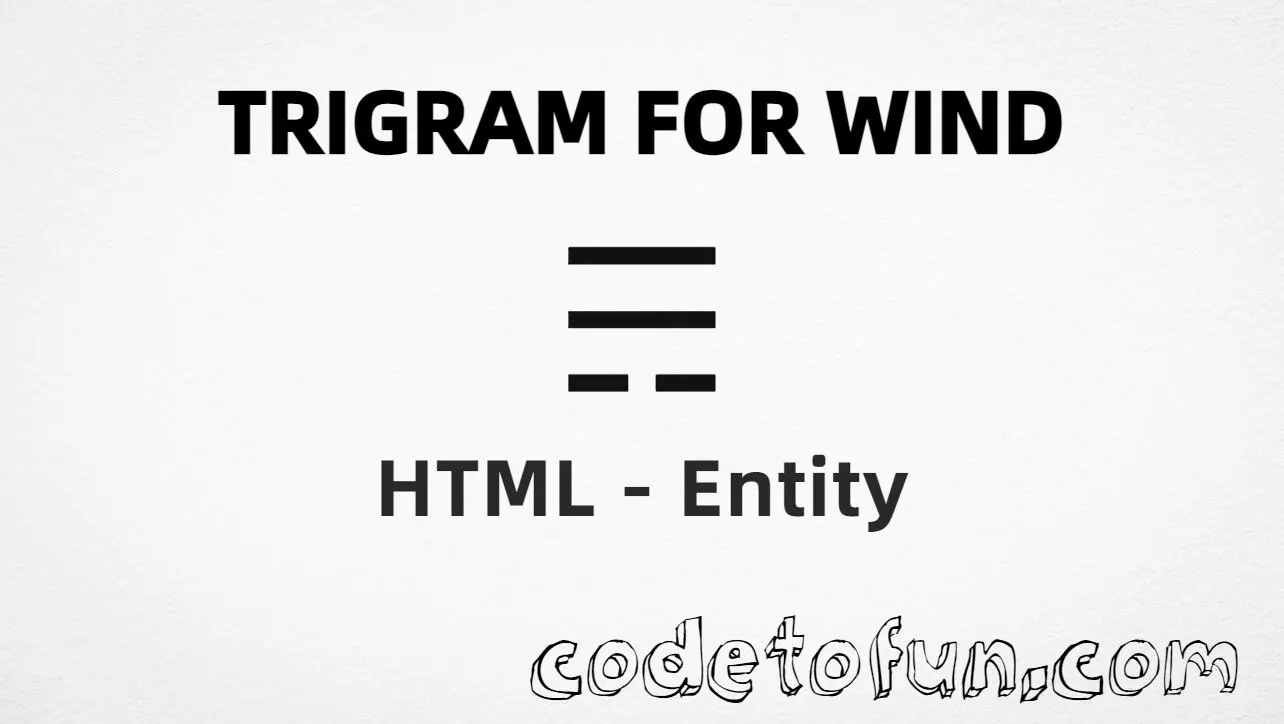
Trigram Wind (☴) is the Miscellaneous Symbols character at Unicode U+2634 (TRIGRAM FOR WIND). It is the I Ching (Yijing) Xun trigram — three lines representing the wind (or wood) element.
Remember
Character     ☴
Unicode       U+2634
Hex entity    ☴
Decimal       ☴
Named entity  (none)
CSS escape    \2634
Not the same  ☵ (water) · ☰ (heaven) · ☯ (yin yang)
Hex, decimal, CSS, and a typed character all produce the same glyph: ☴. Prefer ☴ when you want an explicit entity. Next in the entity sequence: Triple Integral (U+222D).
Using Hex Code: ☴
Using HTML Code: ☴
Using CSS Entity: ☴
☴ Wind (Xun) trigram
How It Works
1. Hex:U+2634 → ☴ in HTML. The browser turns it into ☴.
2. Decimal: same code point as 9780 → ☴. Same result as hex.
3. Named: HTML5 does not define a named entity for this character — use hex or decimal instead.
4. CSS: use \2634 in content (not an HTML entity). #point::after appends that ☴ after the paragraph text.
Pitfalls & Tips
Common mistakes when working with Trigram Wind.
Look-alikes
☴ ≠ ☵ ≠ ☯
U+2634 is wind (Xun). Water and yin yang are different characters — do not mix them when naming I Ching symbols.
Named
No &…; name
Do not invent a name. Use ☴ or ☴.
A11y
Label the trigram
A lone ☴ may be unclear. Add text like “Wind trigram” or an accessible name for screen readers.
Fonts
Glyph coverage
Miscellaneous Symbols coverage varies. Test I Ching UIs on mobile and provide a fallback if ☴ is missing.
CSS vs HTML
Do not mix escapes
\2634 belongs in CSS. ☴ / ☴ belong in HTML.
Semicolon
End references
Always finish with ; — write ☴, not ☴.
Compatibility
Browser Support
Trigram Wind (U+2634) and its entity forms (☴, ☴, CSS \\2634) are supported in all modern browsers. Glyph coverage depends on the font.
✓ Universal encoding
Trigram Wind (☴)
Encode with hex, decimal, or CSS escape — or type ☴ directly in UTF-8 HTML. No named entity.
100%Browser coverage
Google ChromeSupported
Yes
Microsoft EdgeSupported
Yes
Mozilla FirefoxSupported
Yes
Apple SafariSupported
Yes
OperaSupported
Yes
Internet ExplorerIE 9+
Yes*
U+2634Full support
Bottom line: Prefer ☴ for readable HTML. Use \\2634 only inside CSS content. Label cultural symbols for accessibility.
Remember
Key Takeaways
Unicode: this symbol is U+2634 (decimal 9780) — trigram for wind (Xun).
HTML: prefer ☴ — or use ☴. No named entity.
CSS: use \2634 inside content for generated trigram markers.
Watch out: not the same as water (U+2635) or yin yang (U+262F).
One line:U+2634 → ☴ / ☴ / CSS \2634 (no named entity).
Frequently Asked Questions
Use ☴ (hex), ☴ (decimal), or the CSS escape \2634 in the content property. All render ☴ when the font supports Miscellaneous Symbols. There is no named HTML entity.
U+2634 (TRIGRAM FOR WIND). Hex 2634, decimal 9780. It belongs to Miscellaneous Symbols (U+2600–U+26FF). It is the I Ching Xun trigram (wind or wood).
No. HTML5 does not define a named entity for U+2634. Use numeric references like ☴ or ☴.
Use it for I Ching content, Taoist or Chinese philosophy pages, cultural design, and educational material on trigrams. Pair the glyph with visible text (e.g. “Wind trigram”) for accessibility.
U+2634 is TRIGRAM FOR WIND (Xun). U+2635 is TRIGRAM FOR WATER. U+262F is YIN YANG (taijitu). Related cultural symbols, different characters.
HTML entities (☴ or ☴) go in markup. The CSS escape \2634 is used in stylesheets (usually in the content property of ::before/::after). Both render ☴.
🤔
Did you know?
Trigram Wind is Unicode U+2634 (decimal 9780) — TRIGRAM FOR WIND (Xun) in Miscellaneous Symbols. HTML5 has no named entity — use ☴ or ☴. One of the eight I Ching (Yijing) trigrams (wind / wood). Do not confuse it with Trigram Water (U+2635) or yin yang (U+262F).