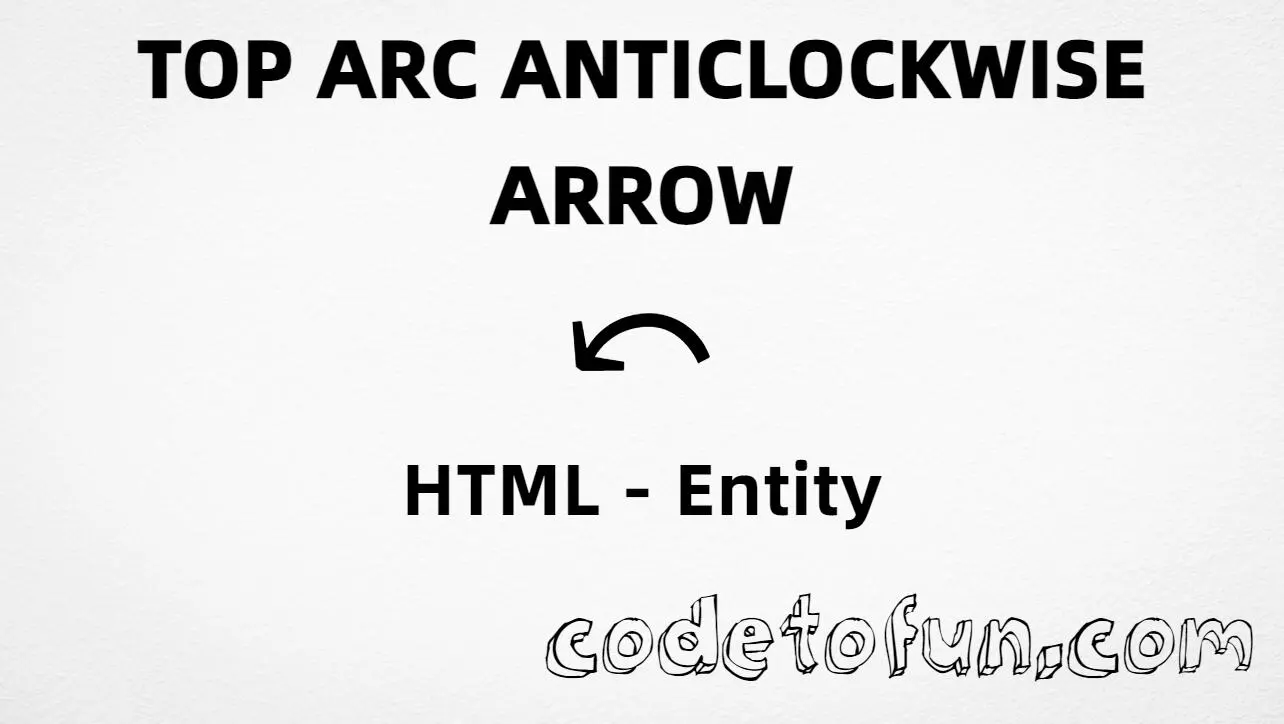
Top arc anticlockwise arrow (⤺) is the Unicode character at U+293A in Supplemental Arrows-B. Official name: TOP ARC ANTICLOCKWISE ARROW — a curved arrow often used for rotate, undo, or refresh-style UI cues.
Remember
Character     ⤺
Unicode       U+293A
Named entity  (none)
Hex entity    ⤺
Decimal       ⤺
CSS escape    \293A
Not the same  ↺ · ⤽ · ↶
Prefer ⤺ or ⤺ in HTML markup. You can also type ⤺ in UTF-8. For a simple open-circle anticlockwise arrow, use ↺ (↺) instead.
Using Hex Code: ⤺
Using HTML Code: ⤺
Using CSS Entity: ⤺
Typed directly: ⤺
Label: Undo ⤺
How It Works
1. Hex:U+293A → ⤺ in HTML. Preferred numeric form when you need an entity.
2. Decimal: same code point as 10554 → ⤺. Same glyph as hex.
3. CSS: use \293A in content (not an HTML entity). #point::after appends that ⤺ after the paragraph text.
4. Typed / label: paste ⤺ in UTF-8, or write Undo ⤺ for a short UI label.
5. No named entity: HTML5 does not define a name for U+293A — use numeric references or type the character.
Pitfalls & Tips
Common mistakes when working with U+293A.
vs ↺
Not an open-circle arrow
↺ (U+21BA) is the common anticlockwise open circle arrow. U+293A is a top-arc form with a different shape.
vs ⤽
Not the plus variant
⤽ (U+293D) adds a plus sign. Use it only when your notation needs “anticlockwise + plus”.
Named
No named HTML entity
There is no &toparcanticlockwisearrow; for U+293A. Use ⤺ or ⤺.
Fonts
Needs Supplemental Arrows-B coverage
Some UI fonts omit rarer arrows. Prefer a stack that includes a symbols font if the glyph must always show.
CSS vs HTML
Do not mix escapes
\293A belongs in CSS strings. ⤺ / ⤺ belong in HTML.
A11y
Name the action in context
Screen readers may announce this unevenly. Prefer nearby plain-language text such as “undo” or “rotate left” when the arrow carries meaning.
Compatibility
Browser Support
Top arc anticlockwise arrow (U+293A) and its entity forms (⤺, ⤺, CSS \\293A) are supported in all mainstream browsers. Visible glyphs depend on Supplemental Arrows-B font coverage.
✓ Universal support
Top Arc Anticlockwise Arrow (⤺)
Encode with hex, decimal, CSS escape, or type the character — same code point everywhere encoding is supported.
100%Browser coverage
Google ChromeSupported
Yes
Microsoft EdgeSupported
Yes
Mozilla FirefoxSupported
Yes
Apple SafariSupported
Yes
OperaSupported
Yes
Internet ExplorerAll versions
Yes
U+293A / entitiesFull support
Bottom line: Prefer ⤺ or ⤺ in HTML. Use \\293A only inside CSS content. There is no named entity.
Remember
Key Takeaways
Unicode: top arc anticlockwise arrow is U+293A (decimal 10554) — glyph ⤺.
HTML: no named entity — use ⤺ / ⤺ / type ⤺.
CSS: use \293A inside content for generated text.
Meaning:⤺ is top-arc anticlockwise — not ↺, not ⤽.
One line:U+293A → ⤺ / ⤺ / CSS \293A (no named entity).
Frequently Asked Questions
Use ⤺ (hex), ⤺ (decimal), type ⤺ directly in UTF-8, or the CSS escape \293A in content. There is no named HTML entity.
U+293A (TOP ARC ANTICLOCKWISE ARROW). Hex 293A, decimal 10554. It belongs to Supplemental Arrows-B (U+2900–U+297F).
No. Use numeric references ⤺ or ⤺, or type the character in UTF-8.
No. U+293A is a top-arc anticlockwise arrow. ↺ is U+21BA (anticlockwise open circle arrow), a different Supplemental / Arrows glyph.
Use it for UI hints such as undo, rotate left, or refresh-style controls when you specifically need the top-arc anticlockwise form — not as a generic left arrow.
HTML entities (⤺ or ⤺) go in markup. The CSS escape \293A goes in stylesheet strings (usually content on ::before/::after).
🤔
Did you know?
Top arc anticlockwise arrow is Unicode U+293A (decimal 10554) — glyph ⤺ in Supplemental Arrows-B (U+2900–U+297F). Official name: TOP ARC ANTICLOCKWISE ARROW. HTML5 has no named entity — use ⤺ or ⤺. Do not confuse with anticlockwise open circle arrow U+21BA (↺) or the plus variant U+293D (⤽).