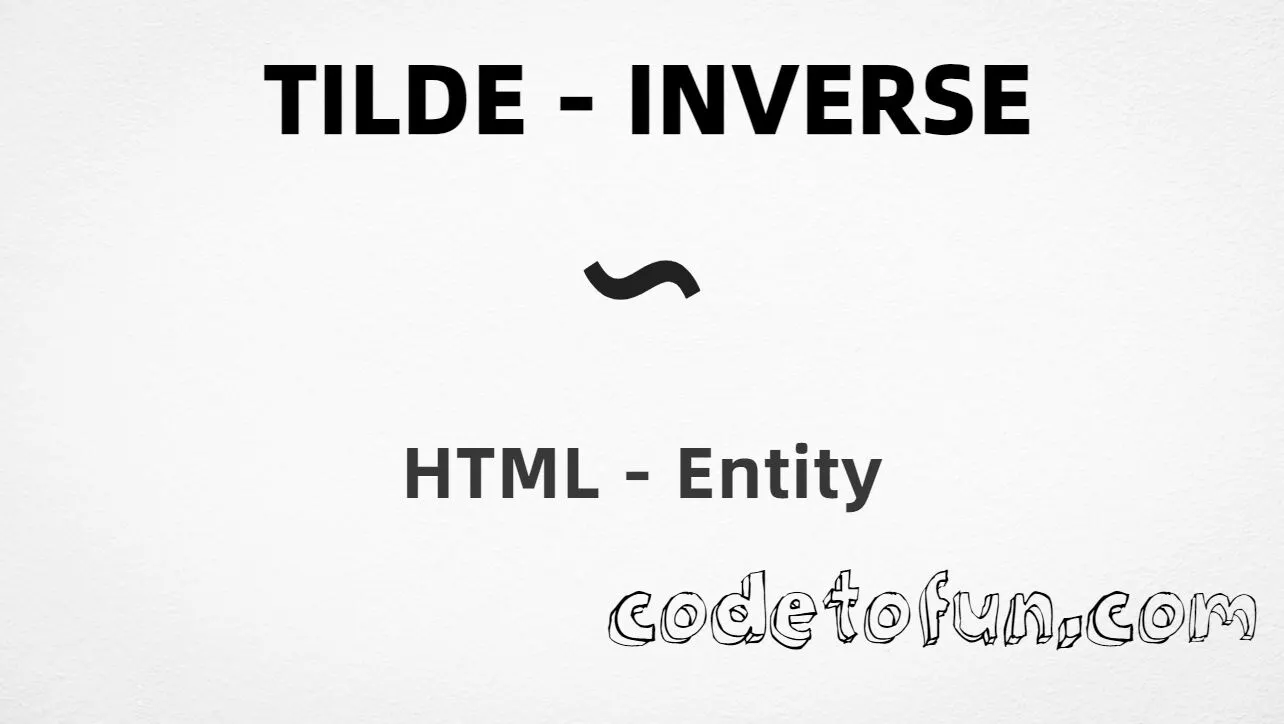
HTML Entity for Tilde Inverse (∽)

Beginner
⏱️ 5 min read
📚 Updated: Jun 2026
🎯 1 Code Example
Unicode U+223D

What You'll Learn

How to display the Tilde Inverse symbol (∽) in HTML using hexadecimal, decimal, named entity, and CSS escape methods. This character is U+223D (REVERSED TILDE) in the Mathematical Operators block (U+2200–U+22FF)—used for inverse similarity and equivalence in mathematical logic and set theory.

Render it with ∽, ∽, the named entity ∽, or CSS escape \223D. Do not confuse ∽ with ∼ (Tilde Operator, U+223C, ∼) or ~ (ASCII Tilde, U+007E).

⚡ Quick Reference — Tilde Inverse Entity

Unicode U+223D

Mathematical Operators

Hex Code ∽

Hexadecimal reference

HTML Code ∽

Decimal reference

Named Entity ∽

Most readable option

Reference Table
Name           Value
────────────   ──────────
Unicode        U+223D
Hex code       ∽
HTML code      ∽
Named entity   ∽
CSS code       \223D
Block          Mathematical Operators (U+2200–U+22FF)
Official name  REVERSED TILDE
Related        U+223C; = Tilde Operator (∼), U+007E = Tilde (~)
1

Complete HTML Example

This example demonstrates the Tilde Inverse symbol (∽) using hexadecimal code, decimal HTML code, named entity, and a CSS content escape:

html
<!DOCTYPE html>
<html>
<head>
 <style>
  #point:after{
   content: "\223D";
  }
 </style>
</head>
<body>
<p>Using Hexadecimal: &#x223D;</p>
<p>Using HTML Code: &#8765;</p>
<p>Using Named Entity: &bsim;</p>
<p id="point">Using CSS Entity: </p>
</body>
</html>
Try it Yourself

🌐 Browser Support

The Tilde Inverse entity renders in modern browsers when fonts include Mathematical Operators glyphs:

Chrome 1+
Firefox 1+
Safari 1+
Edge 12+
Opera 4+
Android 4.4+
iOS Safari 1+

👀 Live Preview

See the Tilde Inverse symbol (∽) in mathematical context:

Relation AB
Large glyph
Tilde set sim   ∽ bsim   ~ ascii
Numeric refs &#x223D; &#8765; &bsim; \223D

🧠 How It Works

1

Hexadecimal Code

&#x223D; uses the Unicode hexadecimal value 223D to display the Tilde Inverse symbol.

HTML markup
2

Decimal HTML Code

&#8765; uses the decimal Unicode value 8765 to display the same character.

HTML markup
3

CSS Entity

\223D is used in CSS stylesheets in the content property of pseudo-elements like ::before and ::after.

CSS stylesheet
4

Named Entity

&bsim; is the semantic named entity — short for “backslash similar” and the easiest to read in source HTML.

HTML markup
=

Same visual result

All four methods produce the glyph: . Unicode U+223D (REVERSED TILDE) in the Mathematical Operators block.

Use Cases

The Tilde Inverse symbol (∽) commonly appears in:

🧠 Mathematical Logic

Formal logic and inverse similarity relations.

🔬 Set Theory

Equivalence classes and theoretical mathematics.

⇆ Equivalence

Proofs showing inverse equivalence or similarity.

📄 Scientific Docs

Research papers and academic publications.

📝 Proofs

Theorem statements and formal demonstrations.

🎓 Education

Logic and set theory textbooks.

💻 Technical Specs

Algorithm descriptions and formal specifications.

💡 Best Practices

Do

  • Prefer &bsim; for readable source markup
  • Use ∽ for reversed/inverse tilde in math notation
  • Pick one style (hex / decimal / named) per project
  • Add aria-label for standalone symbols in UI
  • Test the glyph across browsers and math-friendly fonts

Don’t

  • Confuse ∽ (bsim) with ∼ (sim) or ~ (U+007E)
  • Mix entity styles randomly in one file
  • Put CSS escape \223D directly in HTML text nodes
  • Use HTML entities in JS (use \u223D instead)
  • Assume all fonts render ∽ clearly at small sizes

Key Takeaways

1

Three HTML references all render ∽

&#x223D; &#8765; &bsim;
2

For CSS stylesheets, use the escape in the content property

\223D
3

Unicode U+223D — REVERSED TILDE

4

Prefer &bsim; — the named entity for reversed tilde

5

Pair with Tilde Operator (∼) when documenting tilde symbols

❓ Frequently Asked Questions

Use &#x223D; (hex), &#8765; (decimal), &bsim; (named), or \223D in CSS content. All produce ∽.
U+223D (REVERSED TILDE). Mathematical Operators block (U+2200–U+22FF). Hex 223D, decimal 8765.
In mathematical logic, set theory, equivalence relations, scientific documentation, academic papers, mathematical proofs, and any formal content representing inverse similarity or equivalence.
The named entity &bsim; is more readable in source code. Numeric references (&#8765; or &#x223D;) are more explicit. CSS escape \223D is for stylesheets only. All produce ∽.
&bsim; is the named HTML entity for ∽. The name bsim stands for backslash similar / reversed similar and is part of the HTML5 standard.

Explore More HTML Entities!

Discover 1500+ HTML character references — math operators, logic symbols, and more.

All HTML Entities →

About the author

Mari Selvan M P
Mari Selvan M P 🔗

Developer, cloud engineer, and technical writer

  • Experience 12 years building web and cloud systems
  • Focus Full Stack Development, AWS, and Developer Education

I write practical tutorials so students and working developers can learn by doing—from databases and APIs to deployment on AWS.

8 people found this page helpful