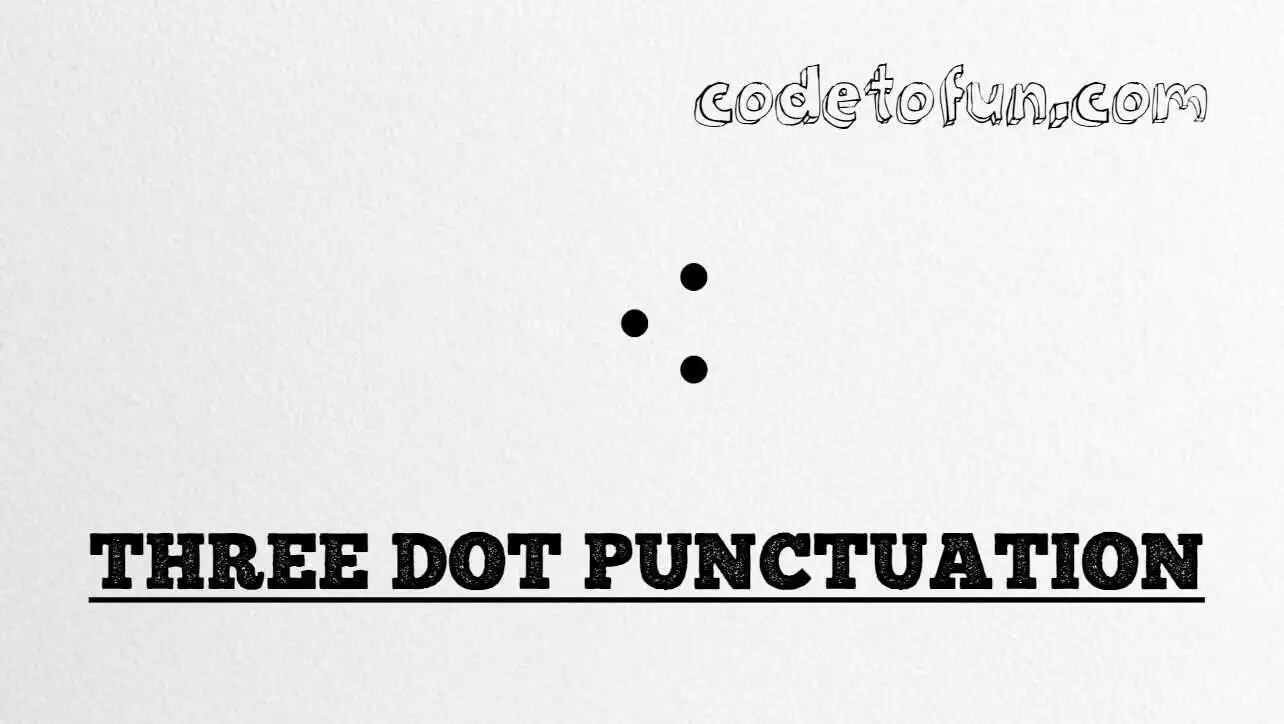
Three dot punctuation (⁖) is the Unicode character at U+2056 in General Punctuation. Official name: THREE DOT PUNCTUATION. It is a specialized three-dot mark used in editorial and typographic design.
Remember
Character     ⁖
Unicode       U+2056
Hex entity    ⁖
Decimal       ⁖
CSS escape    \2056
Named entity  (none)
Not the same  ∴ · ∵ · …
Prefer ⁖ or ⁖ in HTML markup. You can also type ⁖ in UTF-8. There is no named entity.
Using Hex Code: ⁖
Using HTML Code: ⁖
Using CSS Entity: ⁖
Typed directly: ⁖
Example: Note⁖ see also
How It Works
1. Hex:U+2056 → ⁖ in HTML. The browser turns it into ⁖.
2. Decimal: same code point as 8278 → ⁖. Same result as hex.
3. CSS: use \2056 in content (not an HTML entity). #point::after appends that ⁖ after the paragraph text.
4. Typed / example: paste ⁖ in UTF-8, or write Note⁖ see also for a short editorial example.
Pitfalls & Tips
Common mistakes when working with Three Dot Punctuation.
Named?
No named entity
HTML5 does not define a named entity for U+2056. Use ⁖ or ⁖.
…
Not an ellipsis
… is the standard horizontal ellipsis. Prefer it for omitted text; use U+2056 only when you need this specific punctuation glyph.
∴
Not therefore or because
∴ and ∵ are Mathematical Operators with logic meanings — different characters from U+2056.
Fonts
Punctuation font coverage
Some UI fonts omit less-common General Punctuation marks. Prefer a font that covers this block for display.
CSS vs HTML
Do not mix escapes
\2056 belongs in CSS strings. ⁖ / ⁖ belong in HTML.
Semicolon
End numeric references
Always finish with ; — write ⁖, not ⁖.
Compatibility
Browser Support
Three dot punctuation (U+2056) and its entity forms (⁖, ⁖, CSS \\2056) are supported in all mainstream browsers. Visible glyphs depend on General Punctuation font coverage.
✓ Universal support
Three Dot Punctuation (⁖)
Encode with hex, decimal, CSS escape, or type the character — same code point everywhere encoding is supported.
100%Browser coverage
Google ChromeSupported
Yes
Microsoft EdgeSupported
Yes
Mozilla FirefoxSupported
Yes
Apple SafariSupported
Yes
OperaSupported
Yes
Internet ExplorerAll versions
Yes
U+2056 / entitiesFull support
Bottom line: Prefer ⁖ or ⁖ in HTML. Use \\2056 only inside CSS content. There is no named entity.
Remember
Key Takeaways
Unicode: this mark is U+2056 (decimal 8278) — glyph ⁖.
HTML: use ⁖ or ⁖ — no named entity; typing ⁖ also works.
CSS: use \2056 inside content for generated text.
Meaning:⁖ = three-dot punctuation — not …, not ∴.
One line:U+2056 → ⁖ / ⁖ / CSS \2056.
Frequently Asked Questions
Use ⁖ (hex), ⁖ (decimal), type ⁖ directly in UTF-8, or the CSS escape \2056 in content. There is no named HTML entity for U+2056.
U+2056 (THREE DOT PUNCTUATION). Hex 2056, decimal 8278. It belongs to General Punctuation (U+2000–U+206F).
No. HTML5 does not define a named entity for this character. Use numeric forms ⁖ or ⁖.
Use it as a specialized three-dot punctuation mark in editorial or typographic work. Prefer … for a standard ellipsis and ∴ when you mean therefore.
HTML entities (⁖ or ⁖) go in markup. The CSS escape \2056 goes in stylesheet strings (usually content on ::before/::after).
No. ⁖ is three dot punctuation (U+2056). ∴ is therefore (U+2234). ∵ is because (U+2235). … is horizontal ellipsis (…, U+2026).
🤔
Did you know?
Three dot punctuation (⁖) is Unicode U+2056 (decimal 8278) — THREE DOT PUNCTUATION in General Punctuation. HTML5 has no named entity — use ⁖ or ⁖. Do not confuse it with therefore (U+2234, ∴ / ∴), because (U+2235, ∵), or ellipsis (…).